
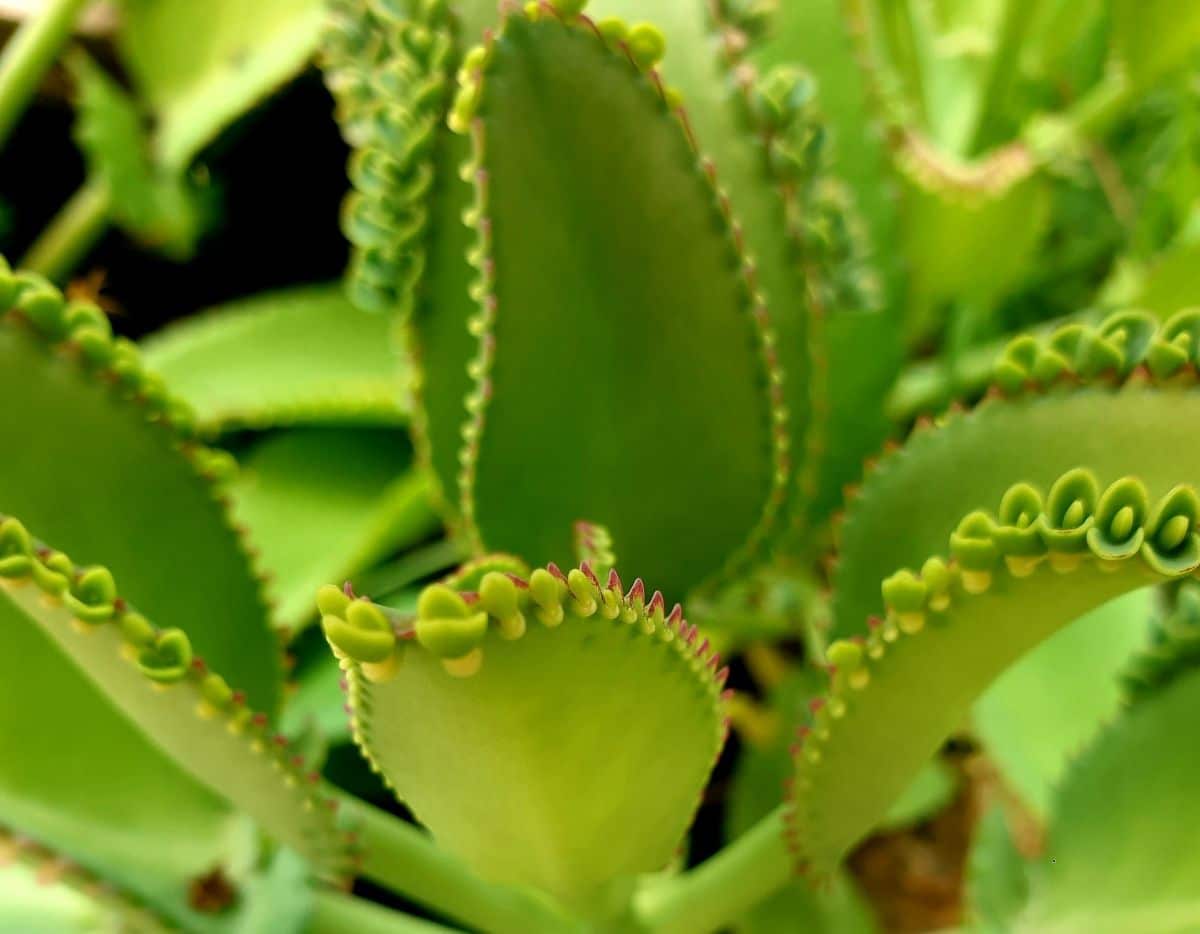
Succulents, genus to which it belongs the kalanchoe, is characterized by fleshy and normally hard leaves. However, when you have a soft-leaved kalanchoe, you worry because you know that something may happen to it that, at the moment, you don’t really know what it is.
If this has happened to you, or you’ve just realized that your kalanchoe has limp leaves, we’ll give you a list of possible reasons why this is happening, and everything you need to do to try to save it and give it the same look again and again. Keep reading to find out.
Why does the kalanchoe have soft leaves?

When a plant that is supposed to have tough, fleshy leaves appears with the opposite, it is cause for concern. And it is that there is something that affects him in a negative way and for which it is not fair.
However, if you don’t have much of an idea, it’s normal that you can go a little blind. For that, try these options which may be just what is harming your plant.
lack of lighting
Kalanchoe is a plant that needs a lot of light. When this doesn’t happen, the lower leaves tend to curl downward, a symptom of lack of light that your plant warns you about.
If you don’t pay attention to it, and as time passes, most likely it will begin to taper its leaves, and eventually they will be limp.
What to do in this case? If you have just bought your kalanchoe, it is possible that you did not want to put it in full sun for fear that it would not acclimatize well. (Moving from a nursery or store to direct sunlight can be stressful and you can get burned).
But it is convenient to give it more and more hours of direct sunlight. At first, you can put it only 1-2 hours of sunshine a day in the morning or afternoon. But then we advise you to have at least 2-3 hours.
Now, if your succulent is already bent and also has limp leaves, sometimes it’s best to cut it down and start over because that way it can acclimatize better. But beware, if you want to do it it is better that you read a little on the subject so as not to be mistaken.
harmful
Another reason you have soft-leaved kalanchoe is because of the pests that can affect it. And believe it or not, they can be very, very problematic.
If you notice that the leaves of kalanchoe are soft, we recommend checking the leaves, both from the front and from the back. In fact, if you have a magnifying glass, it’s much better to use it because that way you will see better if there are pests. Normally the one that can affect you the most is cochineal, but you can also suffer from powdery mildew.
If you encounter the first case, it is best to take 70° alcohol and a cotton ball or similar and clean each of the leaves, stem, etc. to completely eliminate scale insects. You may need to repeat after 5-6 days, but this way you will eliminate it forever.
In the case of powdery mildew, you can try milk. It’s true, milk is one of the items you have at home that can help end this problem.
Humidity
As you know, kalanchoe is a sun-loving and heat-loving plant. Plus, it doesn’t need very high humidity to be good. So if there’s excess moisture, what you’re going to get is the plant suffocating.
And how can you know? Well for starters, you will notice that the leaves are soft, but also that the plant itself is also sad and dull.
You must be careful because your loss can be very fast. Normally, moisture not only attacks the leaves, but directly into the substrate, and this will affect the roots and eventually rot.
To solve this problem, you can place the kalanchoe in a sunnier area so that there is less humidity around it. If this is due to irrigation, it is better to change the pot and the substrate for a dry pot, to make sure that it has more possibilities.
unsuitable substrate
succulent like the kalanchoe needs a substrate that is not only rich in nutrients, but also well-drained so that the roots can breathe and perform their functions. But if the soil is too compacted, the only thing you will get is to prevent the roots from absorbing nutrients and water, or from growing.
When this happens you will notice the leaves curling down and over time the leaves may start to soften.
over watering

We assume that kalanchoe is not a plant that requires a lot of water. In fact, its risks are rather spaced out in time. AND making them suitable plants for those with little time.
However, you should not only consider the watering times, but also the amount of water they need. If you go too deep and the soil stays too waterlogged, or you pour a lot of water into it frequently, you’ll end up with a plant with limp leaves, which can drop off when touched, or when touched, it’s like you crush something that leaves your fingers sticky
If you don’t want it to reach that extreme, control the water you pour into it.
additional fertilizer
With that, we’re not saying you can’t (or should) pay the factory. In fact, yes, you should. The problem is that nitrogen fertilizers, as well as salt, can cause the roots to burn and not absorb moisture. It is more, this will also cause leaf scorch and obviously limp leaves.
Therefore, try to choose a suitable fertilizer for succulents.
With this data, they can get your soft-leaved kalanchoe back. Although we have already warned you that you will not always get it. Has this ever happened to you?