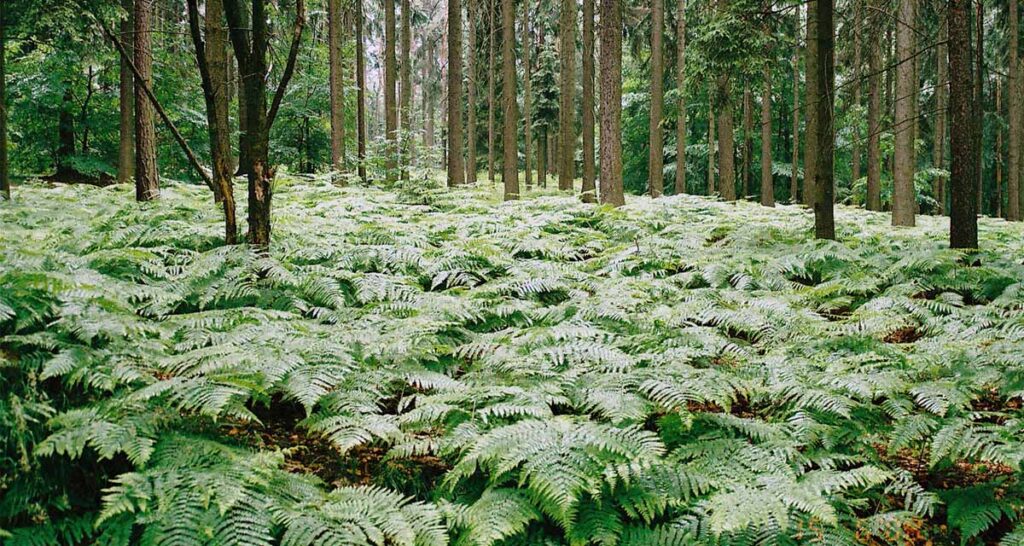
There is no doubt that the ferns like Pteridium aquilinum they are a totally different group of plants than we are used to, and yet we can enjoy it in any type of weather and condition. Ferns are a group of plants that includes some of the oldest and most primitive species of the plant kingdom.
They are considered an intermediate evolution between algae and flowering plants, and occupy a central place in the history of plants. Ferns are found worldwide, from the tropics to the poles, and can adapt to a wide variety of habitats.
One of the main ferns, due to its population and recognition, is the eagle fern or amambay, scientifically known as Pteridium aquilinum.
Its development is visually spectacular, covering large tracts of land, protected by the partial shade of tall trees. Without flower or colorful fruit, the fern has always attracted man. Maybe it’s the shape of its stems, the bright green or whatever surrounds the evolutionary history of this planthas always been a highly valued and respected species.
In this article, we focus on Pteridium aquilinuma fern used to living in wetlands, with fertile soils and medium temperature environments. We tell you a bit about this plant.
Characteristics of Pteridium aquilinum (eagle fern)
The bracken is a large species. Under optimal conditions, it can develop stems that protrude 2 meters in length. It has an ever-bright green color, no visible flowers, a multitude of leaves (tripinnate or quadpinnate) and a hairy texture, with villi.
always a fern it is reminiscent of humid, tropical or Southeast Asian environments. And it is that, although it has the ability to adapt to a multitude of environments, it prefers those where there is high humidity and soils with a certain fertility, the result of the decomposition of the litter and stems in organic matter.
In general, ferns are slow growing, allowing Pteridium aquilinum be grown in pots during the first years.
taxonomy
| Order | Pteridales |
| Family | Dennstaedtiaceae |
| Genre | pteridium |
| Scientific name | Pteridium aquilinum |
Common names: eagle fern, amambay, common fern.
The genre pteridium is characterized only by fern species, harboring 10 different types, being Pteridium aquilinum The most important.
 Director of photography: Rob Young
Cultivation and growth conditions
The fern is one of most common plants in the world. Its presence is said to be guaranteed in all environments except in certain deserts and extremely cold areas such as Antarctica.
Usually the fronds (stems of the fern) grow in early spring (March to May), replacing stems that could have frozen under very cold temperature conditions.
Climatology
Even though Pteridium aquilinum has great adaptability, where it really grows optimally is in temperate environments (15 to 30 ºC), with high humidity and shaded areas.
This does not mean that it grows in colder areas, since it can grow even with temperatures of 1-2 ºC. However, we are talking about optimal growth zones.
On the other hand, although prefers humid environments Its effective control of the opening and closing of the stomata guarantees that it can develop in particularly dry environments, those where one might think that they are not ideal for this type of species.
the type of soil
Eagle fern grows well in soils with strong presence of organic matter, cool, humid and with an acid or neutral pH (5.5-7.5). That is why it usually grows in wooded areas under the development of large deciduous trees, where in autumn they lay their leaves on the ground, which slowly decompose and form a valuable natural compost for the soil.
The western fern prefers deep, well-drained soilsalthough they hold moisture well, which is achieved in areas with high organic matter content.
Multiplication
spores
Reproduction of this fern occurs by spores, lodged in the leaves. Usually from the 2nd year of cultivation it is already able to produce them, although in general terms they are produced after the 3rd or 4th year of development. In numerical terms, one leaf can produce over 300 million spores per year.
These spores have good germinative power and are generally easily dispersed by the wind. These spores do not require any germination, stratification or dormancy breaking process. Therefore, it is easy to see how quickly the fern pteridium It covers large areas of temperate and humid forests around the world.
vegetative propagation
Ferns are also characteristic for reproducing vegetatively, by its rhizome, which contain a high volume of dormant buds. By separating the rhizome, any part can germinate and form a new plant.
can it be grown Pteridium aquilinum in jars?
As we previously anticipated at the beginning of the article, the western fern can adapt perfectly to pot culture. Since your growth is slow and the temperature and humidity adapt to its growing conditions, the care is not very demanding and brings a different touch to the home environment.
The main requirements for its cultivation are:
- Size of pots: do not use particularly small pots, as the rhizome of ferns is long and needs its space to grow.
- Climatology: adapted to house temperatures, with slightly low humidity if you do not live in a coastal area. However, it is not necessary to modify these conditions or perhaps, in very dry summer periods, a foliar spray with distilled water.
- Substrate: mix coconut fiber, universal substrate and earthworm humus, so as to simulate a soil with high fertility and sufficient capacity to retain moisture, a perfect environment for Pteridium aquilinum.
- Fertilizers: replenish the nutrients of the substrate by providing in spring and summer (once a month) liquid earthworm humus. In the spring, coinciding with budding, a small amount of liquid or solid fertilizer can be used.
Related Fern Articles
Cover photo: Charlesblack, taken in Erzgebirge, Germany.