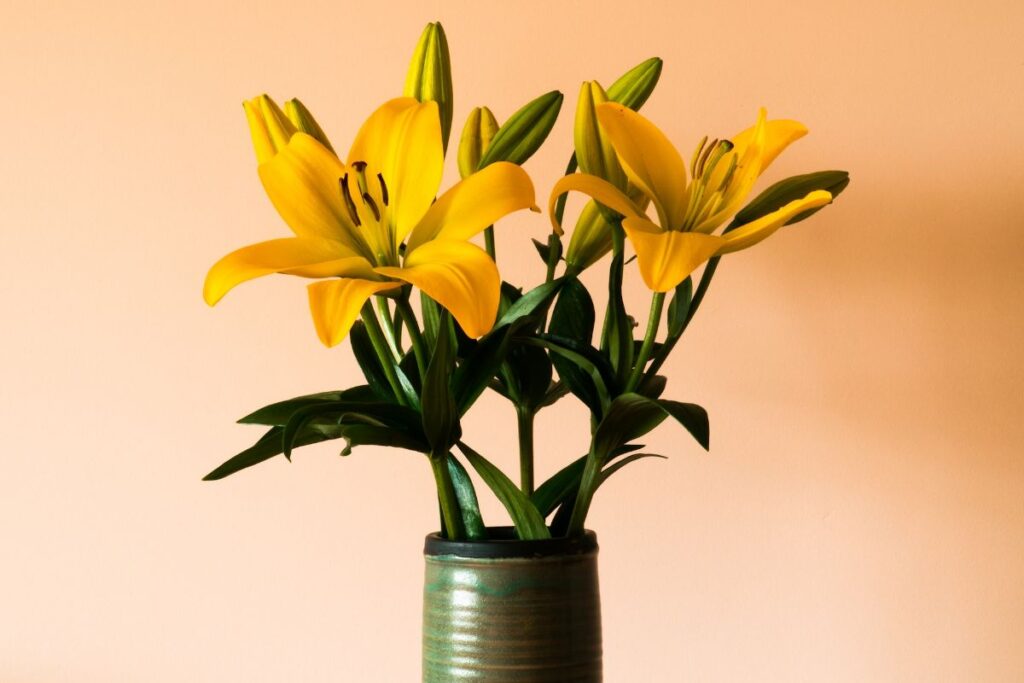

Have you fallen in love with a pot of lilies? Do you know how to care for potted lilies? Although you might think it’s the same as if they were on the ground, or almost similar to how flowers are cared for, the truth is, it’s not like that.
We will explain, step by step, everything you need to do to take care of potted lilies and that they are always beautiful and healthy. Do you want to know how? Keep reading.
How to care for potted lilies

As you know, lilies are bulbous and generally perennial plants (there are some varieties that have rhizomes). Its flowers are produced in the spring, and can last all summer, which is why they are very popular.
Now, caring for a few lilies outdoors and planted in the ground is not the same as caring for them in a pot. What is the difference between them? We explain it to you.
location and temperature
In general, lilies are very sun-loving. And the light. So the more hours they have, the better. Now well, When they are in a pot you need to control this exposure as the type of pot they have can affect them.
For example, if it is a plastic pot, the sun will heat it much more, causing it to experience drought more frequently, and if you don’t realize it, it can die from lack of irrigation. On the other hand, those made of clay or ceramic keep the roots cooler, but also colder, which can harm the health of the plant.
Bearing this in mind, our recommendation is that, if the plant is still small or medium, do not place it in full sun, but better in partial shade and give it a few hours of direct sun in the morning or late afternoon.
As for the temperature, you will have no problem with the heat, because they tolerate it and hold up quite well. But not the cold. They hold it, yes, but not the freeze and it is better to protect them if you see that the thermometer drops too much.
Substrate and Subscriber
When choosing the substrate for potted lilies you should keep in mind that they need two very important things: good drainage, so that water does not accumulate inside and can rot roots ; and a good fertilizer (or fertilized soil) at least twice a year (especially during the flowering period).
That being said, we can tell you that you can choose all types of calcareous and clayey soil. Combine it with drainage to make it perfect.
When you change the soil, it is not advisable to add fertilizer, as the soil will already be carrying the necessary nutrients. However, After a few months, you can add fertilizer for the lilies. If possible, make it organic, mineral and liquid, so you can add it to irrigation water.
Unlike other plants, lilies do not do well with high nitrogen fertilizer.
Irrigation

Watering is one of the most important parts of caring for potted lilies. And it is that the irrigation must be abundant, but only when you notice that the land is dry. In general, it is watered once a week in winter, and two or three times a week in summer. But it all depends on the weather in your area.
It’s best to use rainwater but, in case you don’t have any, always have tap water stored for use after 48 hours (this way you make sure you can water without anything happening to the plants).
Size
Pruning potted lilies will rely primarily on cleaning up dead leaves and faded flowers.
However, in autumn, when the plant begins to prepare for winter, the stems must be pruned at the height of the first leaves (below where the flowers were).
Transplantation
You should change the pot about every two years. When it touches, you have to wait for the flowering to end, and for the plant to turn yellow. At this time, do not water it and let it dry out, after a few weeks (or about a month), remove the bulbs and always store them in a dark place.
In the spring, you can replant them and enjoy them again for two years.
Multiplication
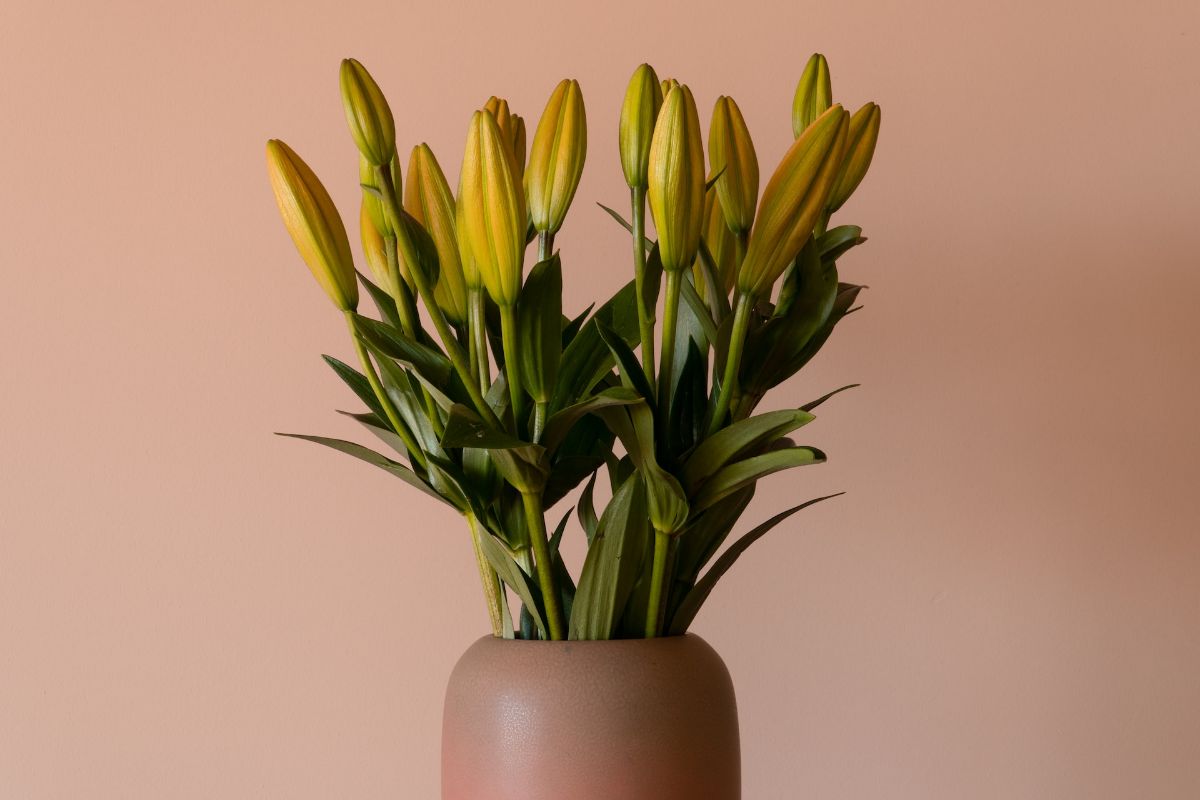
Lilies are usually propagated by bulbs. To do this, in spring they are planted, always about 8-10 centimeters deep and they are watered by wetting the entire area around the bulb (but not directly in the bulb).
As it germinates and the plant begins to emerge, it is important that the irrigation is constant so that the soil does not dry out. Since you need this water to move forward.
In addition, it must be put in the sun.
Bloom
One of the most beautiful features of lilies are their flowers. But often when caring for potted lilies, you may find that they don’t bloom for you. Therefore, there are a few things to consider that can help you achieve this. Specifically, the following:
- Control the temperature. You may not know it, but if you manage to keep them at a constant temperature of 15-20ºC, you’ll have a better chance of them thriving.
- Keep the soil moist. You have to be careful with this as there is a fine line between dampness and waterlogging. If you go overboard with the watering, you will eventually kill the plant. A moisture meter planted in the ground can help.
- Good daylight hours. The sun is very important for this plant, and especially for flowering, because it will activate it. So try to give it a few hours of direct sun avoiding the maximum incidence (from 12 to 18 hours).
Plagues and diseases
Unfortunately, lilies are one of the plants most pests attack. You will have to be very careful with thrips, spider mites, aphids, mites (especially in the bulb) and whiteflies.
Also, when it comes to lily diseases, the most common are botrytis, fusarium, pythium, lilium virus, and lilium spot.
Each of them has a treatment to apply to try to save the health of the plant (and the plant itself).
As you see, caring for potted lilies is not difficult, and control those little details that ensure your plant will continue to look as good as the first day you bought it. Do you have lilies at home?