

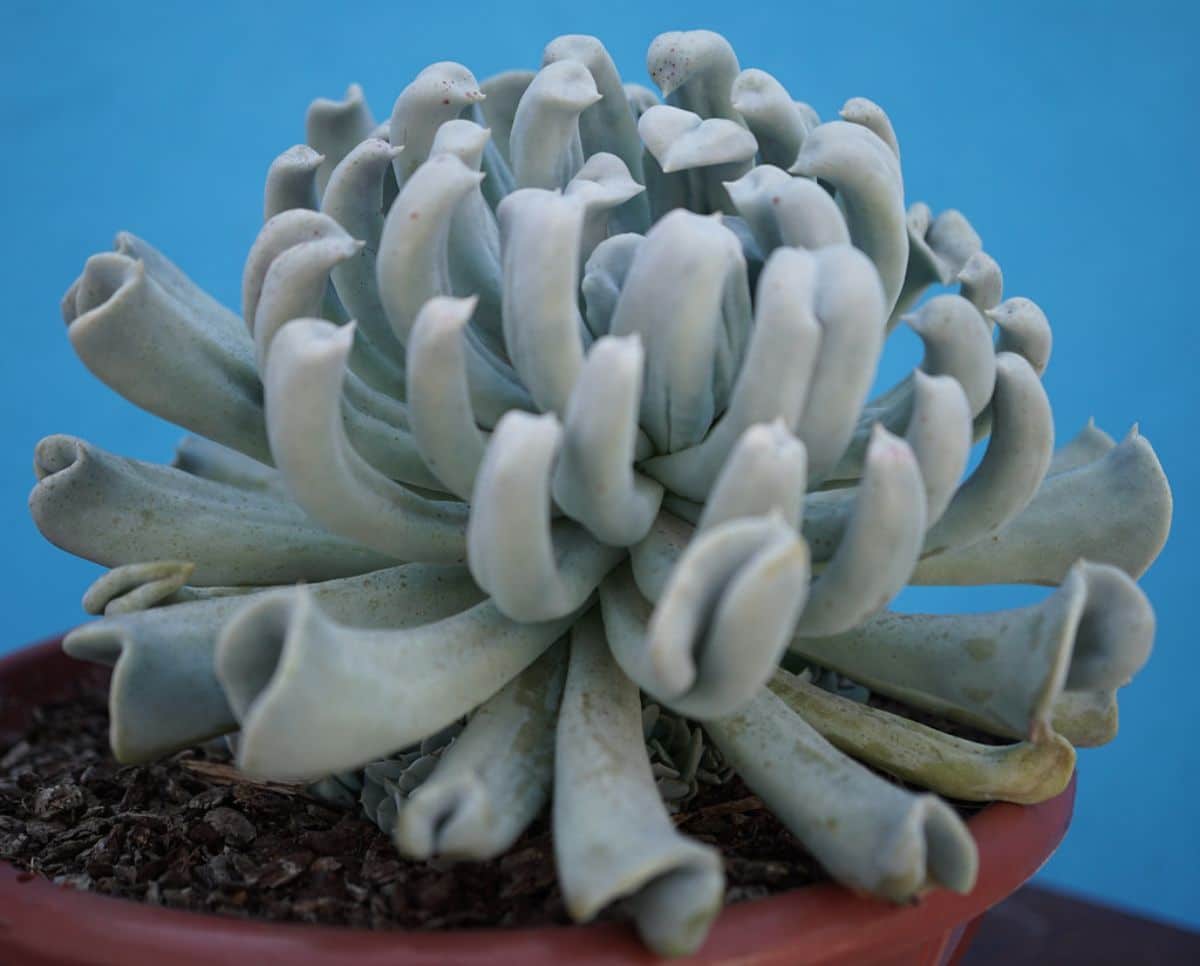
Have you ever seen Echeveria runyonii? Were they curved, smooth, elongated leaves? No, we were not mistaken, there are so many varieties that it is difficult to tell you about all of them.
It is a succulent native to Mexico. Want to know more about her? How is he, what is his story? And how to take care of it? Well, keep reading because in this file you will find it.
How is Echeveria runyonii

As we have already told you, Echeveria runyonii is native to Mexico. Moreover, it has a special history. The first time it was discovered was in 1935, by a scientist and botanist, E. Walter.
Another of the names by which this succulent is known is Echeveria runyonii San Carlosbecause it is the region of Puebla, Mexico (a mountainous region) where it usually lives in its natural habitat.
Physically, it is an echeveria rosette. It has fairly thick leaves (because that’s where water collects) and a bluish-gray color. Now, if you put it in the sun, it is one of the succulents that turns whiter. It has many flowers and can easily reach 10 centimeters in height.. However, where you will see the most growth will be in width, since rosettes are usually 12 centimeters in diameter.
Regarding flowering, the flowers are orange and pink, which come out of a long stem. These flowers are not very large and can reach 2cm.
As for its growth, always you will notice the difference in the summer when the plant becomes active.
Now, everything we have told you about the physical characteristics of Echeveria runyonii may not be of any use to you and there are many varieties. However, if we focus on the “originals”, in this case, at the time, there were two: the original Echeveria runyonii and the Echeveria runyonii macabeana. But actually there are more versions, like the Topsy turvy, with more rolled leaves, the Texas Rose, ‘Dr Butterfield’…
We can’t really list them all because we haven’t been able to find them, but it’s also been known that they often change their names to market them in different countries and which can cause the same to receive several names.
Echeveria runyonii treatment

If you want to get an Echeveria runyonii and take care of it properly, Here you will find a short guide where you have all the needs of the plant covered. Generally, you won’t have a problem with this because succulents aren’t plants that require tending. And with that much less.
Now, what should you take care of? We tell you.
lighting and temperature
We start with the location of the Echeveria runyonii. Like all succulents, they love the sun. But we do not recommend putting it in direct sunlight in summer, especially during the hottest hours. Because this will only cause burns on its leaves. It is best to provide it with 4 to 6 hours of direct light daily, preferably in the morning (before 12 p.m.).
Then you can stay with the light outside, but without it hitting you directly.
Regarding temperatures, It is a plant that will tolerate heat very well. (although from 35ºC, if it is the first year, we recommend that you be a little more aware of it).
The ideal temperature for this plant is between 18 and 26ºC. But you don’t have to worry about the cold either, because, As long as it doesn’t drop below 8°C, you won’t have a problem. (if he falls just protect him).
Substrate
Succulents have the advantage of adapting to any soil you give them. And in the case of Echeveria runyonii, you won’t have any problems with that. It is a plant that, if you give it a universal substrate mixture with perlite, it will be perfect.
In fact, some experts recommend incorporating certain mineral components to prevent fungus (since they are prone to it).
Irrigation
Do you remember that echeverias don’t need a lot of watering? Well, you know it’s a lot less. To begin, it will be necessary to wait until the substrate is completely dry to be able to water.
In winter, it is possible that with the humidity of the environment it will be more than enough and you will not have to water. While in the spring and in summer the risks are slightly increased, but basically you will water it once every 8-10 days.
Now, as we always tell you, it all depends on where you livewhere you have it, what sunshine it gives it, temperature… We therefore recommend that you adjust the irrigation according to the needs of the plant.
Subscriber
In general, succulents do not need you to fertilize them. It’s not something you have to do, but, if you see it set back a bit, you can always put in a slow-release fertilizer in early summer. Although, as we tell you, it is not necessary (yes, give him half the dose that the manufacturer puts because if you over-fertilize him it will affect his growth).
Size
Pruning Echeveria runyonii is primarily based on removing the branches of already faded flowers, faded or dead leaves, etc. All of this will keep the pot healthy and prevent problems with fungus or pests.
Plagues and diseases
Pests are one of the common problems with Echeveria runyonii. Concretely, it will be necessary to pay attention to scale insects (especially on dry and flowering leaves), as well as to aphids. If it affects the flowers, the most effective is to cut the stem (so as not to affect the plant itself).
As for diseases, the worst will be due to excess humidity. This can lead to root rot or, even worse, fungus attacks.
the reproduction
In case of reproduction, It is one of the easiest that exists, being able to reproduce both by leaves and by suckers.
Of the two methods, the most used is the leaf method, which, as you know, is very easy to obtain.
As you see, Echeveria runyonii is very easy to get and it will not cost you time or money in products for the plant. So, do you dare to have one?