

Image – Flickr/Hermès Almond
The almond tree is a tree of Asian origin widely cultivated throughout the Mediterranean region for centuries; in fact, many of us who live in lands bathed by this sea, have so many specimens throughout our lives, that we consider it a “tree that is truly ours”. Of course, particularly dry and hot summers cause their leaves to drop earlier than they should. But he also has another much more serious problem if possible: the ocher stain.
From the first moment you can see that something is happening to it: the leaves, previously green, now begin to have spots that turn yellow and then brown; and in the end they completely dry up and fall off, leaving the tree leafless. For it, it is very important to know everything about the ocher spot of the almond treesince in this way we will have the possibility of recovering it.
What is the ocher spot of the almond tree?
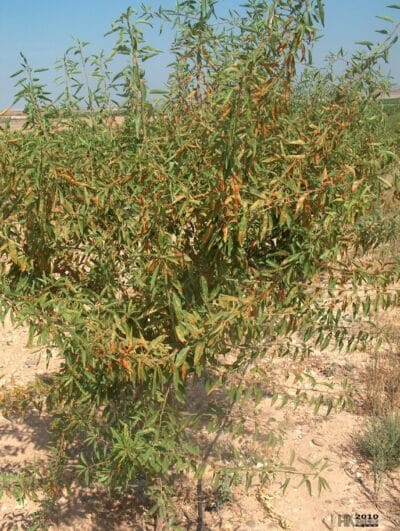
Image – Flickr/Hermès Almond
It is a disease caused by asmycetes fungi of the species Polystigma fulvum (before Polystigma ochraceum). Although the symptoms are very visible, they usually do not appear until a month after infection, so it is advisable to be vigilant, especially if there are almond trees with this problem in our area.
These symptoms are the appearance of yellow-brown spots on the leaves, which eventually turn brown and fall to the ground. What happens is that the microorganisms will stay there in the soil over the winter, where they will grow to infect new almond trees.
When do the first symptoms appear?
An infected tree will begin to show symptoms in the spring, this is the season when the fungus is much more active. These spots can measure up to a centimeter in diameter, overlapping as they grow.
Later, when the disease is very advanced, they develop reproductive structures in order to create new spores. In this way the Polystigma fulvum can continue to grow.
What conditions does the fungus need to grow?
You mainly need this: high humidity and heat of the air. This is why it is so common in the Mediterranean region, since in summer the temperatures exceed 30ºC, and the air humidity is very high (over 50%) which makes every morning humid, with dew . .
So, although it usually doesn’t rain at all during these months, the fungus can grow normally, harming the almond trees in the area.
Are there varieties of almond trees that are resistant to ocher spot?

Image – Wikimedia/Diego Delso
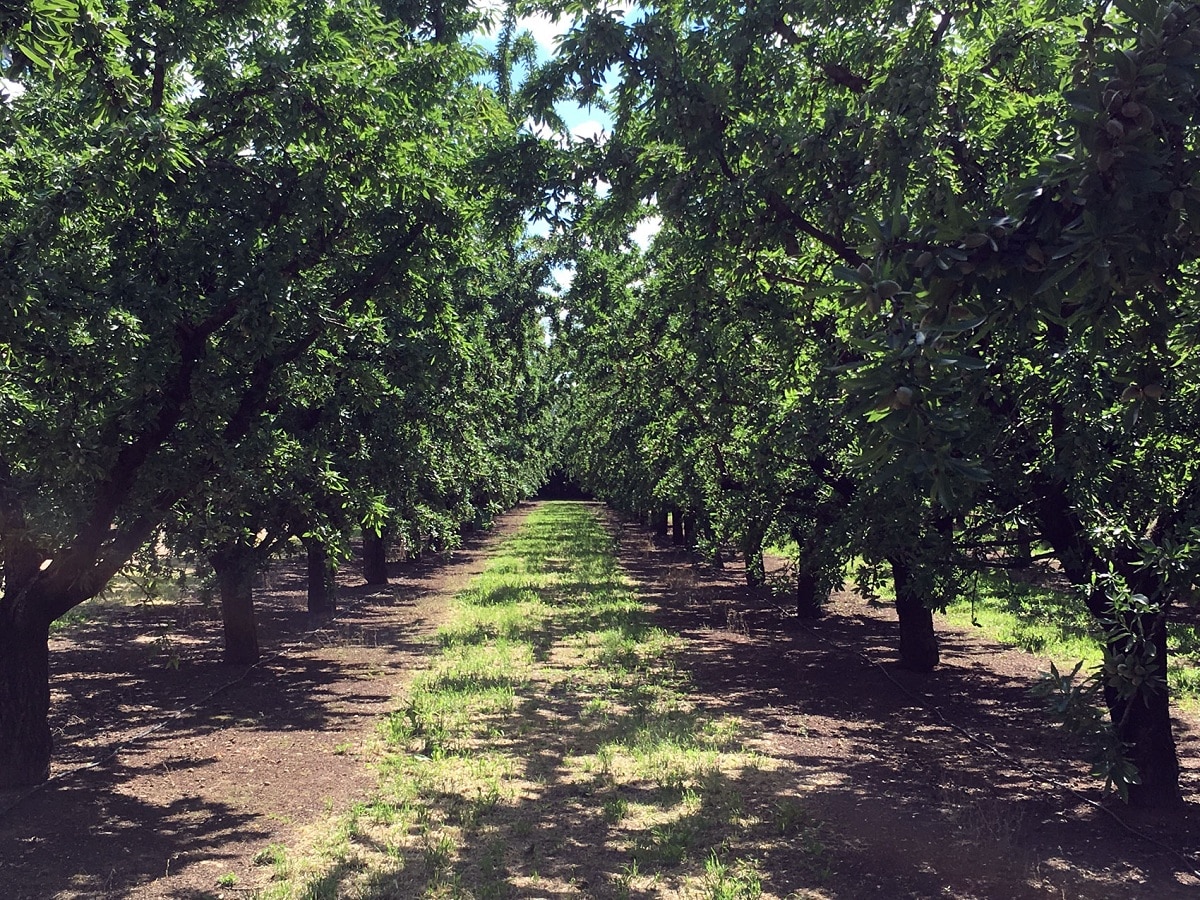
It is not that he is more resistant, but he is more tolerant. I’m talking about variety Bellona. It is a late-flowering variety, developed in Aragon (Spain) in the late 1980s. Unlike other varieties, this one begins to flower at the end of February, not in January, when the almond tree ripens is therefore not delayed. until mid/late summer.
On the contrary, the Tono, Vairo or Guara varieties are very susceptibleto the point that they may be left leafless after infection.
Related article:
Characteristics and cultivation of the Guara almond tree
What is the treatement ?
Since symptoms take time to appear, the best we can do is to prevent infection. And it goes through remove all fallen leavesas this reduces the risk of fungi damaging the tree.
It is also practical carry out treatments with insecticides whose active ingredient is Boscalidaafter flowering, and after an episode of heavy rain.
Can an almond tree be prevented from getting tan spot disease?

Image – Flickr/Maja Dumat
Not at all, but in addition to carrying out the preventive treatments that we mentioned above, it is important to take good care of the tree. In other words, if we know that during the summer it has a hard time due to the lack of water, we can help it if we water it from time to time (2-3 times a week) until until the rains come and the weather gets colder. down.
Likewise, it will be strongly advised to pay it in spring and summer with natural fertilizerssuitable for organic farming, such as guano (not mixed with fertilizers), compost, seaweed fertilizer, mulch, manure,… or any other of organic origin.
Related article:
How to Care for an Almond Tree
Also it is extremely important not to prune it, or to do it only at the end of winter. We will use previously disinfected tools and we will seal the wounds with healing paste. Also, when pruning, avoid cutting thick branches, as these take longer to heal, and other than that, the only thing that is achieved is that the tree does not look pretty.
I always say the best cut is the one that doesn’t show, and that’s the way it is. You have to respect the plant you are pruning and eliminate or cut the necessary branches, no more and no less. You should choose to prune small every year or every few years, rather than pruning drastically once a year.
Almond tan spot is a very common condition, but it can be treated.