landscaping with trees giving the exterior a major facelift, this has become the norm. And with this growing popularity, hydrangeas are leading the way.
Still, there is a bit of confusion as to whether the hydrangea exists. Does such a thing exist? You may even have come across nurseries advertising hydrangeas.
And that may have you wondering what the difference is between a hydrangea and a shrub. We’ll cover that and more in this guide.
Which hydrangeas are trees?
Before determining which hydrangeas are trees and which you can classify as shrubs, let’s cover the main types of hydrangeas. What are?
1) Broadleaf hydrangeas
These species also have other names such as Hortensia and French Hydrangeas. They are the most common type of hydrangea in the United States and include:
bulbous hydrangeas
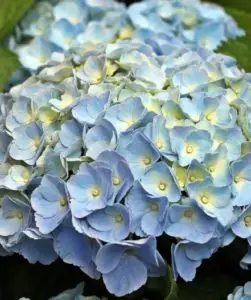
These have large flower heads with shades of pink, purple or blue.
In addition, its leaves are quite shiny and thick (about 15 cm long and 4 cm wide) and are often heart-shaped. They have coarse teeth on the edges. Under optimal conditions, these hydrangeas can develop quite large leaves.
display hydrangeas
Bulbous hydrangeas and screen hydrangeas have similar leaf shapes. As such, you can confuse one with the other.
However, their flowers are very different. These have the fertile flowers in the center, while the outer edges contain the sterile flowers.
mountain hydrangeas
It is not easy to come across these hydrangeas, they are quite rare. However, they are much hardier than previous species and can survive harsh winters, hence their name. Its flowers are quite small.
2) hydrangea panicles
 Of all the varieties of hydrangeas, these are the best adapted to survive in harsh climates. As such, they do quite well in hardiness zones 3 through 7.
Its flowers are white initially and as they mature they may turn pink. How can you distinguish these types from others?
You focus on the leaves, which are much smaller and finer than the bulbous hydrangea. In addition, its edges are much rougher.
3) Sweet Hydrangeas
These varieties grow like shrubs and are also known as wild hydrangeas. Unlike panicle hydrangeas, these do well in warmer climates.
Therefore, you can grow them in hardiness zones 4 through 7. They tend to grow tall and stick out, making them ideal for hedges.
How to distinguish them from others? They have thin, heart-shaped sheets and much thicker edges than mops.
4) Oakleaf Hydrangeas
Most hydrangeas get their name from their shape and this variety is no different. It has leaves like you would find on a red oak.
They can be small with an average width of 4 inches or as wide as 10 inches! These strains are ideal for landscaping because its leaves change color in the fall.
(Good: they’re the only hydrangeas that can change color!) So if you’re looking for something out of the ordinary, this is it. This variety grows best in areas with hot summers.
5) Climbing hydrangeas
Did you know that some hydrangeas have creeping tendencies? Well now it is! Native to Asia, this species climbs on structures and can measure up to 25 meters high!
So if you want a landscape that shows the beauty of rock climbing, that would be a great idea. You can grow them in hardiness zones 4 to 8.
If you like this article, check out our article on hydrangeas against lilacs.
Now back to our question: which of these hydrangeas is a tree?
If we’re going to be scientific about it, none of these types of hydrangeas are real trees. They are all bushes. However, panicle hydrangeas have certain characteristics that make them somewhat tree-like.
What is this? First, it does not form new branches from the root, unlike bushy types. Second, they have a central trunk that can become a trunk, creating the illusion of a tree!
If you opt for the Paniculata grandiflora species, you can expect a tree 6 meters high. And when it starts to bloom, you can imagine how beautiful it looks!
Can other varieties of hydrangeas create this illusion? Certainly! Options include:
- Light hydrangeas: They are not necessarily trees. So you can’t expect them to grow a few meters tall. Instead, they can reach a height of 6 feet with greenish-white flowers.
- Small lime hydrangeas: If you’re looking for a short tree to spruce up your space, this option will do. It has a unique lime green hue and grows up to 4 feet.
What about other species, as mentioned above? Well, these begin to branch out at ground level (like bushes). So they will eventually grow into a bush no matter how much you prune them.
Hydrangea Tree vs Shrub – What’s the Difference?
 The difference between tree and shrub is in the growth pattern. Shrubs begin to branch at ground level and grow outward.
However, tree species start from a central trunk that branches out over time, but not at ground level.
For example, with regular pruning, you can remove the suckers from the trunk to ensure the trunk doesn’t branch out too much.
However, you should keep in mind that the hydrangea is not a tree. As such, it needs help maintaining its shape or it will turn into a bush.
Hydrangea Tree vs Shrub – What Are the Benefits?
Why would one choose a tree over a bush or vice versa? Let’s see the advantages of each:
the hydrangea
What makes the tree a good deal?
extra space
Shrubs take up a lot of space when growing and growing. So you cannot include more plants in a bushy area.
After all, he would suffocate under the bushes. But with trees, you can also introduce other plants into the garden. Makes hacking a magazine-worthy landscape easy!
Aesthetics and visibility.
Have you ever seen a flowering tree? It looks great even from a distance. Plus, it exudes an exotic vibe and is just the way to achieve stunning beauty.
Plus, with other plants growing under the tree, blooming flowers will be the icing on the cake.
The hydrangea bush
Is a bushy variety the best option for you? He has:
Variety
One of the main advantages of bush varieties is that you have more options. You will be able to choose with pleasure the species that best suits your landscape or your interior.
Lots of weird options
You don’t have to stick with the same old options when growing a hydrangea bush. You can try rarer options like Bristol Hydrangeas and Miss Saori.
You can experiment with impressive varieties and make the most of your outdoor or indoor space.
Both options have a lot to offer.
You might be interested in our article on the Common problems with potted hydrangeas.
Hydrangea tree vs shrub: what are the disadvantages?
Is there a reason for the tree to fall on the bush or the bush on the tree? Let’s find out:
the hydrangea
Although having a towering hydrangea is a dream come true for many people, it does have a few downsides:
limited variety
We mentioned earlier that the hydrangea normally grows like a shrub. As such, the few options that grow like trees are quite limiting.
If you’re looking for countless options to find what’s best for your stamina zone and aesthetic, you might be missing out.
No rare varieties
Wouldn’t it be cool to grow an unusual variety of hydrangeas in your space? Unfortunately, you don’t have that option with tree hydrangeas. Again, the choice is quite limited.
Large size needs
No matter how tall the tree is, you will need to prune it quite often to maintain its shape.
And that means using shears on the tree at least once a year, increasing your maintenance needs. If you don’t follow it, the tree will try to become a bush!
Cost
Did you know that making a tree takes a lot of effort? Therefore, nurseries often provide trees at a much higher cost than shrubs.
The hydrangea bush
Why would the shrub be a bad idea for your home or landscape?
space restrictions
Once a hydrangea bush has established itself in the garden, you cannot add more plants to the section. The bush will continue to expand and all new plants in the garden will die due to reduced nutrition.
reduced visibility
Shrubs tend to obscure people’s vision. You may have a beautiful display of flowers, but your eyes may not immediately notice the flowers. This is due to the congestion caused by the bushes. So to see the flowers you have to be close to the landscape.
Susceptible to fungal diseases
Shrubs grow close to the ground, creating a moist environment where fungi can thrive. It is therefore much easier for these species to suffer from diseases that can affect their aesthetics.
Again, both options have significant drawbacks.
Final Thoughts: Hydrangea Tree vs. Shrub
 So which one to choose? It all depends on why you want the hydrangea in the first place.
If you want a unique addition to your landscape that doesn’t take up a lot of space, the tree will work.
But if you want an option you won’t find in most gardens, look for rare species of shrubs. What would it be?
Happy gardening!
Before you go, here are some other related articles that I encourage you to read below to solve more of your gardening problems:
How to use baking soda to grow hydrangeas
How to Get Rid of Black Spots on Hydrangea Leaves?
Why are my hydrangeas turning green?