

Are you looking for a plant for your garden that covers you a lot and gives you that special “something”? So why not take a look at Imperata cylindrica? It is a plant that attracts a lot of attention due to the reddish tone that the tips of the leaves have.
Want to know more about her? Do you know what your care is? So keep reading because we have prepared a dossier on its characteristics and care.
How is the Imperata cylindrica

Imperata cylindrica is also given other names, such as Imperata cylindrica red baron, Japanese red grass, Imperata cylindrica rubra, cogon grass, marciega, bloody grass, cisca.. And yes, before you wonder, she is from Japan.
It is an evergreen grass or herb that grows forming groups of shrubs composed of green and vertical leaves, but with the particularity that the tips are red, to the point that it changes color with the seasons. one of the most beautiful plants there is).
It is not common for it to flower and if it does, the weather needs to be cold to achieve this.. For this reason, although many may think that it is not very pleasant for a garden, the red tint, unlike the green, already makes it attractive enough to put in the garden. It grows up to one meter high and about 70 centimeters wide. Even so, if you are lucky enough to have it bloom for you, it will do so in September or October, with flowers that can be white with silver tones.
Now well, keep in mind that Imperata cylindrica is a plant that has the reputation of being invasive, as it grows quite quickly and gains ground where you plant it. For this reason, it can be kept in the garden, but with barriers that prevent it from invading the space of other plants, or in a pot.
Imperata cylindrica treatment
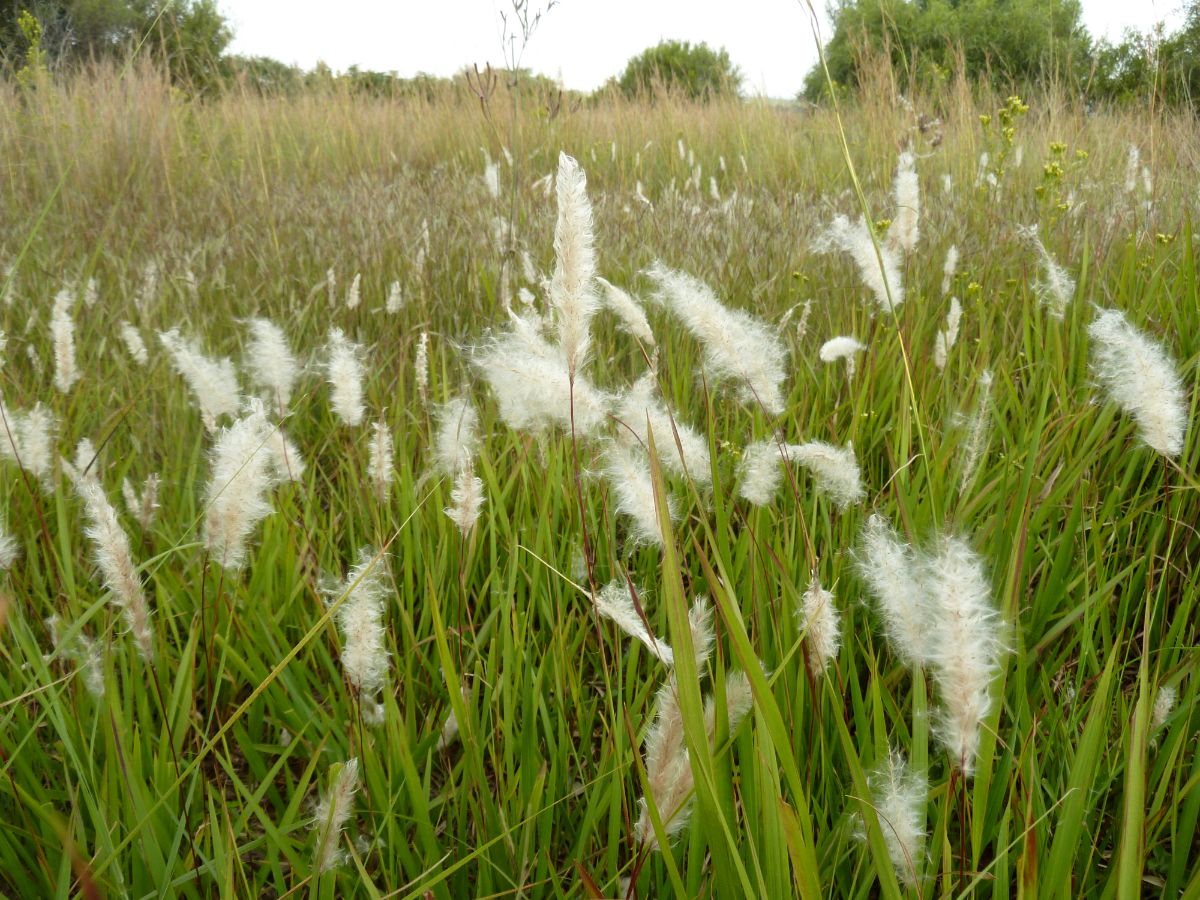
Now that you know a little more about Imperata cylindrica, how about we talk to you about care? It is not a very complicated plant to have. But like the grass that she is, she needs to know her quirks.
location and temperature
Let’s start with location. Imperata cylindrica is a plant that needs to be outdoors. In this sense, it can be in partial shade or in full sun. What does it depend on? Basically, the time you have. If it’s cold or hot, you can leave it in full sun and enjoy the changes in tone it undergoes. For its part, if it is hot, and it is too hot in summer, partial shade would be preferable so that peak hours do not burn the tips (which is the best part of this grass).
Regarding the temperature, it can tolerate the highs, and also the lows. In fact, it is said to hold up well down to -15ºC.. Nevertheless, during the first years we would tell you to protect it, at least the ground, to prevent it from freezing and to adapt well to the climate where you have it.
Substrate
Imperata cylindrica is not a very demanding plant on this point. With one detail: it does not like chalky soils. So try to give it nutrient rich, light and of course drained soil.
You should give it a soil with a neutral pH. Therefore, a mix with very nutritious soil and perlite or similar will be ideal.
Now, as we have already told you, the Imperata cylindrica is a plant that you can have in the garden or in a pot. In the case of the garden, before planting it is a good idea to put some manure or compost in the hole to nourish this part of the soil (in addition to mixing it with the one you use to fix the plant on the ground).
In the case of the pot it will not be so necessary.
Irrigation

Depending on the weather, where you put it, etc. you will have to water it more or less. In general, it is of average irrigation and You must always have a slightly moist soil, but without going too far because it could suffer from rot.
Thus, you might be told that it should be watered two to three times a week in the spring and summer, while in the fall and winter it might be enough once a week or every two weeks.
Subscriber
Before I told you a little about fertilizer when planting. But what is the next step? Being a perennial plant, Imperata cylindrica appreciates that from time to time, especially in spring and summer, which is its growing season, new nutrients are brought in.
We advise you to use manure or compost to feed it in the garden. But, if you have it in a pot, it may be better to use a liquid fertilizer that you mix with the irrigation water.
Size
In this aspect you should not worry at all because unless you see it very badly you should not prune it. Remember that it is a perennial plant and the only thing you would have to cut is when you see the burnt, shabby, withered leaves…
Plagues and diseases
In the case of pests and diseases, Imperata cylindrica is not a very affected plant. First, because it’s a weed and they don’t usually attack it; secondly because, by not flowering, it does not attract birds. Even so, you might have trouble with snails or slugs wanting to feed on it.
Regarding diseases, Perhaps the most important are related to excess or lack of water or lighting.
Multiplication
Do you want to propagate Imperata cylindrica? We have already told you that it is an invasive plant, which means that it grows in bushes and spreads. And that’s what helps you reproduce it.
All you have to do is, in autumn and winter, divide the bush to put it in different pots (or in different areas of the garden).
Now you know what the Imperata cylindrica looks like and what it needs. Would you like to have it in your garden?