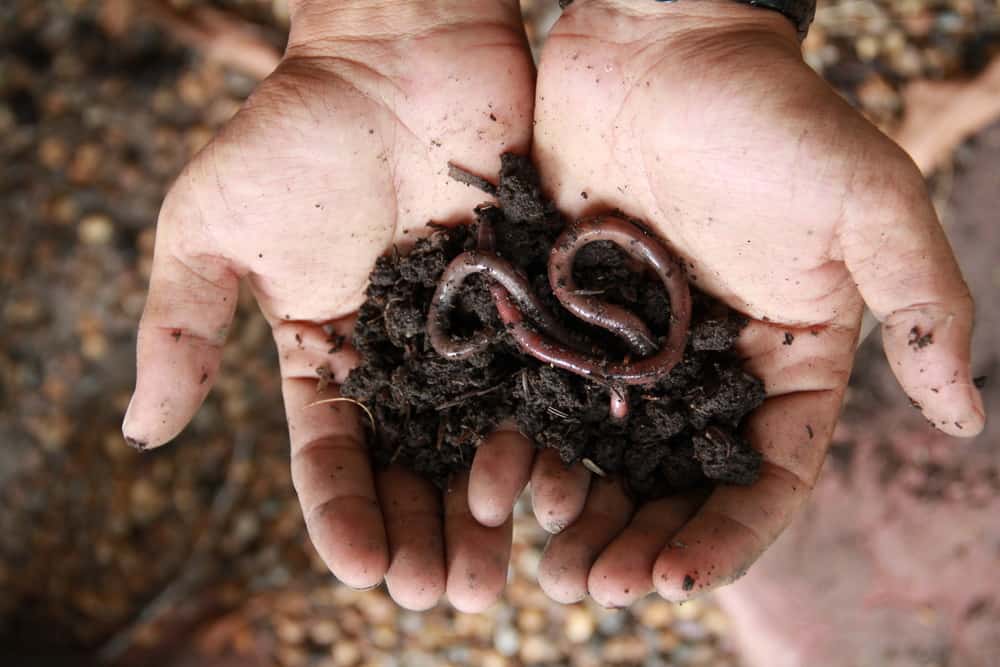
Most of us who live in North America were raised to believe that earthworms are beneficial allies in the garden. We were taught that these restless weirdos were invaluable for healthy soil and as food resources for hungry birds.
The general idea was that if you dug into the soil and found a handful of these worms, then said soil was super healthy. Plus, you can also use these wrigglers as fishing bait!
Imagine how surprising it is to discover that common earthworms are invasive in North America. Moreover, they are not only invasive: they are actually very harmful to our local ecosystems. That’s because the same traits that make them perfect for our gardens wreak havoc on forestry systems.

How do invasive earthworms harm local ecosystems?

Gardeners, botanists and biologists are well aware of the role of earthworms in soil health. These worms break up the soil by wriggling through it, aerating it and releasing nutrients.
Water then moves more easily through the soil, carrying nutrients through the soil and onto the plants growing there.
Now, the problem is that native North American plant species have evolved over millennia to adapt specifically to their local environments. Forest plants, in particular, have learned to extract nutrients from the soil as efficiently as possible. Invading earthworms ruin it all.
Soils “Mor” vs. “Mull”
If you’ve ever walked through a forest, you’ve noticed that the forest floor is covered in trash. This organic material consists of dead leaves, slightly decomposed leaf mold, fallen conifer needles, dead insects and fungi. The floor of a forest is known as “Mor” soil and consists of these detritus deposited on lower mineral-rich soil, rather than being mixed with it.
Now, when earthworms are introduced to these soils, they change them dramatically. Only a few years after their introduction, the worms shuffle these layers together. Thus, the ground “Mor” becomes “Mull” instead.
The layers are mixed more evenly, which is detrimental to the health of native plants. Basically, the plants that have evolved to thrive in the different layers no longer know what to do with themselves.
All effects propagate outwards
Invasive plant species take root less deeply than native species, which had to adapt to draw minerals from the lower layers of the soil. Thus, these invasive species end up thriving while native species lack nutrients. [1]
It’s not just plants that lack these nutrients. Remember that nothing in nature exists in a vacuum and this redistribution of nutrients also affects soil microbes and insect health. In fact, altered soil biology can also affect the health of mycorrhizae, which will in turn affect all other life forms nearby.
In fact, each change spirals outward and affects other species. For example, native plants that don’t grow as well won’t be able to feed pollinator species that have evolved to feed on them.
In turn, these insect species will not be as abundant for local or migratory birds, or small mammals. As you can imagine, predators that prey on these birds and small mammals (e.g. hawks, owls, foxes, etc.) see their food sources diminish as well.
Over time, what was once a thriving forest full of interdependent species becomes unbalanced. Invasive species thrive while the natives die off and may never recover in this area again.
Where do these earthworms come from?

Three of the most common invasive species, Lumbricus terrestris, Octolasion tyrtaeum Savigny and Dendrobaena octaedra Savignywere introduced to North America in the 17th century. [2]
Scientists speculate that these worms hitchhiked to this continent to produce root bulbs. They (and their eggs) likely stowed away in cabbages, onions, and other food plants that European immigrants brought to the new world.
Then they continued on their merry way once introduced into the ground, dropping their offspring as they squirmed. These worms do not need partners to reproduce, so nothing hinders their procreation.
Considering the number of earthworms that currently exist on this continent, you can see how prolific they have been!
Can we take steps to reduce their populations?
These worms are widespread and prolific, as mentioned. It would therefore be very difficult for us to significantly reduce their number. That said, we can take some steps to reduce their population on our own properties.
Crowd them out with a mustard dewormer
Pick a day when the weather is nice enough and the ground is already moist. For example, on a hot summer morning or evening after a thunderstorm. Next, dissolve 1/3 cup dry mustard powder in a gallon of water and soak an area of soil with it.
There is an organosulfur compound in mustard called allyl isothiocyanate, which gives the mustard its slight burning effect. This component is also present in radishes, wasabi and horseradish.
It irritates the worms’ skin when it seeps into the soil, and they will try to crawl away from the burning sensation. This pushes them up and out of the ground, at which point you can grab them and throw them in a bucket.
From there, it’s up to you whether you want to move them, kill them, or use them for other purposes. For instance:
Feed them to wild animals

You’ve probably noticed that you bring a lot of worms to the surface when you till your soil. Every time you turn over this soil, hundreds of worms and their eggs are exposed. The local animals have learned to recognize this buffet and gather each time we plow. Then herds of all species descend to devour the worms before they can disappear again.
You can team up with your local wildlife to help reduce earthworm populations. Collect exposed worms in a bucket as you turn your soil. Then spread them out on a tray near your bird feeders. We also give them (along with various larvae and slugs) to our raccoon friends to snack on.
If you used mustard for (aka “mustard dipping”) as mentioned above, you will need to wash the earthworms before feeding them to animals. Although mustard does not harm birds or mammals, it is not an appealing flavor to them.
In fact, most of them will avoid it. As such, rinse the worms thoroughly with a hose to remove any lingering mustard powder. So treat your wild friends to the worm buffet they’ve always wanted.
Let your fowl or fowl eat them

If you have chickens, guinea fowl, ducks, quail or other domestic/game birds, you’re in luck. Earthworms make tasty and nutritious treats for all of these species. As such, let your birds run wild in the garden after plowing so they can gorge themselves.
Alternatively, you can also offer them a worm and grub buffet similar to the wild bird snack board mentioned above. Simply wash off the mustard as above if you did a soak to get them out.
Use them as fishing bait

Do you live near a river, lake or ocean? Then dig up some of these earthworms and use them as fishing bait. Saltwater fish like cod, halibut, mackerel and plaice love these worms. The same goes for freshwater species like bass, catfish, trout, yellow perch and bluegills.
Although using worms as fish bait does not significantly reduce earthworm populations, every little bit counts.
Reduce the spread
Avoid moving soil from one area of your property to another, especially if you live near a forest. If you live near the woods, use these mustards on the edges of your property. This will discourage worms from moving in that direction.
Also, if and when you buy compost or mulch from a garden center, make sure it has been heat-treated. This treatment sterilizes the contents so you don’t spread soil pathogens. As an added bonus, the heat also kills earthworms and their eggs so they cannot establish and spread.
It is important to recognize the impact of human activity on the health and well-being of ecosystems. By being aware of how every action impacts outward, we can be more diligent about invasive species in the future.
We may not be able to eradicate the invasive earthworms from North America, but hopefully we can refrain from doing further damage while we are here.
References:
- Qiu, J., Turner, MG Effects of non-native Asian earthworm invasion on temperate forest and prairie soils of the American Midwest. biol invasions 19, 73–88 (2017). https://doi.org/10.1007/s10530-016-1264-5
- Nico Eisenhauer, Stephan Partsch, Dennis Parkinson and Stefan Scheu. 2007. Invasion of a deciduous forest by earthworms: changes in soil chemistry, microflora, microarthropods and vegetation. Soil Biology and Biochemistry 39: 1099-110.doi:10.1016/j.soilbio.2006
Was this article helpful?
Yes No ×
We appreciate your helpful feedback!
Your response will be used to improve our content. The more feedback you give us, the better our pages will be.
Facebook pinterest