money trees (aquatic pachira) which like a certain humidity, which sometimes turns gardeners away from this pretty plant. That’s always a shame, because not only is the plant sturdy and attractive, but moisture issues can be easily fixed by following some of the steps in this article.
I’m sure if you’ve read the suggestions below, you’ll be inspired to add one of these beauties to your collection.
Humidity is important to keep the money tree in top condition. This can be easily managed by following a few simple steps that any gardener can follow.
What humidity level is right for your money tree?
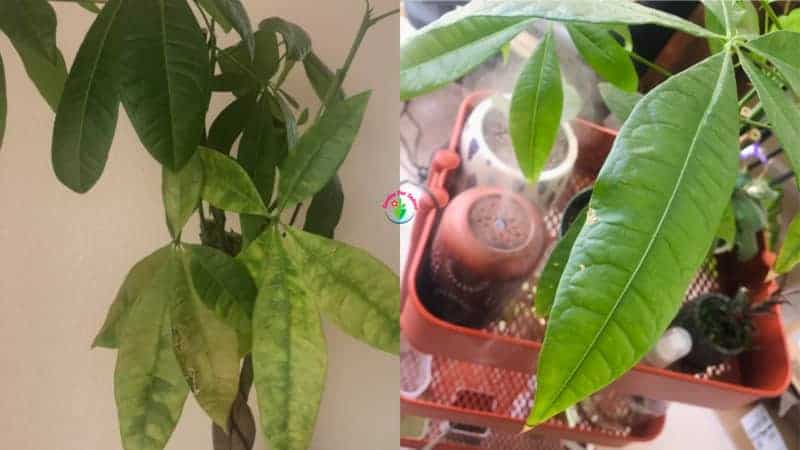
Ideally you want to keep the humidity around fifty percent and your plant will thrive. The humidity in a typical home is usually between 30-40%, so you can see that we don’t need to change much to create the ideal conditions for a money tree.
The reason humidity is important to your money tree is that it controls the opening and closing of pore-like holes on the underside of the leaf called stomata.
These regulate the amount of CO2 absorbed by the plant and therefore the amount of oxygen released. This will affect the overall health and growth rate of your plant.
A little humidity
Humidity is the amount of water vapor in the air. In general, the warmer the air, the more moisture it can hold.
This is not always the case, because in very hot regions, such as deserts, the humidity is often low, but this is because there is no source of water available to create humidity. ‘humidity.
Your money tree is native to swamps and swamps in Central and South America where the air temperature is high but the humidity is also high. This results in high humidity.
We like to regulate the temperature in our homes. This affects moisture absorption and this in turn has an effect on our money trees. It also means we have to constantly monitor the humidity as it changes.
This is usually more apparent during the winter months when we start using some of the different central heating options available to us. Most often they have a drying effect.
How to measure the humidity in your home
The only reliable way to know for sure what the humidity is is to use a moisture meter. Digital moisture meters are available at most hardware stores and garden centers and only cost a few dollars.
They give amazingly accurate readings of the humidity in your immediate vicinity. If you have a large collection of plants, consider buying several and spreading them throughout your indoor jungle.
Use a moisture meter
These little digital devices (called hygrometers if you want to sound technically familiar) are very easy to use. They are usually battery powered and all you have to do is insert the batteries and turn them on.
Place them near the plant you are interested in and leave them for about two to three hours to adjust to their position. They then give the humidity value as a percentage.
Most will also give you a temperature reading. Money trees like the temperature to drop between 60° and 75°F; (16-24°C)
Helping Your Money Tree When Humidity Gets Too High
After determining the level of humidity, you may need to take appropriate steps to correct it. Assuming it is too high, here are simple steps to reduce it.
excessive watering
Always dangerous for money trees. Let the soil almost dry out between each watering. Regularly dip your finger in the soil and when the top centimeter is dry, then, and only then, is it time to water.
Remember that overwatering is the most common cause of death for houseplants. We gardeners often love our plants.
A critical point around watering is that the container your plant is in must have adequate drainage. The drainage hole should be at least large enough to insert your fingertip.
Also; Once you’ve watered the plant, let the excess water drain out before placing the pot back in the saucer.
air circulation
The air in most homes doesn’t move as much as it does outside, allowing stagnant air to trap excess moisture. Opening a few windows for an hour or two during the hottest part of the day will minimize this problem.
Carefully choose the position of your plant
Keeping your plant near a window will likely improve air circulation and reduce humidity.
Make sure your plant is not in direct sunlight. Money trees evolved in forests where they were protected from direct sunlight by the canopy above them. They like bright light, but can be damaged by direct sunlight.
the type of soil
The bottom acts like a sponge and retains moisture. If it gets too wet, the humidity will increase as it evaporates. Using soil with a high drainage capacity solves this problem.
Try mixing a good quality potting soil with fifty percent perlite to add extra drainage. Additionally, some potting soils contain plant material that retains moisture. Avoid potting soils with a lot of peat or coir when planting your money tree.
grow lights
Indoor grow lights reduce the moisture-carrying ability of the air around your plants and help your money tree sweat faster. These lamps have become much cheaper in recent years.
Try to place them where the light is shining from above and don’t let the light touch the foliage. Do not leave them on 24 hours a day. Like us, plants need a few hours of rest to perform at their best, so give them their nightly nap.
Signs of Low Humidity in the Money Tree
The most obvious sign of too low humidity is that the the leaves turn brown and drying the margins and working inwards. Don’t worry, it won’t happen overnight.
Confusingly, these signs are similar to signs of too little water. Check the moisture in the soil with your finger and if it’s damp and you’ve followed a good watering regimen, you can be sure the lack of moisture is to blame for your plant’s unhappy behavior.
These plants are tropical plants and low humidity in our homes is usually much more common than too high humidity. This problem is often exacerbated during the winter months when we use air dryer heaters and other heating appliances. The good news is that the situation can be corrected.
Money tree humidity improvement
Humidity often confuses gardeners because, unlike watering and feeding, they feel it is an environmental factor over which they have no control.
In fact, that’s not true, and we gardeners can manage the humidity around our plants quite easily using several simple techniques.
Band
Probably the easiest technique to increase humidity is to keep plants in groups rather than leaving them alone.
Plants release moisture into the air through a system called transpiration. This is very similar to the human respiratory system.
By grouping your plants into groups, their combined transpiration increases the humidity near that group. It’s like creating a little oasis or microclimate.
gravel buckets
Another low-tech method to increase humidity is to use gravel pits. Gravel boxes are just shallow boxes (plant boxes work well) filled with gravel. We can pour water on it and then put our pot on it.
The water will slowly evaporate and thus increase the humidity while keeping the base of the plant water free as it rests on the gravel.
misting
A popular and easy solution to low humidity issues is to occasionally mist the leaves of your money tree with water. A cleaning bottle filled with filtered water is ideal for this, especially if it makes a very fine spray.
Just moisten the leaves and the humidity will rise quickly. Try to do this early in the day so the air will absorb the water from the leaves. Water on the leaves at night can cause fungus and other diseases.
Be sure to use filtered water or collected rainwater as it does not contain any chemicals. Regular household tap water contains chlorine.
In small amounts this won’t cause any problems, but over time the chemicals build up in the leaves and clog the pores, reducing the plant’s ability to transpire.
The use of this method has become quite controversial in recent years. Some proponents argue that this only creates a short-term solution and does not solve the problem, while increasing the risk of fungal diseases. Others rely on a daily misting routine.
I float somewhere between the two fields. I don’t spray my houseplants that have thick leathery leaves and those that have brittle, thin, or hairy leaves. My money tree falls into the first category.
humidifiers
These easy-to-purchase items increase humidity by introducing a fine mist into the air near the Money Tree. They have become more affordable and smaller as their home market has expanded. This helps the gardener hide them among his plants.
They work in one of two different methods. One heats the water and sends it into the air as a fine mist, and the other stirs the water and disperses it as a fine mist.
Both methods are effective and you can consult your supplier for advice on which system best suits your needs.
Models are now often equipped with a sensor that automatically switches them off when they reach the desired humidity level.
Since you now know that fifty percent humidity is the ideal percentage for your Money Tree, you can set your humidifier to turn on and off only as needed to maintain that percentage.
For these humidifiers to work, they need to be close to the plants, as they don’t project moisture over great distances. Also, remember to surround them with plants that require similar humidity levels.
indoor greenhouses
The problem of controlling the environment around your plants always comes down to how much air you want to manage. If your plants are in an open space, controlling humidity is much more difficult than if the plant is in a confined space, such as a small greenhouse.
Some manufacturers have started making small greenhouses that you can place in your home. They consist of a glass or plastic covered frame that you place the plants in to keep them in a very controlled and easy to manage environment.
Although it allows me to maintain an almost perfect environment, I personally like my plants to be freely displayed in a greenhouse, which is why I rarely use this equipment, although some sellers have started making much better specimens. .
main points
- You need a moisture meter
- Check your plant’s leaves regularly for early signs of trouble.
- Apply a healthy watering routine
- Don’t expect the humidity to stay constant all the time
- Experiment with some of the methods above until you find one that works for you and your money tree.