

If you like cacti then you may know the Rhipsalis cereuscula, an easy to find and not too expensive plant, but it can be perfect for a window box, a balcony or a rock garden.
Want to know what this plant looks like? And the care she needs to stay healthy and grow well? Afterwards Pay attention to the guide we have prepared.
How is the Rhipsalis cereuscula

We must start by telling you that the Rhipsalis cereuscula is in fact a hanging cactus. It is an epiphyte, that is to say it will grow on a surface or on another plant, but unlike others, it does not parasitize (it does not eat this other plant).
It is native to Brazil (especially the northeast, east and south). It is found in Rio de Janeiro, Santa Catarina, Paraná, Sao Paulo…
It can reach up to 60 centimeters in length and the truth is that sometimes you will find it with other names such as rice cactus or coral cactus. It is characterized by very short cylindrical stems, one on top of the other, from which the branches arise, which will be very thin and long. Don’t be surprised that it branches out a lot, as it is very prolific in that sense. And that’s what causes them to grow in clusters and that these, because of the weight, end up hanging down. As for the color of the stem and the branches are pale green. And we have already warned you that it has no thorns, so you shouldn’t worry about that.
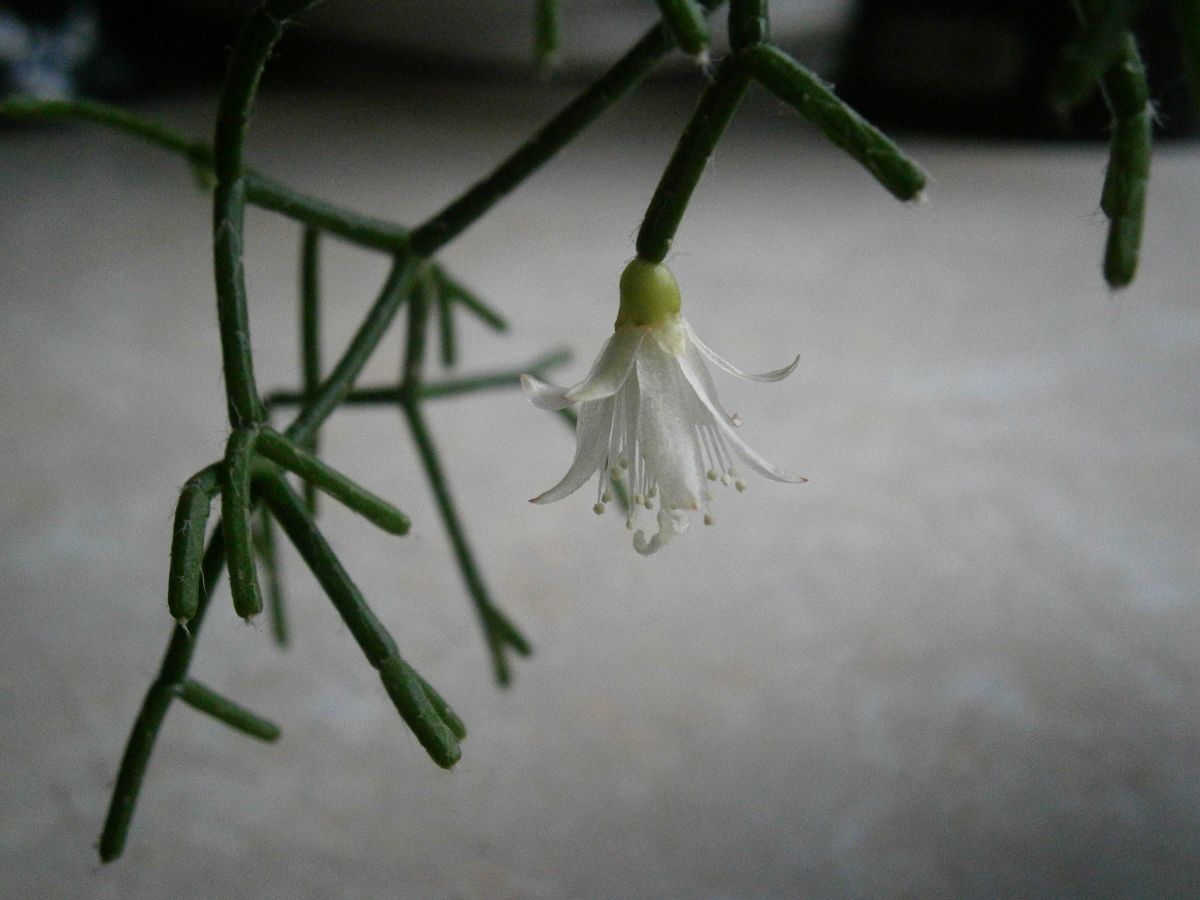
In addition, you should know that it also flowers. The flowers open during the day, but close at night and last only a few days. It has a bell-shaped shape and they are also white, although in some cases you can find them pink. They are not very long, they will be between 8-15 mm long and 10-20 mm in diameter. As for its flowering, it does not take place in summer, but at the end of winter and especially in spring.
Of course, for them to do so, you have to provide them with an adequate temperature, between 4 and 18ºC, if it exceeds it, it can slow down and put less flowers (or not at all). A piece of advice we give you is that as soon as it is in bloom, you should not touch it or move it. because it is so delicate that any blow or movement will cause it to lose these flower buds (they fall off very easily).
After the flowers will come the fruits, in the form of berries and white. or, exceptionally, red. In them you can find the seeds.
Rhipsalis cereuscula treatment
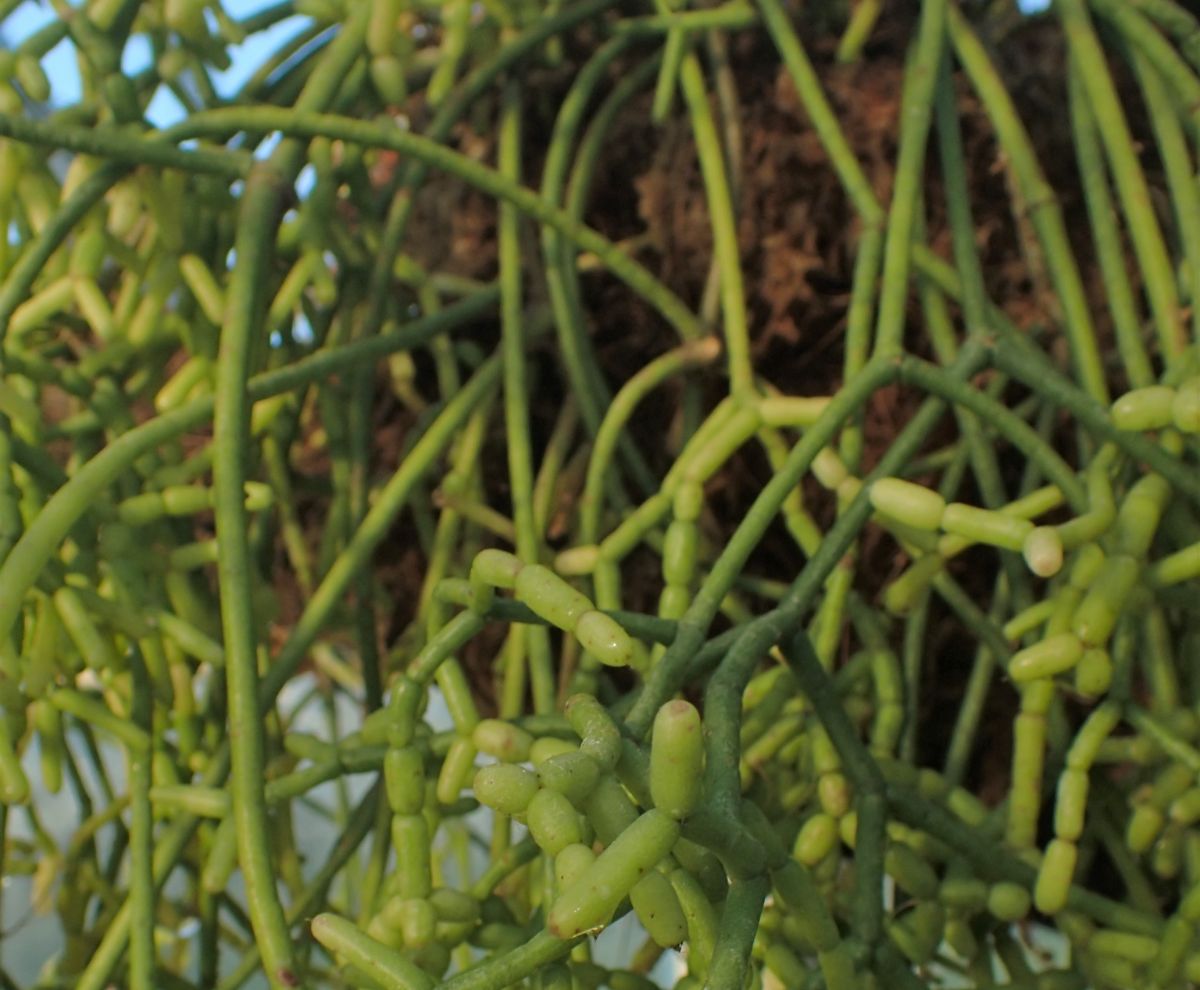
Rhipsalis cereuscula is a plant with which it is not necessary to have experience. In fact, even those less good at gardening will be able to enjoy it. And it is that It is very resistant to almost everything.. But that doesn’t mean you can leave it to your own free will. You should take into account some important precautions.
location and temperature
If you want to have a healthy Rhipsalis cereuscula, We advise you to always place it in a semi-shaded place because it tends to burn if it receives direct sunlight. (unless it’s the first in the morning or the last in the afternoon).
It is a plant that does not need a lot of light (in case you want to keep it indoors with only a few hours of light).
As for the temperature, its ideal is between 10 and 30ºC. Obviously, jellies are not his thing it will therefore have to be protected in winter unless the weather is mild (if there are sporadic frosts and it is well established, it could withstand them). Even so, below 5ºC it will start to suffer.
Substrate
The special soil for Rhipsalis cereuscula is one that has organic matter, drainage and a permeable plant substrate. This combination will help him feed well and meet the tropical needs of the plant.
In case you can’t do that, then go with cactus soil but add more drainage like orchid soil. This, yes, keep in mind that the Rhipsalis cereuscula does not like the ground to stay cold (Faced with winter it will be necessary to protect it with a thermal cover and, in the case of a pot, to protect it).
Irrigation
Compared to other rhipsalis, Rhipsalis cereuscula needs slightly more water than a cactus of another variety. To start, do not wait for the soil to dry before watering.
That implies that, in the summer you need to water 3-4 times a week. And during the rest of the seasons at least 1-2 times a week. Of course, we do not recommend using water with lime because it will damage the cactus. If possible, use rainwater and never pour it on the leaves (always at the base of the plant).
Subscriber
Just as we told you that Rhipsalis cereuscula needs more watering than a “normal” cactus, something similar also happens with fertilizers.
You will need to fertilize it in early spring and monthly until late summer. In fact, at times (early spring to early summer) it will be best to do this every two weeks, then cut back until you no longer fertilize by early fall.
Plagues and diseases
Although Rhipsalis cereuscula is not a plant that succumbs to many pests and diseases, that does not mean that it is free from them. Watch out for snails and slugs (because by requiring more humidity and irrigation they will appear for it).
You should also keep an eye out for aphids and scale insects. To eliminate them, you will need to clean the leaves and stems with a cloth soaked in alcohol and soap.
Multiplication
The propagation of this plant is quite easy, since it is enough to cut parts of the stem for new plants to come out. This, yes, You need to let them dry for at least a week. so they don’t rot when you put them in the ground.
Another way to reproduce it is by using seeds, although this process usually takes longer to see results.
As you see, the Rhipsalis cereuscula is not difficult to maintainOn the contrary, and as it has a curious shape, it can be perfect for a tropical-style garden. Do you dare to have some at home?