Money trees and money plants are believed to bring health, wealth and prosperity to the home.
They are also widely used in business with the belief that they bring repeat customers and good luck to the restaurant or store. It seems that the labels “money trees” and “money plants” are almost interchangeable, but are they?
It is believed that “money factories” bring financial success to a home or business, but there are many of them, for example, a Chinese money factory.
“Money trees” are believed to do the same thing, but are believed to be just one true money tree, namely Pachira Aquatica.
So is there a difference? Let’s take a look at some money trees and money plants and why people like to grow them.
Are the money plant and the money tree the same thing?
When we talk about trees and plants, we know that trees are plants in the sense that they grow in the ground and in pots. So, although all trees are plants (part of the global plant family), not all plants are trees.
There is a difference, albeit small, between money trees and money plants. However, both refer to shrubs that are usually grown in pots and are believed to bring good luck and happiness.
What Are Popular Money Trees?
 There is actually only one true money tree and it can be grown as a dwarf variety or as a regular tree. The dwarf variety will reach around 1′, while the common tree can reach around 5′ tall.
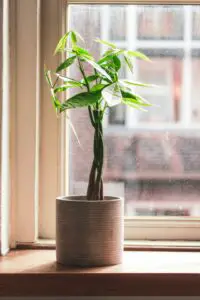
You may have heard of the aquatic pachira. This is a dwarf money tree, the trunks of which are neatly intertwined with each other.
They are often used as additions to home decor and are widely used by Feng Shui practitioners, especially in Asian homes. These plants are believed to bring prosperity and financial success.
To make the braided trunk, several plants are grown together, and as they grow, the seedlings are neatly intertwined.
The Pachira Aquatica is also known as the Lucky Tree, Provision Tree, Wild Kapok Tree, and Malabar Chestnut, among others.
You will notice that the stems have five leaves each. These represent earth, water, fire, wind and metal. Very occasionally you will find a seven leaf money tree. These are said to bring additional wealth and prosperity to the owner.
If you come across a tree with eight leaves, you are very lucky! Indeed, in Asian culture, the number eight is the luckiest number of all. Eight-leaf trees are very rare and if you have one, you are truly blessed.
If you like this article, check out our article on money tree lighting requirements
What are popular silver factories?
Although there is only one recognized money tree, there are several known as money plants.
The jade plant (Crassula ovata)
It is normally the plant that most people associate with the money plant.
You can also find them in many oriental stores, restaurants and takeaways and this is due to the plant’s ability to grow and flourish in artificial light. They can also grow at high temperatures.
Jade plants are often given as gifts, especially wedding gifts or housewarming gifts, because they last a long time. You can easily expect your Jade plant to live to 50 years and beyond!
Read our article to learn more about a jade plant. Why is my jade plant turning brown?
Chinese Money Plant (Pilea Peperomioides)
This plant is called a coin plant because the leaf is as flat as a coin. It originated in China’s Yunnan province and was later discovered in Scandinavia, where it was quickly adopted for use in home decor.
Against the background of white walls, the plant contrasts nicely.
For more information on a pilea plant, read our article on What are the most common problems with a pilea?
Golden Pothos (Epipremnum aureum)
This plant is known in Southeast Asia as the money plant. The theory is that the vibrant colors of gold and green represent banknotes. It does not require much attention and is easy to maintain.
It is also a climber, making it a popular choice in many homes.
This money plant grows quickly and likes to climb trellises, canes, or anything close to it. They also do well as a hanging plant where the leaves look like a silver waterfall.
For more information on golden pothos, we have an article on a Hawaiian Pothos versus Golden Pothos.
Some Lesser-Known Money Plants
Swedish ivy (Plectranthus verticillatus)
This plant is native to Southeast Africa and is also known as Creeping Charlie.
You can grow this plant outdoors as a hanging basket or even as a ground cover. If you are growing the plant indoors in a pot, make sure the plant is not exposed to direct sunlight, which can scorch the leaves.
Lucky bamboo (Dracaena sanderiana)
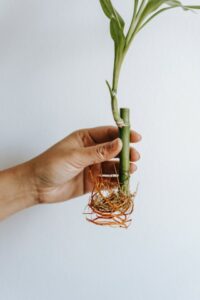 These are easy to find in gift shops and supermarkets. You will find them mainly in oriental supermarkets because they are native to Asia. They are believed to bring good luck and happiness to the house.
They are easy to grow. In fact, Lucky Bamboo grows very well in water. You just need to keep the roots under water to do it right.
It’s a plant that thrives on neglect, so it’s perfect for anyone worried about not having a green thumb or green thumb.
Holy basil (Ocimum tenuiflorum)
Holy basil is of great importance in India, where it is used as one of the most powerful medicinal herbs.
It grows outdoors and often stands in front of an Indian house. It is said to bring health and wealth to the home and also acts as a very effective mosquito deterrent.
This plant can be grown indoors if placed near a west-facing window.
Rue (Ruta graveolens)
You may have heard it called Witchbane, Ruda or even Queen of Grace.
It is a strong-smelling herb native to southern Europe and said to contain medicinal and magical properties that bring luck, protection, wealth and good fortune.
This plant can be grown outdoors on a sunny balcony or indoors near a south-facing window. You need to have well-drained soil to do well.
Clover (Oxalis regnielli)
According to Irish legend, Saint Patrick wanted to demonstrate the teachings of the Holy Trinity, so he picked a shamrock.
Each leaf is representative of the father, son, and holy spirit, and because of this event, the clover is considered lucky.
You can grow clovers indoors. It should be placed near a window where it gets some direct sunlight.
Clover also needs some humidity, so add a humidity feature, which is a saucer full of pebbles under the pot. Keep the soil slightly moist as much as possible.
Hawaiian Ti Plant (Cordyline terminalis)
This plant dates back to early Polynesian times and is said to have magical powers, bringing luck and money.
Be sure to use well-drained soil for this plant, as it does not thrive in humidity. Also, keep temperatures above 50 degrees F, as it won’t grow below that.
Why are they called money trees?
According to legend, the money tree was the answer to a prayer. A poor man prayed for money and then found wealth by growing many trees from a tree he found in his field.
He attributed his newfound wealth to the tree, hence its name.
You may also be interested in: Why Are the Leaves Hanging from My Money Tree?
Why are they called money factories?
Money plants, and the jade plant in particular, are thought to resemble coins. Many of them are actually round and flat.
The five leaves on the stems of the jade plant represent a balanced energy called the five elements of Feng Shui. They are fire, earth, wood, metal and water.
Home harmony and assured happiness are restored when Qi is in balance and can flow uninterrupted.
Money Tree vs Money Plant – What are the similarities?
The similarities between money tree and money plant are more or less the same. Indeed, they are both usually grown indoors and are believed to bring good luck and happiness.
They also don’t like to be grown in a pot with poor drainage and don’t like being overwatered.
You may also be interested in: Money Tree Plant Problems
Money Tree vs Money Plant – What are the differences?
The common money plant, namely the jade plant, needs at least 6 hours of bright light per day. You should keep smaller seedlings out of direct and indirect sunlight until they become established.
Once established, they can be moved to locations with more direct sunlight. However, care must be taken that the light reflected through the panes does not burn them.
Money trees grow best in bright, indirect light. They also prefer moderately high humidity. They don’t like direct sunlight which can cause scorching, although they can grow well in low light areas.
Money trees do not do well if placed near hot air vents and radiators or excessive drafts.
Final Thoughts: Money Tree Vs. Money Factory
 An important point to consider when choosing between a money tree and a money plant is whether you have pets in your home.
Money trees grow quickly, are easy to care for, and can remove toxins from the air. More importantly, they are not toxic to cats or dogs, so they are safe in a home with pets.
Money plants can be very toxic to pets. In fact, the jade plant is very poisonous and can cause irregular heartbeats and upset stomachs in an animal.
It is a very popular plant to grow indoors, but you should always keep your pets away from the plant.
The money tree and money plant are said to bring health, wealth and prosperity, so there’s no reason you shouldn’t have one of these amazing plants in your home.
Whether you think they’ll make you rich or not, they’re both great examples of low-maintenance, still-beautiful houseplants.
Before you go, here are some other related articles that I encourage you to read below to solve more of your gardening problems:
Why are the leaves of my money tree turning yellow?