

If you are fascinated by the world of roses, surely you have already taken a look at some of them and have been amazed. The one that leaves you speechless is the La Minuette rose. But what do you really know about her?
If you want to learn more about this rose cultivar and want to see if you can place it in your garden and enjoy these striking roses, keep reading as we’ll tell you all about it.
How is the La Minuette rose

The first thing you need to know about the La Minuette rose is that we owe it to rose grower Walter Edward Lammerts, also a scientist, geneticist and horticulturist. This American professional managed to cultivate it in 1969 in California and today it has become one of the most appreciated for the roses it produces. Other names you may find it under are Sweetheart, La Minuette or LAMinuette.
In fact, the cultivar is a modern rose from the Floribunda group. In case you don’t know what we mean, These are modern roses whose “origins” are hybrid tea roses (which we will tell you about on another occasion), and polyantha roses (which are crosses of Rosa chinensis and multiflora).
Thus was born the rose La Minuette, an alliance of two roses: Peace and Rumba. The rose of peace is quite large (it actually has between 40 and 45 petals each) and yellow in color with pink edges. For its part, the Rumba rose blooms with flowers that mix red with the color apricot (a soft orange). They are also large, although less than the previous ones (they have more than 40 petals).
Thus, the result is a rose bush up to 60 centimeters in height, growing in the form of a bush. Regarding the leaves, they are shiny and dark green.
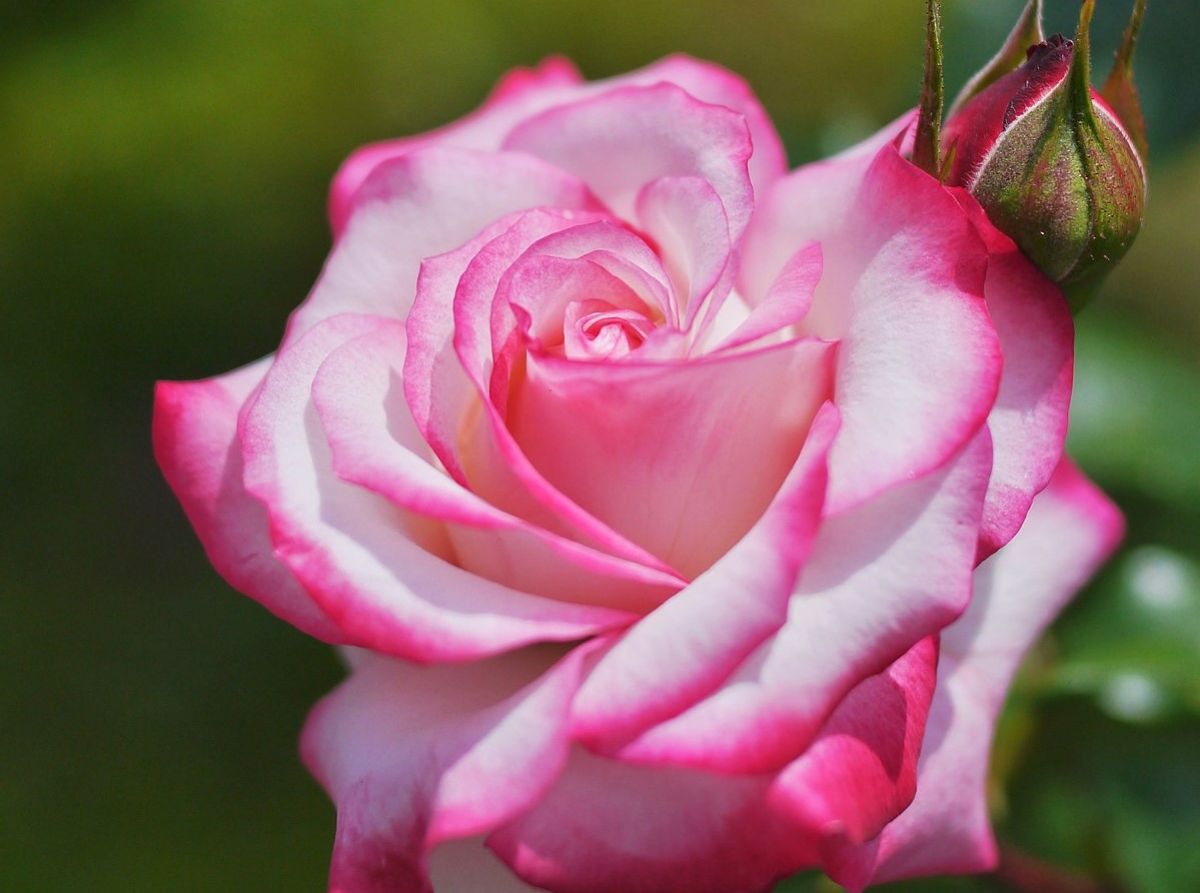
But the most beautiful and characteristic of this rose cultivar is none other than its flowers. By combining the two types of roses above, Lammerts found white and red roses, with the edges of the petals being red. In addition, the rose is smaller than its “parents”, since it consists of 17-25 petals. These bloom solitarily, meaning each stem produces a single rose (that doesn’t mean a stem only produces one rose, but it won’t throw you a bouquet). As for their size, they are usually about 10 centimeters in diameter.
Its flowering season, like many other roses, is spring and summer, but this can influence the timing of pruning so that you extend the rose season longer.
La Minuette rose treatment
After hearing about the La Minuette rose, it is possible that after seeing it in photos, you liked it enough to want to have it in your garden, either planted in the ground or in a pot.
To start, you should know that this rose is easy to care for, although it has some peculiarities that you must take into account to avoid dying on you. Therefore, as we want to help you, you can have a practical guide below so that you can give him all the care he needs.
location and temperature
Like any rose, the La Minuette rose needs to be outside. You can keep it in a pot inside the house, but the truth is that it needs at least 6 hours of direct sunlight to be well nourished. Therefore, it is best to put it outside, on a balcony, terrace or directly in the open air.
In this location, the best spot would be in full sun, although they can tolerate being in shady areas. What difference could there be? Especially in terms of growth and flowering. When in the shade, it grows more slowly and also blooms in less quantity. This is why it is more advisable to place it where the sun gives it the most time to better appreciate its flowers.
As for the temperature, it tolerates high temperatures very well, but low temperatures will cost it dearly, which is why it is recommended to protect them with a wire mesh and a little mulch on the ground to take care of its roots.
Substrate
The soil you should use with the La Minuette rose must be a mixture of a universal substrate, earthworm humus (to keep the humidity during watering) and perlite (so that it drains well). The ideal pH for this type of roses should be close to 7. It will therefore be necessary to check every x times that it has not decreased.
When the rose bush has time and has adapted, nothing happens, but if it is young it can affect the level of flowering or growth.
Irrigation

Roses are plants that need water, but not as much as you might think. Indeed, when it comes to a specimen of a young rose bush, it will need a little more watering to develop. But As an adult, it can tolerate drought or water shortages better (and still thrive for you).
Depending on where you have it, weather, temperature, etc. it will be more or less watered. But in general, you can choose to water 1-2 times a week in the summer and 1-2 times a month in the winter.
Subscriber
During the spring and summer months. As long as it has not been transplanted at this time, a rose bush (or flowering plant) fertilizer should be added to the irrigation water. If the specimen is young, add slightly less than the manufacturer’s recommended dose to avoid wear. If it’s older, you can add the full dose, but space out the number of times you fertilize it a bit or use a slow-absorbing fertilizer.
Size
The La Minuette rose should be pruned at the end of winter or at the beginning of spring. Always when frosts and low temperatures begin to slow down and between sunny days.
We recommend that you always cut the oldest stems, those that are dead or look diseased. You also need to make sure that the stems do not cross each other or allow enough air and sunlight to enter the whole rose bush.
Plagues and diseases
Although this rose bush is hardy and generally unaffected by pests and diseases, the truth is that there are some that you need to keep in mind. For example, in the case of pests, slugs, snails… can be one of those that affect this (eat the leaves and even the flowers).
As far as diseases are concerned, one of the most common is the “blackhead”. It is caused by a fungus, Diplocarpon rosae, which can cause the disease by causing black spots to appear on the leaves. These increase and decrease the health of the rose bush.
the reproduction
Finally, concerning the propagation of the rosebush, this can be done by stem cuttings. In this case, these can be placed in water or planted directly on land to see if they are successful. Of course, not everyone you cut will get it.
Now that you know the La Minuette rose better, do you dare to have it in your garden?