
Cacti and succulents have the advantage of being hardier plants that don’t die easily if cared for properly (or left to their own devices). This is the case with Senecio barbertonicus, also known as the succulent bush senecio. Do you know how it is?
Below you will learn about the main characteristics of this plant, and we will give you the care you need to give it in order for it to succeed and last for many years. Go for it?
How is the Senecio barbertonicus

Senecio barbertonicus is a succulent that you can keep all year round. Native to South Africa, you can find it in its natural habitat in the subtropical forest.
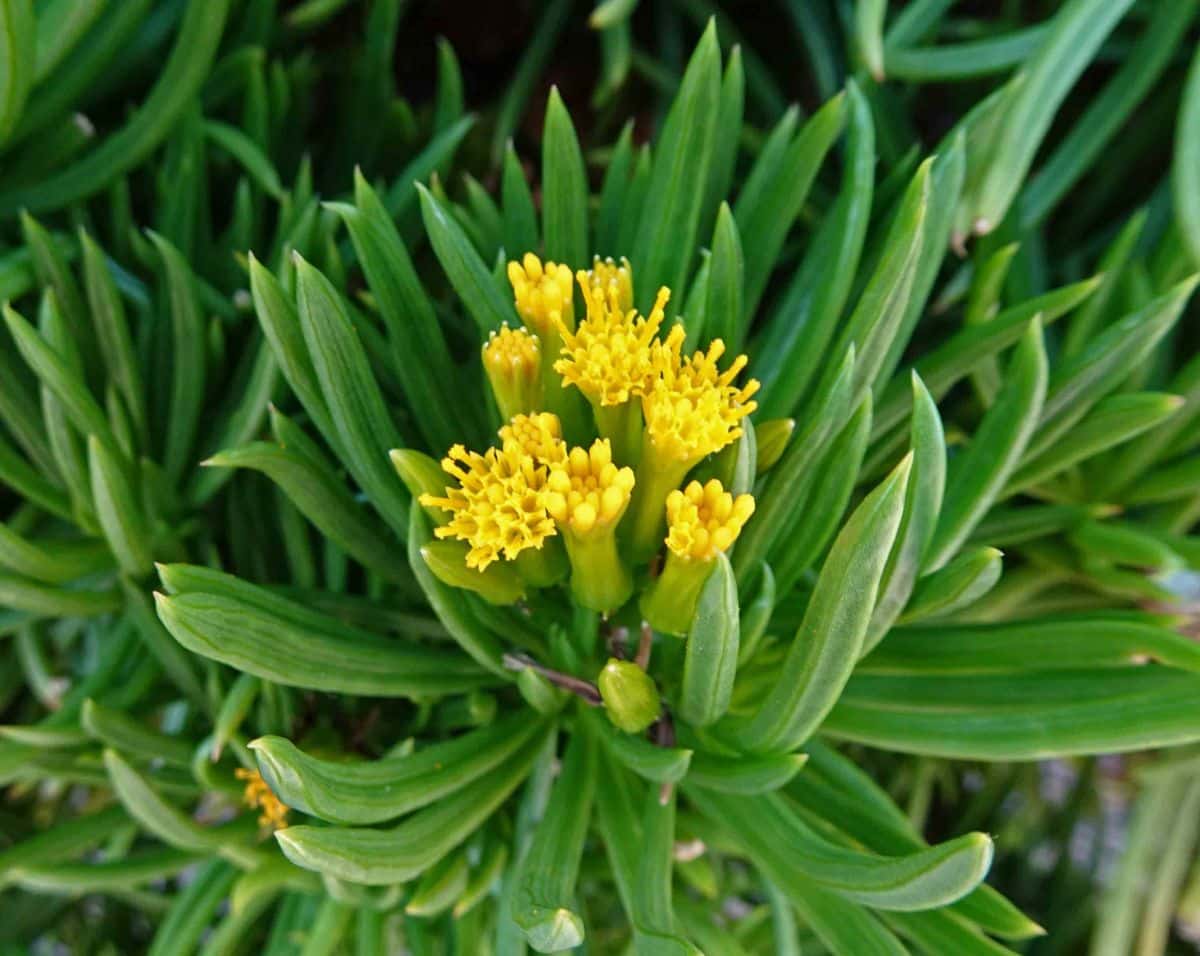
It is characterized by a shrub-like shape (reaching one and a half meters in height) with very thick finger-like leaves. These are usually near the stem and the color depends on how much light it gives it. In fact, it can range from bright green to olive green. These leaves are more or less large, since the minimum they reach is 5 centimeters (the maximum is 10). In addition, they also have a diameter ranging from 5 to 10 mm.
One thing that differs from other succulents is that this plant never goes dormant. Indeed, it is in winter that the plant will flower. The flowers are in clusters and they contrast a lot as they are golden yellow. (Some compare them to daisies). If you ever see any, know that they are very aromatic, and that the scent they exhale is quite pleasant. Then come the fruits, which are generally small (3 to 5 mm) and cylindrical in shape.
Senecio barbertonicus care

After learning a little more about Senecio barbertonicus, do you dare to have it at home? Keep in mind that it is not as showy as other succulentslike the echeverias, but it has its charm and the fact that it flowers in winter makes it appreciated by many.
However, to achieve this, you must first have had special care so that he is in good health for this. Here we leave you the most important.
location and temperature
Like any other succulent, Senecio barbertonicus should be outdoors and in full sun. However, unlike others, it likes to stay in the shade at times of greatest incidence because the rays can burn the stems.
We do not recommend keeping it indoors as it is more likely to suffer from etiolation, i.e. it the plant will grow in a certain way making it very unattractive, in addition to weakening it to the maximum.
As for the temperature, the resistance range is quite high, since it can go from -2ºC to more than 32ºC. This, yes, If you want to provide an ideal temperature, this is between 18 and 26 ºC. A tip given by many professionals is that the ground is completely dry if the temperatures start to drop below 10°C.
And in the event that the temperatures drop beyond these two negative degrees, it is preferable to protect it, either by returning it (always sheltered from drafts or heating), or put a mesh on it so that the cold does not enter it.
Substrate
The Senecio barbertonicus is not particular about the soil to use for its pot. As long as it has good drainage, it adapts to anything.
But if what you want is for it to be very healthy, we recommend a mixture of universal substrate, worm humus and drainage to go ahead.
This earth It is the same that you must use whether you have this senecio in the garden or in a pot. The only difference will be that it will be more constrained and may require slightly more regular watering.
Irrigation
As we told you, the leaves of Senecio barbertonicus are quite thick and this causes water to accumulate in them. It is for this reason that yes, it must be watered, but only and exclusively when the soil is completely dry.
In autumn and winter, irrigation must be very well controlled because low temperatures and high humidity can be enough to rot the plant.
Subscriber

The succulent subscriber is not something obligatory; but it is true that from time to time mineral fertilizer is added to the irrigation water. Now well, It is added to irrigation water only once a year, right at the end of summer (preparing it to flower and move forward).
Size
As for the subscriber, Senecio barbertonicus can also be pruned. In fact, it is something that many usually do when they have adult specimens because in this way they manage to make them look neater and less wild.
In addition, it is a way to obtain cuttings to multiply it.
Plagues and diseases
In general, succulents are not plants that have to deal with many pests and diseases. But that doesn’t mean they don’t.
The most common are aphids and scale insects. If at any time you see them you will have to clean all the leaves of the senecio to remove them and repeat the process again at least one more time to make sure the plague has passed.
As for diseases, the most common are related to excess water, which in turn causes the appearance of pests and rotting of the roots. If this happens to you, and you catch it in time, you can always try to transplant it into a dry substrate to save it.
Multiplication
Finally, you have several methods to propagate your Senecio barbertonicus. We explain which ones:
- with leaves. Pull out one of the main stems (it comes out completely), and let it dry out for 2-3 days before putting it on the ground so that it can flourish. You’ll need to keep the soil moist until it’s rooted, then it’s almost like a mature plant.
- By the stem. For example, cut a stem with leaves, let it dry for 2-3 days and then plant it. This is the most common and also the fastest because you don’t have to start from scratch like you do with leaves.
Do you dare to have a Senecio barbertonicus at home?