He cannabis cultivation It has gained notable importance in recent years, both medicinally and recreationally. As the ban has been lifted in several countries and public acceptance has increased, there has been growing interest in optimizing cultivation techniques to achieve healthier and more productive plants. Among the many variables that influence the development of cannabis plants, the fertilizer use stands out as a fundamental practice to obtain fruitful results.
Fertilizers play a crucial role in the supply of essential nutrients that plants need for optimal growth and development. Rich in macronutrients like nitrogen, phosphorus, and potassium, as well as vital micronutrients like zinc, iron, and magnesium, these compounds act as the fuel that boosts metabolism and the formation of healthy plant structures. Cannabis, being a vigorous and fast-growing plant, requires adequate and balanced nutrition to reach its full potential.
In this article, we will explore in detail the importance of use of fertilizers in the cultivation of cannabis like those you can find in Tecnocultivo and how they can help improve the quality of plants and increase their performance. We will analyze the different types of fertilizers available on the market, from organic to synthetic, and we will evaluate their specific advantages and considerations for growing cannabis. Plus, we’ll also cover fertilizer application best practices, including the most effective rates, timing, and application methods.
How to choose the right type of fertilizer depending on the phase in which the crop is
Promotes root development
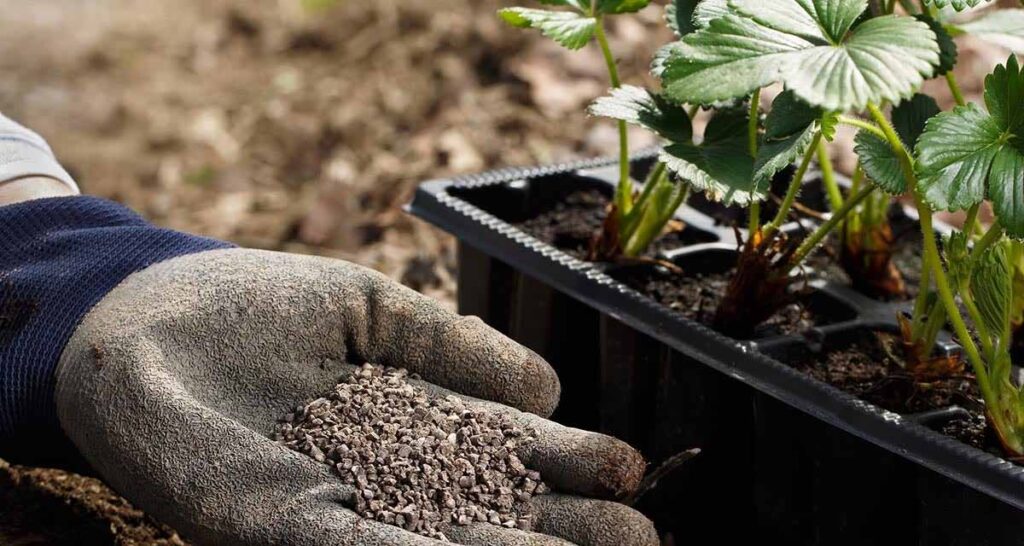
The transplanting phase is distinguished by having a small plant and quite sensitive to atmospheric phenomena and the salinity of fertilizers. As the root system is very small, the fertilizer input must be very low, giving priority to elements such as nitrogen and phosphorus. In general, it is recommended do not apply high conductivity fertilizer which generally tend to be of mineral or inorganic origin. Indeed, the roots are extremely sensitive to changes in the substrate, in particular due to the accumulation of salts. Although it is a critical phase, it is advisable to start with the use of fertilizers if the substrate does not provide or hardly any nutrients, such as coconut fiber, perlite, vermiculite, etc.
Organic fertilizers:
- Humic extract, liquid compost or earthworm humus: they promote the enrichment of the soil, the development of root and block salts.
- Amino acids: They provide energy to the crop and stimulate the increase in root length.
- Seaweed extracts: They provide sugars, polysaccharides and growth regulators that potentiate the root system, promoting an increase in the number of roots.
inorganic fertilizers:
- NPK 13-40-13: high in phosphorus.
- Monoammonium phosphate: phosphorus with ammoniacal nitrogen, easily absorbed by plants.
- Ammonium nitrate: provides 2 different forms of nitrogen (nitric + ammoniacal).
Development of leaves and shoots
At this stage, rapid development of the plant is sought, especially of the aerial part. we are looking for generate new shoots and leaves to build good plant architecture, before the emergence of buds and flowers. It is the basis of all productive crops, generating a strong, vigorous and healthy plant that allows it to accumulate enough sugars from photosynthesis for the formation of buds and flowers.
Organic fertilizers:
We can promote the development of new shoots and leaves, as well as increase their length and thickness, from the application of the following products. Many of them can be applied foliar (with a sprayer), which speeds up the process compared to irrigated application, although it is also recommended when you do not want to increase the ambient humidity excessively.
- Amino acids: a heterogeneous combination of different amino acids increases the photosynthetic rate of the crop and generates more energy for the plant to produce new leaves and shoots.
- Seaweed extracts: They provide natural growth regulators, such as auxins, cytokinins and gibberellins, which are essential for tissue differentiation.
Mineral fertilizers:
- NPK 15-5-5
- Calcium nitrate: provide calcium.
- micronutrients: they avoid deficiencies in microelements, with particular importance for iron.
In cases where you want to promote ripening and do not wish to apply nitrogen, the combination of phosphorus and potassium (PK) is highly recommended. Phosphorus helps make sugars and potassium participates in many enzymatic processes and regulates plant humidity.
Flowering and production phase
For flowering to occur, the plant need to synthesize more carbon compounds (sugars and amino acids). For this reason, it is generally recommended to reduce the nitrogen concentration to prevent the plant from continuing to put out more shoots and leaves and concentrate on the productive organs. Therefore, it is important to increase the concentration of nutrients such as phosphorus, potassium and, among the micronutrients, boron, because promotes the transport of these sugars or photoassimilates.
Organic fertilizers:
Natural seaweed complexes (with natural sugars, vitamins and phytohormones) or amino acids, usually foliar applied
- Humic extracts, especially fulvic acid, due to its ability to be assimilated by the plant.
- Saccharides and polysaccharides
- seaweed extracts
- Amino acids
Inorganic fertilizers:
- NPK 5-10-10 or similar, with higher phosphorus and potassium content
- Micronutrient complexes, with particular importance in boron and molybdenum.