

There are many flowers that exist on this planet. However, some of them stand out more than others, either by their beauty, or by their properties, or by the importance given to them on the symbolic level. The latter is usually closely related to the region in which we live. It is possible that here a certain plant has no meaning, while in another place it may even be the emblem of the country. This is the case of the Scottish thistle, which we are going to talk about in this post.
So do not hesitate to continue reading if you want to find out what is the relationship between this precious plant and this country belonging to the United Kingdom. we will explain what is the thistle and what is its meaning in Scotland, commenting on some legends related to him. I hope this information is of interest to you!
What is thistle?
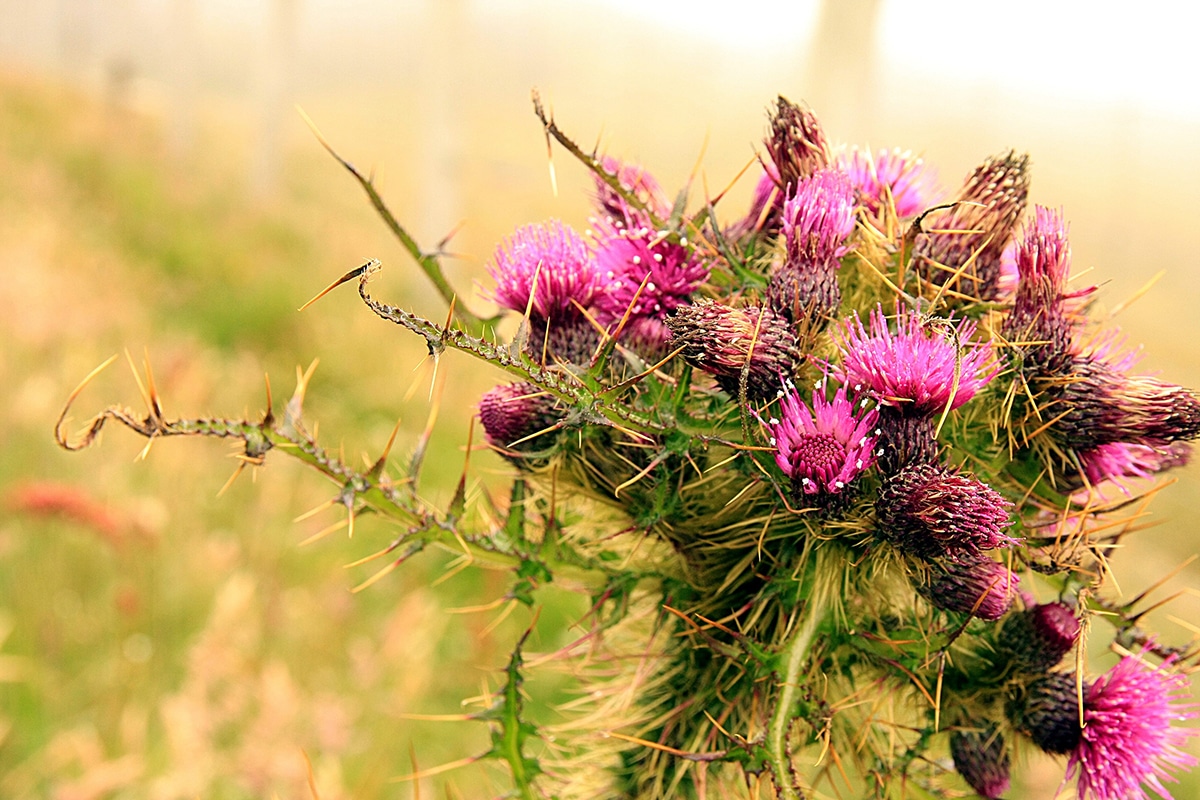
Before explaining the meaning of thistle in Scotland, we will first discuss what exactly this vegetable is. Well, it is a plant belonging to the family Asteraceae whose scientific name is Cynara cardunculus. It is native to North Africa and the Mediterranean region of Europe. It should be noted that the thistle is not only a very beautiful flower, but also edible. It has a fairly fine flavor and is low in calories, making it an ideal vegetable for any diet.
Within a year of planting, the thistle produces a rosette with very large leaves that can reach up to one meter in length. In its second year of life, a ribbed stem emerges from the center of the rosette. This stem can measure up to 150 centimeters. At the top, it ends up branching out. It has very large flower heads that produce artichokes. Besides, It has tubular flowers of purple color and feathery texture. They are very striking and very decorative.
It should be noted that the stems of this vegetable are covered with tiny thorns. They are so small that we hardly see them, but if they come into contact with our skin, they can do a lot of damage to us. Precisely to avoid this stinging pain, various cultures of thornless thistles have been developed, making it easier to harvest artichokes.
What does the thistle mean in Scotland?

The exact origin of the thistle as a symbol of Scotland is unknown. However, historically, its first appearance dates from the mid-15th century, in some sources belonging to the reign of Mary Stuart’s great-grandfather, King James III. At the end of this same century, this flower had already become one of the two most popular emblems of this country, next to the flag of the Cross of Saint Andrew. Its fame was such that it even appeared on the coins of that time.
Some legends related to this flower could explain why it became the emblem of this country, but we will talk about them later. It is probable that the origin of this fact is due to the traditional use which is due to the thistle in Scotland. It was widely used to decorate ships, for example. Arms were also decorated with it which belonged to the prestigious Order of the Thistle.
And what is this command? His original English name is “The oldest and noblest order of the thistle“, which translates to “The oldest and noblest order of the thistle. It is neither more nor less than the second most notable order of chivalry in all of the United Kingdom, just behind the Order of the Garter. Of course, Scotland is the most honorable. Also in this case, the origin of it is unknown, although it is assumed that it was created in the middle of the 15th century by James III. The motto of this order of knights is the same as that of Scotland: “Nemo gives me unpunished lacessit“. This sentence is in Latin and means “No one provokes me with impunity”.
As already mentioned above, the historical origin of the thistle as a symbol of Scotland is not known. However, there is a legend that can shed light on this subject, but of course, we will never know if it is true or not. It takes place in the High Middle Ages, a time when the Scots were fighting against the Vikings. According to what they say, a group of these Nordic warriors were going to ambush a group of the first. However, one of the Vikings accidentally stepped on a thistle. As the thorns of this flower dug into her, she couldn’t help but scream in pain. Obviously, the Scots were alerted and were able to save themselves. Thanks to this miraculous event, the thistle became the guardian of warriors and, therefore, the national flower of Scotland.
They also say that Queen Mary Stuart loved this beautiful plant, especially for decoration. According to what is said, this flower was present in the vast majority of the fabrics and embroideries he made. In fact, this queen owned a gold ring that contained an engraving of a thistle necklace. This royal jewel is to this day in the British Museum. Also note that in the abbey where the queen rests, in Westminster, there is a sculpture which includes the Scottish thistle to keep her memory.
For those of you who don’t know much about Scottish history, Queen Mary Stuart was executed at Fotheringhay Castle in England. Later, Jacques VI, his son, would demolish it. According to legend, the Scottish Queen placed the aforementioned golden ring at this location. Since her tragic death, it is said that thistles bloom around the castle each summer, called “Queen Mary’s Tears”.
It is very curious how something as simple as a flower can have such high iconic and national value. The Scottish thistle is a very beautiful flower and ideal to represent this country.