Some of the links in the post are affiliate links and I receive a commission for purchases made through some of the links in the post.
Don’t like spring? Sure. It’s time to plant. Anyone with even green fingers and thumbs likes to get out in the garden and watch things grow.
From flowers and vegetables to shrubs and trees, spring is the time to plan your summer garden.
When considering adding trees, there are a few things to keep in mind. Perhaps most important is the root system of the tree.
Trees are like icebergs in the ocean. We only see the top, but below is a completely different world, deep and vast, seeking food and water wherever it can find it.
Our farm in Spain has a septic tank system and when I plant something near it I always think of the root system.
Replacing a tree is easy and inexpensive compared to repairing a septic tank!
Two kinds of carrots
Trees have two types of root systems. They are the main root system and the adventitious root system.
Crane roots grow downward, while the adventitious root system spreads and develops.
If you were to look underground, you would see that taproots have a long, straight taproot with much smaller roots growing out the sides.
Opposite is the fibrous or adventitious root system, where most of the root is close to the soil surface.
Here you can see a dense network of roots that stretch outward in a constant search for nutrients.
Plants found in arid conditions generally have deep root systems, unlike plants that grow where water is more available and have shallow root systems.
So if we plan to add a tree, the root system should be one of the most important points to consider.
Non-invasive roots are roots that go deep instead of into your septic tank or house for water.
Top 5 small trees with non-invasive roots
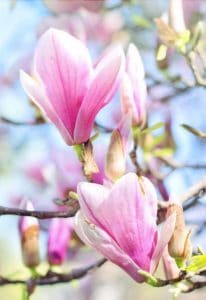
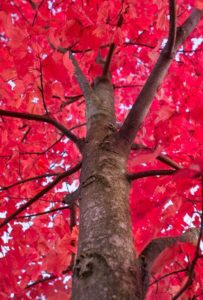 Several trees are classified as non-invasive roots; Japanese maple, Korean dwarf lilac, magnolia, crab apple and kousa dogwood.
Rapid tree growth is described as growing over 36 inches per year, so this is something to keep in mind when choosing your “little” tree.
Small trees with non-invasive roots can be safely placed near patios, walls and houses without fear of roots developing there.
An advantage of small trees with non-invasive roots is that they are generally sturdy and less likely to topple over and crush your garden or fence in strong winds.
Small ornamental trees with non-invasive root systems are the perfect solution for beautiful gardens. Ornamental plants grow to a manageable height and can even be grown in containers.
They fit into smaller spaces and are easy to maintain and keep in the desired shape.
1) Japanese maple
Japanese maple is perfect for small places and also does well in containers.
They come in a variety of leaf colors ranging from orange, green, red, and purple, as well as a variegated variety.
See his article on where to plant a japanese maple
2) Dwarf Korean Lilac
It is an unusual tree that bears lilac to reddish-purple flowers and small dark green leaves.
The tree will bloom profusely in the spring and have a delicate fragrance once the buds begin to open.
3) Magnolia
It is also called star magnolia and has large white flowers that develop before the leaves straighten.
4) Crab apples
These trees are very popular as ornamental trees because they flower very early in the spring.
They also stay quite small, even as mature trees. Look for the red jewel and the royal raindrops.
5) Kousa Dogwood
You may also have heard of this Japanese strawberry tree or Chinese dogwood. It is a slow growing tree, managing only 12 to 24 inches per year.
The beauty of this tree is the amount of flowers that appear in the spring, which is why people often plant it.
First fruit trees with non-invasive roots
There are several fruit trees classified as non-invasive roots.
Not only do they look beautiful and provide you with fruit, but you can be sure the roots won’t get into your water pipes or septic system.
A point to remember is that if you prune the tree down to a manageable size, the roots will accommodate the pruning and won’t spread too far.
- in years
- dwarf pear
- Papaya
- dwarf orange
- dwarf plum
- citrus
- dwarf apple
- dwarf apricot
One of the worst fruit trees to plant when looking for non-invasive roots is the fig tree.
If your heart is in one of these, make sure you can plant it a safe distance from the house, pool, hot tub, and septic tank, as it is a water glutton. and the roots will get stuck in any water source. I can find.
The Best Evergreens With Non-Invasive Roots
 One thing to remember for trees with shallow (non-invasive) fibrous roots is that they need good drainage, so check before planting.
- native frangipani
- Ilwarra Flame Tree
- olive
- paulownia
- english holly
- australian willow
- bronze loquat
- Rhododendron
You might be interested in an article we wrote about What are the fastest growing evergreens for small gardens?
Safe installations for septic tanks
Just because I know how paranoid I was when I wanted to plant something near the septic tank, I’m going to add a pickaxe that won’t damage anything here.
Just because you have a septic tank doesn’t mean you shouldn’t put anything in it.
On the contrary, you should have plants there to prevent erosion. Plants will also absorb moisture from the drainage area.
Grasses and perennials work well in these areas because they have shallow roots. Creeping Charlie works well, as do Jewelweed plants.
You shouldn’t grow plants around the drainage area you plan to eat because you could ingest harmful bacteria, so avoid creating your garden in this area.
Some trees adapted to the septic tank
japanese maple
These trees look great all year round. The trunk of the tree changes color with the seasons and the leaves turn yellow/gold with pink tips.
Cherry
Cherry trees need well-drained soil. Fertile soil will make them happy. One thing they don’t like is being overrun by other trees.
They love sunlight and you should keep them where they get eight hours of sunlight a day.
azalea bushes
When they begin to bloom in the spring, you will notice that they last for several months.
They tolerate shadow and they like to be near other trees, or even under them.
holly
The species includes evergreen, deciduous, and climbing shrubs, all of which can withstand tropical to temperate temperatures.
boxwood
Common boxwood will grow in a round shape. It is persistent and can often be seen on rocky slopes.
Boxwood makes an excellent hedge and border and is also widely used for topiary.
dog wood
This tree is a great decorative addition to any garden. They need a lot of water and if you fulfill this condition they will be happy.
And these are the worst…
- weeping willow
- above all
- Birch
- Elm
- willow
- Maples other than Japanese maple
- Ash
- image
These trees don’t care where they get their water from, they go straight to the point and make aggressive moves to find nutrients.
They are not picky eaters and have been known to destroy many septic tanks!
In general, you should plant your tree as far away from the reservoir as the height of the tree.
Example: If their tree will be 30′ high when mature, they will try to plant it 30′ from the tank.
If you absolutely cannot provide this space, many will want to install a barrier to limit the roots as they grow.
Final Thoughts: Top 5 Small Trees With Non-Invasive Roots
 If you are planning the front garden of a new home, or even if you have moved to a new home and want to add plants to the garden, it is always worth thinking about how tall the new plant will grow.
In years to come, it would be a shame to have to cut down a tree because it has grown so large that it blocks out all light from a room.
Any garden center should be able to tell you how tall a plant will grow.
Root structure is equally important, as the last thing you need is to have to walk down a path after the roots have crossed it.
Most importantly, you don’t need invasive roots near your home, sewers or a septic tank.
Choose your plants with non-invasive roots if there is something nearby they can grow into and damage. Never underestimate the power of roots in finding water and nutrients.
With a little foresight and planning, there’s no reason you can’t have one of the best little trees with non-invasive roots right where you want them.
Written by: Valerie Holyoak
Before you go, here are some more related articles that I encourage you to read below to solve more of your gardening problems:
What are the best trees to plant near you for shade?
The 7 best shrubs to plant at home
Top 5 low growing shrubs for the front of the house