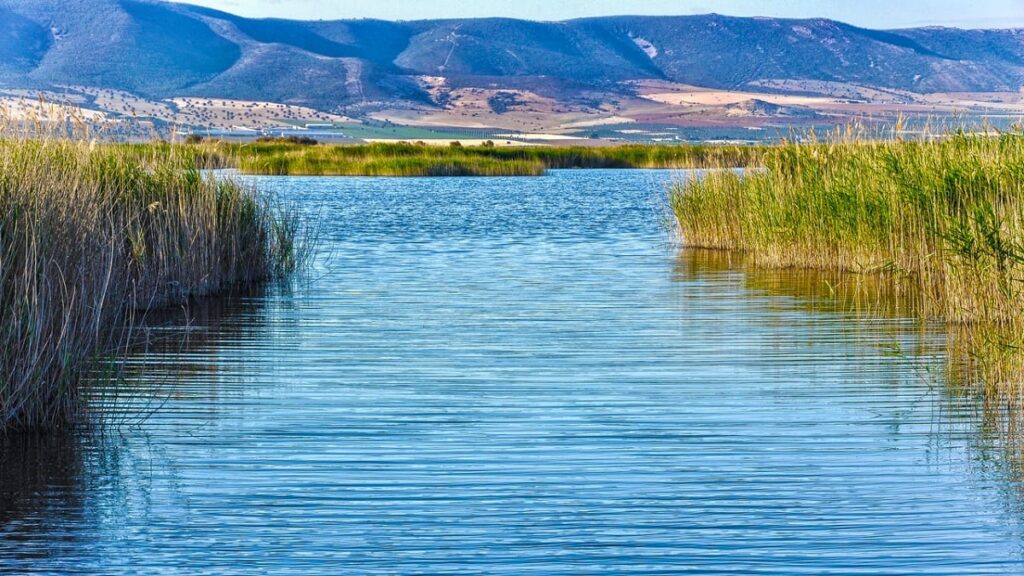

In our natural environments, protective figures are created to preserve landscapes, vegetation and fauna. In this way, we try not to degrade nature and to conserve it as well as possible. One of these quite famous environments is the Tablas de Daimiel. However, many people do not know what are Daimiel tables or their importance.
For this reason we are going to dedicate this article to tell you what the Daimiel Tables are, what are their characteristics, flora, fauna and importance.
What are Daimiel tables

Tablas de Daimiel National Park is a Spanish national park that protects the wetland of the same name, Las Tablas de Daimiel. It is located in Demir and Villarubia de los Ojos, in the province of Real, in the Autonomous Community of Castilla-La Mancha. It is also part of the ZEPA and the La Mancha Húmeda Biosphere Reserve.
Las Tablas de Daimiel is the last representative of the ecosystem known as the fluvial table, formed by the overflow of the Guadiana and Gigüela rivers at the confluence, favored by the absence of irregularities in the terrain. With his announcement, he represents a big step forward in the protection of one of the most precious ecosystems of La Mancha, thus ensuring the survival of the birds that use these spaces as wintering groundsmancada and nesting, creating a complete area for waterfowl.
The Tablas de Daimiel National Park is located in the heart of La Mancha, in the province of Real, between the municipalities of Daimiel and Villarrubia de los Ojos.
Cultural characteristics and values

It is the last representative of the ecosystem known as the fluvial table, formed by the overflow of the Guadiana and Gigueira rivers at their confluence, favored by the absence of irregularities in the terrain. With his announcement, a giant step is taken in the protection of one of the most precious ecosystems of La Mancha, thus ensuring the survival of the birds that use these spaces as wintering, mancada and nesting areas, creating a integral space for aquatic birds.
decades ago, the balance between people and wetlands has been upset. The act of draining the Wetland preceded the overexploitation of water stored in the ground for centuries.
The continuous extraction of water well above the average annual recharge has caused the massive release of aquifers, causing a gradual drop in the water table, the main consequence of which is the cancellation of the natural discharges that have occurred in the Ojos del Guadiana and in the Daimiel tables
Various measures have been taken by the government to restore the natural functions of the ecosystem and its evolution has been rigorously analyzed. Conservation of Las Tablas de Daimiel there should be no conflict between economic interests and ecological interests, but a guarantee of the rational and sustainable development of a renewable resource as important as water.
Until the 20th century, one of the most important human transformations of Las Tablas and its surroundings was the mill. There are up to 14 mills, some dating back to the Middle Ages. The mill was a social center where wheat was grown, fish and game were sold, and people could eat, sleep, and trade goods.
It represents ecosystems associated with humid continental regions. This ecosystem is home to many species, including flora and fauna. Among the flora, aquatic plants are the basic substrate of Las Tablas de Daimiel, and the only trees present are the red willows. The tables home to a wide variety of waterfowl. The most water-adapted are the Great Crested Grebe, Little Grebe and Eared Grebe. Depending on the time of year, one can see herons, egrets, herons and various Iberian ducks.
Flora of the Daimiel Tables
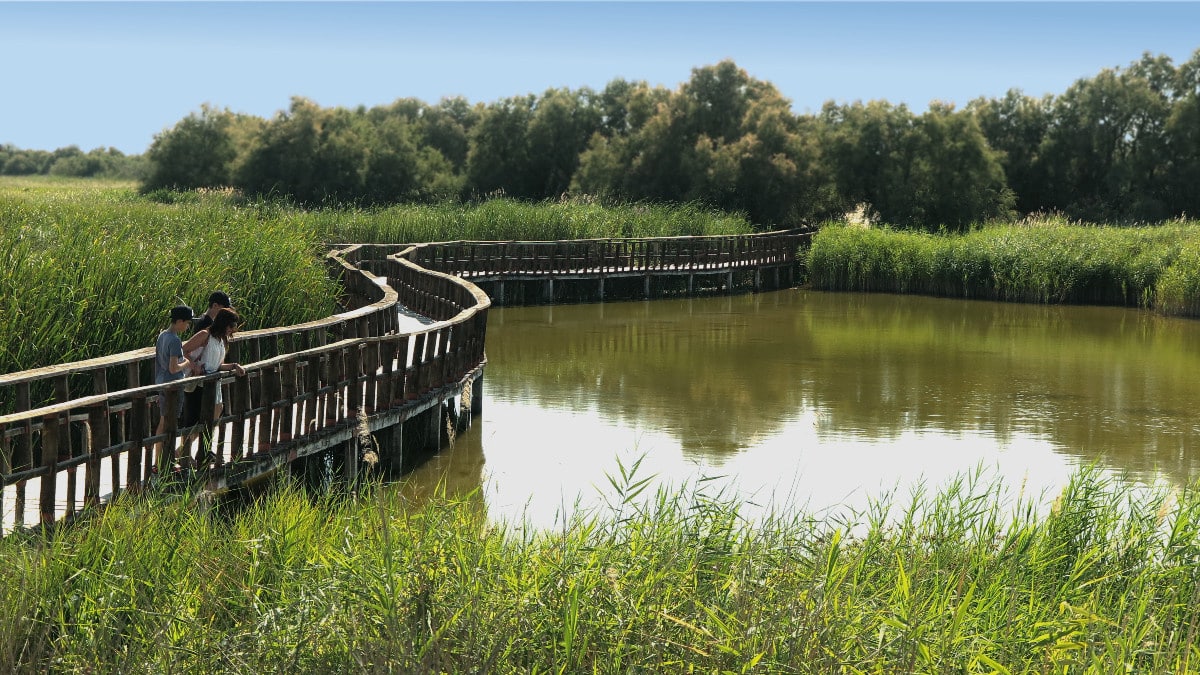
Large extensions of masiega (Cladium mariscum) are distributed harmoniously with the free surface of the water. reed beds (Phragmites australis) they are very adaptable and colonizing, spreading to shallower areas and almost the entire outer periphery of the park. Among them you can see swarms of reeds (Typha domingensis), which populate the depressions.
Until a few years ago, Laguna de La Mancha was periodically inundated with temporary floods hitting the ground. Today they are seriously threatened by the expansion of cultivation, although they are still abundant in national parks. Limonios are mainly species native to salt marshes and salt marshes, which are priority habitat types in the EU and therefore need to be protected.
Some taxa endemic to the province of Ciudad Real are found in the national park and are currently highly threatened by the expansion of cultivation outside the reserve.
One of the most characteristic formations of the national park are the Chara meadows, formed by different species of the genus Chara known as eggs, which they can form an almost continuous tapestry on the submerged bottom. The only tree vegetation is red willows, which form small forests on moist soils that can withstand periods of flooding and some soil salinity.
Aquatic Vegetation Management
In order to maintain the structure and distribution of the vegetal cover of the Tablas de Daimiel in its original state, altered by the modifications that its hydrological network has undergone in recent years, A series of actions have been carried out to control the dynamic vegetationcharacterized by the excessive proliferation of certain plant species which, due to their invasive nature and their resistance to seasonal desiccation, constitute a substitute for other more vulnerable plants.
This relationship is established between species such as reed, red willow and cattail, but not with others. This process is carried out gradually from the marginal areas, where the water temporarily disappears, and until recently the lack of water affected large areas of the park, so that the invasive species reach the interior space, called “table”, dwhere the only existing plants are under water.
The end result of this process is the disappearance of these “tables”, areas of great importance for the permanence and permanence of aquatic birds, and the development of the ovoid meadows that constitute the key to them. Elements of the food chain of an ecosystem.
In addition, the main channels can be blocked, as well as the closure of “paths” and natural channels that allow the flow between the lagoons and prevent the isolation of certain water masses. Therefore, the most important activities are the opening and maintenance of the traditional tables of invasive vegetation, the elimination of plant residues and the control of burning to promote their regenerationonly under specific conditions.
I hope that with this information you can learn more about what Daimiel tables are and their characteristics.