
The scale is inverse and goes from thicker needle 1G 12.7mm at the needle plus 36G thin with only 0.102mm; well, one needle from 11 gauge to 3 mm and is Thicker than a caliber 19G, which measures 1 mm.
What is a straight needle? A needle it is a filament of metal, copper or other hard material, of relatively small size, usually straight, tapering at one end and the other ending in an eye or a handle for inserting a thread. It has been used since prehistoric times for sewing.
What needle does industrial law use? 135X5 (thick rope)-DPX5-134R-797 For the following machines: industrial lines heavy.
What type of needle does the straight machine use? needles Round point There are about 20 different round points, six are the most used. This stitch is used for dense fabrics as it causes less damage, helps establish a stitch right and minimize puckering of the seams.
What is the function of the laboratory dissection needle? The dissecting needles They consist of a straight or curved tip, this is used for the dissection removal and manipulation of tissues on the slide. These are used to work with samples of fabrics or other materials for a certain period of time.
What are the types of needles? There are three types principal of needles medical: needles injection, needles extraction and needles sutures.
What is the thickest needle? – Related issues
How are needles classified?
There are two kinds of needles: “with eye” and “without eye”. The needles “no eye” I know commonly used in surgery. Thread I know inserted inside the needlethe caliber is uniform and does not cause tearing of the fabric on passage. I know also known as “needles atraumatic”.
What is the needle for sewing jeans?
I know recommend using a needle 90/14 when sewing embroideries on heavy fabrics or stabilizers (e.g. denim, foam padding, etc.). Nail needle 75/11 could bend or break and cause injury.
What does the needle 90 14 mean?
75/11 to 90/14: for all types of fabrics of medium thickness. 100/16: thick fabrics. 110/18: perfect for denim (we also find needles special for this task) or upholstery. 120/20: For heavier types of fabrics.
Which needle to use for each fabric?
fabrics very thin or light: wear size 60/8 or 65/9. fabrics Lightweight: carry size 70/10 or 75/11. fabrics average weight: carry size 80/12 or 90/14. fabrics heavy: use size 90/14 or 100/16.
What are the characteristics of the needle?
Definition: The needle allows the passage of the suture thread through the tissues. They are made of stainless steel, curved or straight, and must meet the following requirements: The hole they produce in the fabric must be the minimum allowing the thread to pass. They should not introduce foreign particles into the body.
What is a pointed dissection?
The dissection It can be of two types: • Chopped off: usual action of cutting with scissors • Blunt : closed scissors are inserted between the tissues and opened to separate them. It is necessary to have adequate exposure of the tissues that are going to be affected, avoiding injury to important structures.
Who invented the dissecting needle?
Jacques-Louis Reverdin was born in Geneva-Switzerland in 1842, and studied medicine in Paris from 1862 to 1872.
What are dissecting forceps?
The Dissecting forceps they serve to approach, catch, hold, attract or compress. They are normally used by medical professionals during surgery or during outpatient treatment.
What is the best needle for sewing?

– 60 (EU)/ 8 (USA): This is the finer needle Of the market. auspicious for very fine and delicate materials What the silk.
What is the best needle for hand sewing?

The needle the ideal should be done of steel of quenched and tempered carbon for avoid corrosion. In addition, the trunk must be very well polished and smooth in order to of which does not catch on the fabric, as well as an eye without imperfections which does not cut the thread with which one sews.
What is a triangular needle?
The one whose section has this geometric figure and the cutting edges for the suturing of hard fibrous tissues.
What are cutting needles?
The needles with spikes Chopped off or triangular are indicated to cross resistant fabrics What the skin. There are What take into account What the cutting needles They should not be used on very soft tissues, so as not to cause or produce serious injuries.
How many needle sizes are there?
The first two digits, which are 12, indicate the diameter. The 4 most common types of diameters are #12, #10, #8 and #6, with #12 being the largest diameter which is 0.35mm. #10 is 0.30mm in diameter, #8 is 0.25mm, #6 is 0.20mm.
Which needle to use for each SINGER fabric?
Regular chrome tips (model 2000) are recommended for embroider fabrics woven in all embroidery machines SINGER®. East needle Heavy Duty is more durable and tolerates the high sewing speeds of embroidery machines.
How many needles are used to sew cotton fabric?
From the number 60-70 To sew fine fabrics, cottoncrepe, silk….
What type of fabric does needle number 11 sew?
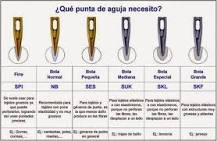
Types of needles:b) Needle for industrial machinery. Where the the number 9, 10 and Eleven are for fabrics thin, the numbers 12 and 14 for fabrics normal, 16 and 18 for denim or heavy knit and numbers 20 and 24 for upholstery and rugs. The needles there are fine point, ball point or half ball point.
How many needles are used to sew Jersey?
Fabric / Thread / Needle Combinations
| stretch fabrics | jersey | Needle round toe 75/11 to 90/14 (gold) |
| wool fabric | ||
| fabrics that I know they tear easily | 65/9 to 90/14 |
15 additional lines
How to identify a ball point needle?

Those of point ball are used for the fabrics of indicate such as Jersey, Ribb, Friza, Tricot, etc. They are also known as needles for Jersey. In general, it is very easy to identify them. The needles with point the balls have all or part of their body with gold plating, while the universal balls are always silver.
How to read hands?
What needle to use for sewing sheets?
Needle Standard: With a normal tip, it is suitable for fabrics such as poplin, satin, natural fabrics (like cotton) and synthetics. It’s ideal To sew shirts, dresses, suits, sheets, coats or do table linen. Apart from size 110, they can be carry all sizes (60, 70, 80, 90 and 100).
What type of needle is used to sew Satin?
80/12 for mid-weight and 90/14 fabrics for medium weight fabrics or when using stabilizer (cotton, wool crepe, flannel, linen, canvas, corduroy, percale, linen, pique, satin…) 100/16 for thick fabrics (coats, baizeton, curtains, denim or jeans, gabardine, canvas, tapestry, veils…)
How many types of hand needles are there?
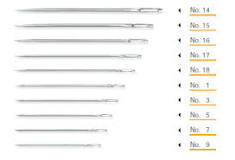
needles from sewing to hand
- needles long seam (Sharps)
- needles seamstress or milliner
- needles tailor’s (Between)
- needles hoods.
- needles for darn (Darners)
- needles for furrier (chief)
- needles ball point
- needles for sew beads (Beading)
What are the types of injection needles?
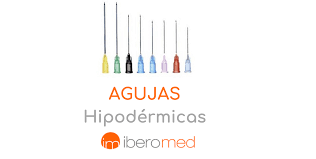
The most common are:
- 1 – GREEN – Intramuscular route: vaccines and other medications, such as analgesics, anti-inflammatories, antibiotics, etc. …
- 2 – YELLOW OR GRAY – Intradermal use, skin tests and local anesthetics. …
- 6 – PINK – Intravenous use, emergency medication or drugs for dilute in serum.
What is the function of suture needles?

The needles are designed to carry the thread of suture through the tissues producing minimal damage. Its selection is given by the type of fabric to be suturethe accessibility of the area to be worked on and the thickness of the wire used.
What are the characteristics of the needle?
Definition: The needle allows the passage of the suture thread through the tissues. They are made of stainless steel, curved or straight, and must meet the following requirements: The hole they produce in the fabric must be the minimum allowing the thread to pass. They should not introduce foreign particles into the body.