
Olive cultivation is one of the star fruit crops in Spain. Our liquid gold, with which we cook absolutely everything, comes from these rustic and appreciated trees. Its subscriber is essential to obtain the highest quality olives with which to make the famous olive oil. As we often say, with a good olive, you can get good or bad oil, but with a bad olive…
Characteristics of the olive grove
The olive tree is a medium tree. It usually does not measure more than 6 to 8 meters and in production formations the size of more than 4 to 6 meters is not generally practiced to facilitate the harvesting of the olive, either by shaking or mechanically by vibration. . It is a hardy and very hardy tree. Somewhat reminiscent of the vine. Both are typical Mediterranean crops whose strains can last over 100 years without ruffling and bearing fruit (except in their later stages of life but they continue to bear fruit).
Very resistant to the formation pruning that has made the cultivation of the olive tree already have a very technical pruning in this sense. It is a vecero crop, and therefore, good fertilization and adequate irrigation (if not grown in dry land) are what greatly mitigate this character.
Article dedicated to bullfighting if you don’t know what it is or if you have forgotten it.
What are the best fertilizers for an olive grove?
Not that there is a better fertilizer. There is no magic formula or perfect elixir. We will have to attend, as in any culture, to the main elements. macronutrients and micronutrients.
Macronutrients (NPK)
The famous trio of essential nutrients that plants need in large quantities for their plant structures and metabolism. Nitrogen, phosphorus and potassium.
Nitrogen: It is the main element of almost all cultures. In the olive grove it was not going to be less. It is the main responsible for the vegetative growth and general development of the plant. It is found in the soil in many chemical forms that are not all assimilable, hence the importance of good nitrogen fertilization.
Match: Responsible for the ripening, flowering and fruit setting processes. This nutrient is essential and the curious thing is that the results of phosphorus fertilization are that they are not immediate. It takes a year or two to show signs of improvement when applied.
Potassium: This element, together with phosphorus, is immediately responsible for good fruiting. Proper potassium fertilization generally results in larger fruits with better appearance and quality. It is essential for the formation and hardening of the olive stone. It also increases the tree’s resistance to fungal diseases and frost.
Micronutrients needed in the olive grove
Iron: Increasing importance is given to this micronutrient in many cultures. In citrus fruits, it is crucial and ferric chlorosis (a condition due to a deficiency in this micronutrient) devastates the yields of many fruit trees.
In the case of olive groves, as they are often found in calcareous soils with a somewhat basic pH and with calcium carbonate, this nutrient, although present, is metabolically immobile and the plant is not able to absorb it. . Therefore, iron chelates are used. Iron deficiency due to iron chlorosis is very easily identifiable in almost all cultures. The inner zone of the leaves becomes yellowish.
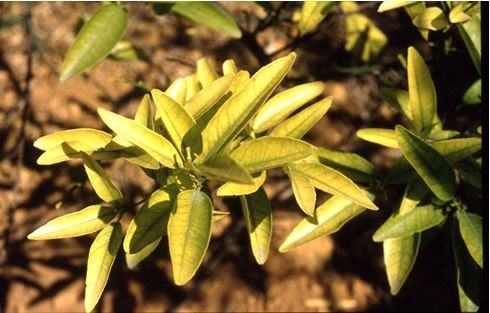 Ferric chlorosis in olive trees
Boron: Another of the important micronutrients whose deficiency causes serious damage to olive cultivation. It is another of those nutrients which, in the presence of calcareous soils, accentuates its lack of assimilability by the olive tree. The consequences are fruits with insufficient fruit set and deformations. It can be confused with K deficiency.
Calcium: After all that has been said about calcareous soils, it is surprising that calcium is the second most important since calcareous soils are full of this mineral. Certainly, but unfortunately in an insoluble way. Calcium carbonate (CaCO3) affects the assimilation of many nutrients and above all it provides no or very little calcium. The life of the olive tree is not easy.
Deficiencies in this element cause chlorosis at the leaf tips (apical zone). Severe deficiencies cause necrosis and leaf drop. Calcium can be added as an additional element in NPK macronutrient formulations in the form of calcium nitrate.
These are the most remarkable and to which more attention should be paid.
When is the best time to fertilize olive groves?
The application of fertilizers in olive groves will mainly depend on the type of crop, differentiating between rainfed crops and irrigated crops (fertirrigation).
In addition, it is necessary to take into account the climate, the characteristics of the soil (soil analysis), the nutritional needs per hectare, the leaf analysis… if we are talking about commercial production.
A subscription plan has a number of variables that are impossible to generalize in a single article, but as general brushstrokes we can say that in:
Rainfed cultivation
As a very, very general recommendation, fall can be considered for phosphorus and potassium applications, as harvest approaches. Remember that these two macronutrients are essential agents for formation, fattening and fruit set. The olive is harvested between October and January-February. We always talk about the northern hemisphere.
Nitrogen should however be added after harvest, at the end of winter, taking advantage of the spring rains. In fact, if complex fertilizers with three macronutrients (NPK) are used, this is the best time, since, in addition, phosphate fertilization requires time for the tree to respond to it, as we have already said.
irrigated cultivation
The difference with rainfed cultivation is that here, as nutrients are supplied by fertigation, the fertilization plan is much more precise and complex to develop, since the demand for nutrients varies depending on the month of the year.
This implies that we must vary the amounts of each nutrient in the irrigation at different times depending on the phenological state. The most common is to bring the nitrogenous part in spring and summer in greater proportion.
However, phosphorus, being less mobile, could be applied more constantly during the campaign.
Potassium can be applied at higher rates from late spring through fall. Above all, you have to be persistent during the fall. Remember that this element is involved in the hardening of the stone and the growth phase of the fruit.