

Image – Wikimedia/ForestWander
Did you think plants only bloom in spring and/or summer? Although you are not without reason, since during these two seasons the conditions in the area are better for the flowers to develop normally, also coinciding with the activity of pollinating insects, which is much greater during these months, the truth is that in autumn we can find flowering plants.
In this article I will mention some fall wildflowers that you can plant in your garden.or grow them in pots to decorate the balcony, or simply to take care of insects that feed on pollen, such as butterflies.
lavender (tooth lavender)

Image – Wikimedia/Marco Antonio Leonel Caetano
I’m not going to lie to you: all lavender flowers almost all year round. But since I’m talking about native species – focusing on those from Spain – I didn’t want to miss the opportunity to mention you at tooth lavender. This species is found in the western Mediterranean, including the eastern and southern coast of the Iberian Peninsula.and of course the Balearic archipelago, my land.
It is a sub-shrub plant – what we would call in everyday language Bush-, persistent, which reaches a height of about half a meter. The leaves are green, hairy on both sides and with toothed edges. And the flowers are purple, very small, just 1.5 centimeters long.
rock mallow (Lavatera acerifolia)

Image – Wikimedia/Balls2601
The rock mallow is an evergreen shrub endemic to the Canary Islands. This means that it is only found in the wild in this archipelago, nowhere else. It can measure up to 3 meters high, and has leaves up to 7 centimeters similar to those of maples. But without a doubt, what strikes the most are its flowers: they measure up to 8 centimeters in diameter, and are mauve in color.
In local nurseries it can be found for sale as an ornamental plant, as it is certainly a very, very pretty species. But if you dare to cultivate it, keep in mind that is sensitive to cold.
olive grove (Dittrichia viscosa)

Image – Wikimedia/Xvazquez
The olive grove is a woody-based herbaceous plant native to the Mediterranean region. It reaches a height of 1.5 meters and produces lanceolate leaves with serrated margins.. Its flowers are yellow and grow in groups in a spiny inflorescence in summer and autumn.
It must also be said that the whole plant smells quite resinous, and that although it is considered a weed, it can actually be used medicinally. And it is that, for example, with the leaves an infusion is prepared to relieve the discomfort of diseases such as arthritis; and when used topically as a poultice, it is used to close wounds.
Tooth grass (Echinochloa crus-galli)

Image – Wikimedia/AnRo0002
Toothgrass is a grass found in Spain mainly on the east coast of the Iberian Peninsula and the Balearic Islands. Its stems reach a maximum length of 120 centimeters.and its flowers are spikes that grow in summer and autumn.
Being a species of the Poaceae family, you must bear in mind that its pollen can cause allergies. So if you already know that you are allergic to this family of plants, it is better to avoid getting too close.
insight (maculosa ladybug)

Image – Flickr/David Illig
The persicaria is an annual herb -that is, it germinates, grows, flowers, produces seeds and eventually dies within a year- that we will find in the Iberian Peninsula, more precisely near rivers and wetlands. It reaches 80 to 100 centimeters in height and develops lanceolate green leaves. Its flowers are pink, and measure about one centimeter.
It is used as food and as a medicinal plant.. The tender leaves can be eaten, for example, in salads, and at a topical level they also help to close wounds or wounds.
Pouliot (Pulegium mint)
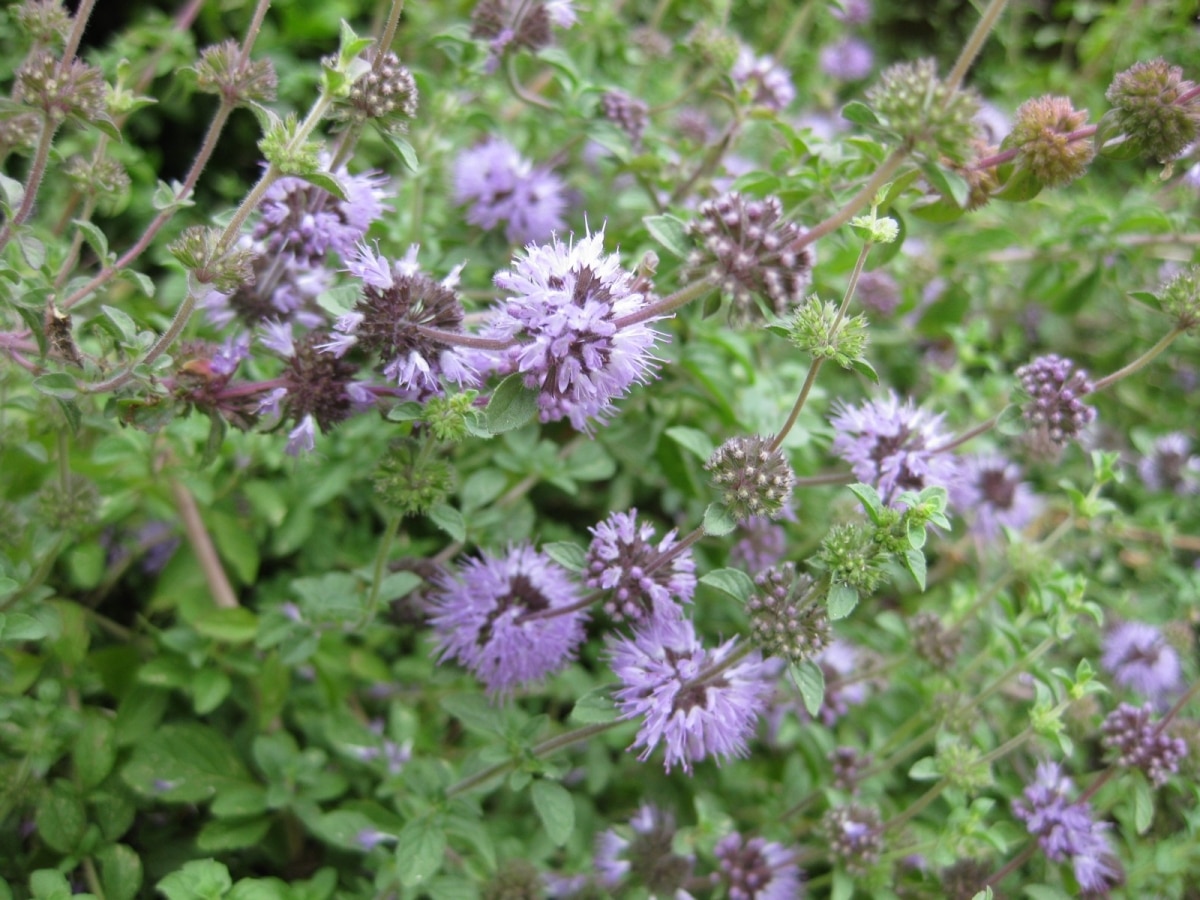
Image – Wikimedia/Raffi Kojian
Pennyroyal is a herbaceous clump present in practically all of the Iberian Peninsula, as well as in the Balearic Islands. Its stems are quadrangular, up to half a meter long, and tend to branch out a lot.. The leaves are lanceolate, green and about 2 centimeters long. It blooms through summer and fall, producing purple flowers that grow atop some stems.
It has several medicinal uses. In fact, it’s often used to make herbal teas to calm cold symptoms, to relax, and even as a carminative.
sea spurge (paralyzed spurge)

Image – Wikimedia/Zeynel Cebeci
Sea spurge is a perennial herbaceous plant native to Macaronesia and the Mediterranean region. It can reach more or less 70 centimeters in height, and develops stems with very small green leaves.. Flowers emerge from the tops of these stems throughout summer and fall.
It grows very fast and tolerates drought very well. It is common to see it in the coastal dunes.
Gorse (Ulex cantabricus)

Image – Flickr/manual mv
Gorse is a very thorny perennial shrub that grows in the Cantabrian Mountains, in the north of the Iberian Peninsula. It reaches a height of 1 meter and produces yellow flowers from summer to fall.and sometimes you can also do it in winter if the snowfall is slow in coming.
It is a plant that, given its characteristics, may not be the best option to grow in a garden loved by children, but it is I think it’s a good idea to plant it in potsor even in a rockery.
Sea purslane (Halimione portulacoides)

Image – Flickr/Gabriele Kothe-Heinrich
Sea purslane is a perennial shrub native to the Atlantic and Mediterranean coast. It also grows in the Balearic Islands. It is part of the coastal flora, both in marshes and in salt marshes. It can reach a meter in height and develops prostrate stems from which grow somewhat fleshy green leaves.. Its flowers are yellow and bloom in summer and until mid-autumn.
Its leaves are suitable for human consumption. In reality, can be eaten in a salad for example, or cooked.
snacks (Colchium montanum)

Image – Wikimedia/Ghislain118
The plant known as take away is a bulbous herb that grows wild in the mountainous regions of the Iberian Peninsula, specifically north of it. When it grows, the flowers appear first, which are lilac, solitary and about 4 centimeters in size.. It then produces green leaves about 20 centimeters long and up to 8 millimeters wide. It flowers from mid-summer to mid-autumn (between July and October in the northern hemisphere).
If you dare to cultivate it, the bulb should be planted in the spring, so that it flourishes as soon as the conditions are met. Place it in a sunny place, and don’t forget to water it from time to time.
So which of these fall wildflowers did you love the most?