
If you purchase an item through links on this page, we may earn a commission. Our editorial content is not influenced by commissions. Read full disclosure.
Pumpkins are vulnerable to a significant number of diseases. In fact, you are more likely to fight fungal or bacterial pathogens than insects or pumpkin pests.
Please keep in mind that although this is a long list of all the things that could go wrong, it doesn’t mean they all will. You could go through several growing seasons without any pumpkin disease rearing its dirty little heads.
Here are some of the most common ones you may encounter and how to deal with them.
1. Powdery mildew

This has been my biggest bane when growing any type of cucurbit. This is particularly insidious because powdery mildew spores can remain in the soil indefinitely.
Destroy plants that show early symptoms and do a garlic dip to kill pathogens. Then, plow the soil well in hot weather to let the sun sterilize the soil, and do not plant cucurbits there for about three years.
2. Mildew

Unlike powdery mildew, which is a fungal disease, downy mildew is a oomycete. That means it’s kind of like a fungus-algae hybrid that responds well to certain fungicides. That said, your best bet is prevention rather than cure.
To avoid soil-borne pumpkin pests, grow your cucurbits upright rather than on the ground. We grow ours on trellises or on sturdy tomato cages. Rotate the crops regularly and destroy any plant matter that looks fuzzy.
3. Anthracnose
Anthracnose is particularly odious when it comes to fungal diseases. It mainly affects twigs and leaves, but its dark, sunken lesions can also appear on fruit.
This plague thrives in cool, wet weather, so zones 3 to 6 tend to be the most affected. You can try to prevent it by rotating crops, sterilizing your tools, and spraying the area with copper fungicide and neem oil.
However, all you can do is slash, shoot, and burn when and if it comes your way.
4. Angular leaf spot
It’s a bacterial disease that wiped out a strawberry crop on my land about nine years ago. There really is no cure, making it one of the most devastating pumpkin pests you could encounter.
If it appears, all you can do is tear up and destroy the affected crop. Then dig, sterilize and dispose of the soil in this area.
5. Pumpkin mosaic virus

If your pumpkins are green and yellow striped and also have yellow mottling on their leaves, you are likely dealing with pumpkin and squash mosaic virus.
It’s incurable, but you can try to prevent it by rotating crops regularly, keeping the surrounding soil clear, and reducing insect activity.
Mosaic viruses are often spread by aphids, so get rid of them with neem oil or diatomaceous earth as soon as possible. If one of your plants is affected, pull it up and burn it.
6. Cucumber mosaic virus
Although it is a slightly different mosaic virus, it manifests in the same way as the one mentioned above. Thus, prevention and treatment are similar. Your best bet is to buy virus-resistant seeds and not save seeds from infected plants.
7. Verticillium wilt
It’s another one of my most hated pumpkin pests because there’s literally nothing you can do to treat or cure it. Your only hope is to purchase green wilt resistant cultivars and religiously rotate your crops.
Resistant plants will be labeled VR.
If and when he appears, tear everything up and burn him.
8. Gummy stem blight
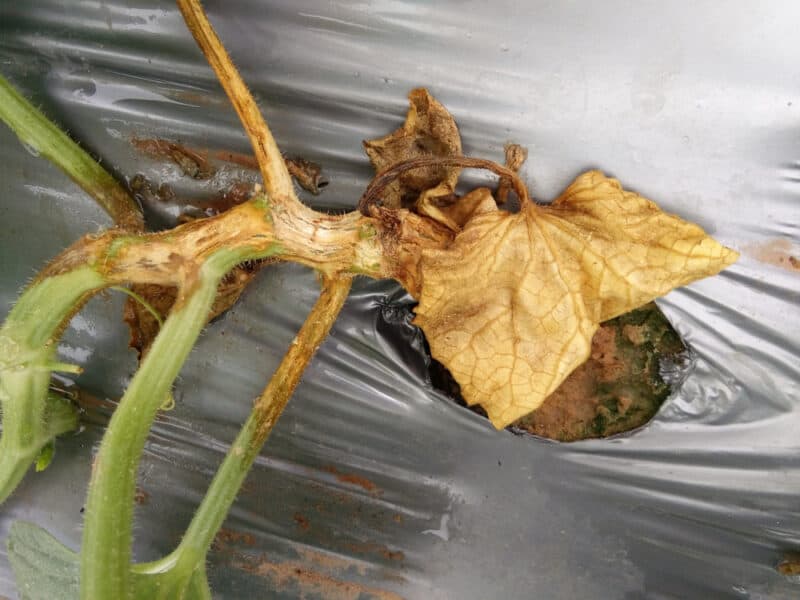
I had never heard of this blight before, but apparently it only affects cucurbits like pumpkins, squash, cucumbers and melons. It is caused by a pathogenic fungus called Didymella bryoniae (anamorph Phoma Cucurbitaceae).
It manifests as dark, circular lesions that spread and rot the entire plant. There is no cure for it, so destroying your crop is the only option if it appears. Then treat the area with a fungicide and do not plant cucurbits there for five to seven years.
9. Sclerotinia rot
Most pumpkin pests are fungal in nature, and this is no exception. Sclerotinia (Sclerotinia sclerotiorum) is also known as “white mold” or “cotton mold” because it appears as white, puffy growths on plants.
It thrives in cool, wet weather, so try to plant your crops once the season really warms up. KEEP SOIL FREE OF LITTER AND PROVIDE Plenty of ROOM FOR YOUR PLANTS: More air circulation results in healthier plants.
This fungus responds well to copper fungicide treatment, but be sure to rotate crops and destroy affected plants as needed.
This blight thrives in low pH soil and can affect nightshades and other fruit bearing plants, as well as pumpkins, melons and cukes. Like Fusarium wilt, it is most often manifested by damping off or “stunting”.
Since there is no cure for it, all you can do is till and sterilize the soil as best you can, keep all garden tools sterilized and clean, and rotate the crops every year.
11. Phytophthora blight
As far as pumpkin diseases go, this one is especially odious. It can make your plants look waterlogged and wilted, and will form yeast-like white blooms on vines and fruit. It thrives in hot, humid weather and can “melt” fruit straight from your vines.
There’s not much you can do to treat it once it appears, other than dig up and burn your plants. That said, you can try to prevent it from installing.
Grow your pumpkins in raised beds instead of in the ground and elevate them further with trellises. Rotate crops annually and treat the area with a copper fungicide if needed.
12. Septoria leaf spot

It is one of the few pumpkin diseases that affects both fruit and leaves. It first appears as yellow-white “buds” on pumpkin leaves before spreading to fruit.
The good news is that it responds well to broad-spectrum fungicides. Also, if you check your plants daily for any problems, you can cut and burn affected leaves before they spread.
13. Southern Burn
Southern rot is caused by a pathogen called Athelia rolfsii. He likes hot, humid weather and moves easily from area to area on his shoes or clothes. It can also be transferred via contaminated garden tools.
It manifests as round growths on the lower erstems, which burst and cause lesions that eventually lead to the death of the plant.
There is no real treatment for this other than destroying the affected plants. However, you can take preventive measures.
Since it thrives in acidic soil, you can try raising the pH level to make said soil inhospitable. Additionally, some studies have shown that adding rye green manure and aged chicken guano to the soil reduces its spread.
Your best bet, however, is to solarize the soil at 122°F/50°C within the first two inches to kill this pathogen. Rotate crops regularly, change and sterilize shoes before entering your pumpkin patch, and sterilize gardening tools with bleach solutions.
How to avoid diseases
There are tens of thousands of problems that have the potential to plague humans, but it’s unlikely that we’ll face them all in a single lifetime, is it?
Your best bet to avoid the problems mentioned above is to take preventative measures. Make sure your soil is in excellent health, and buy seeds (or seedlings) that are resistant to various pathogens.
Surround your plot with a sturdy fence, plant smartly, then be vigilant as your plants grow so you can destroy any that show early signs of disease.
With a little luck and diligent care, you’ll save all kinds of soups, pies, and seeds once fall arrives.
Was this article helpful?
Yes No ×
We appreciate your helpful feedback!
Your response will be used to improve our content. The more feedback you give us, the better our pages will be.
Facebook pinterest