
Like many plant enthusiasts, I grew a tree aloe plant for a long time, best known for its medicinal properties, and I had no idea it could flower.
This is not surprising, since this plant prefers to flourish in its natural habitat, where the climate is very different from ours: the hot and dry climate of Africa, not ours.
That’s why aloe plants don’t flower for us in most cases, but if you create the right conditions for the plant, it can easily thrive in a home environment. This I learned through personal experience.
Below I will describe how an aloe plant blooms, then you will find out what conditions need to be created in your home for the plant to flourish. Everything turns out to be relatively simple.
How and when does the Aloe vera plant flower?
Don’t worry if you’ve never seen flowers on your aloe plant before. Only mature plants, at least four years old, will flower.
Usually flowering takes place between spring and autumn, but it depends on the species and variety. Unlike plants like agave, aloe vera does not die after flowering.
Instead, flowers form at the top of the stem, which may be branched, single, or clustered.
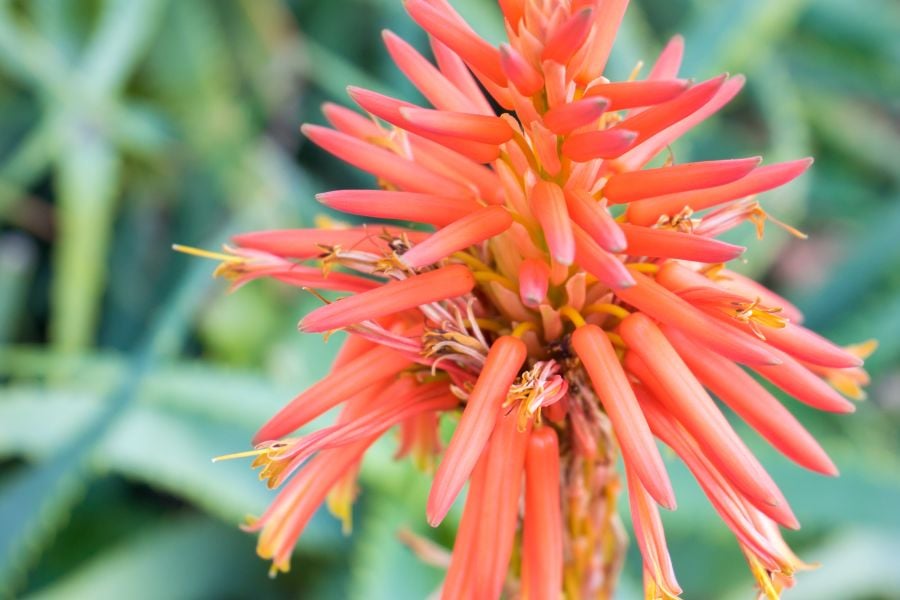
The cluster-like inflorescences of aloe vera, with colors ranging from red to shades of orange and yellow, are similar to those of Kniphofia, a genus of plants in the Liliaceae family.
My aloe plant started flowering after a 40cm long flower stalk emerged from the central leaf rosette.
It had one stem, but there could be several. On this stem were many small, narrow, elongated, bell-shaped flowers in a neat cluster.
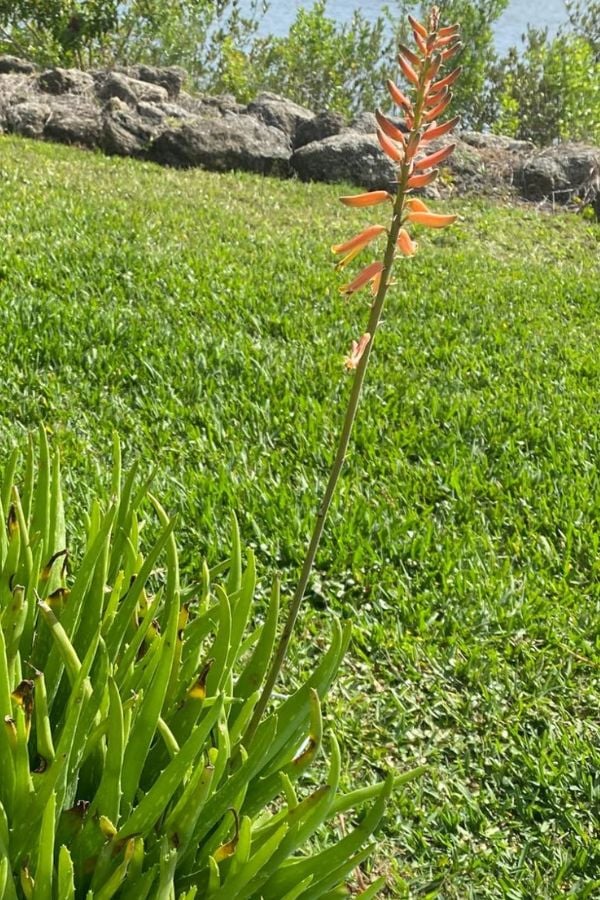
The flowers open gradually from bottom to top. The flowers of my plant were orange, but there were also white, yellow and red flowers in nature.
It was only after that that I studied various books on aloe and learned that the color of the flower largely depends on the species of the plant.
The most common types of flowering aloe plants grown in homes are:
- Aloe arborescens (Torch Aloe)
- Aloe striata (coral aloe)
- Aloe brevifolia (short-leaved aloe)
- Aloe cameronii (Cameron’s Aloe Ruwari)
- Aloe ferox (Cape Aloe)
- Aloe aristata (Morche or Cantaloupe plant)
- Aloe maculata (aloe soap)
Frequency and period of flowering.
With the right growing conditions, aloe plants can usually flower in the third or fourth year after planting.
You can bloom twice a year, in spring and autumn. Aloe flowers can last three to six months.
How to care for aloe so that it blooms
It was very simple: I went on vacation with my family for a summer. Our grandmother took care of my plants, but she forgot the aloe on a small porch and didn’t water them.
When we came back from vacation I was a little upset, but after a while my aloe sent up a stalk and it bloomed. For me, it was a miracle! I didn’t even know it could flower.
Then I realized that in my case the plant was thriving due to drought, which was close to African conditions.
In order to bloom again, I had to perform specific steps each year to bloom:
- Starting in March, I feed the plant twice a month with liquid mineral fertilizer for succulents.
- In the summer, I move the aloe to an open terrace. I leave him there for an hour at first, then gradually increase the time he is outside. During the hot afternoon hours, I provide diffused natural light.
- I water the plant twice a week with settled water at room temperature.
- In September, when the temperature outside drops below 15°C at night, I bring the plant inside and place it on a well-lit windowsill.
- I organized the winter care in December as follows: I placed the aloe in a room with an air temperature of 50-54°F (10-12°C) and low humidity. Then, using fluorescent lights, I adjust daylight hours to 12-15 hours a day. During this time, I water the plant once a week with a small amount of water and stop feeding it.
- At the end of February, I take the plant out of its artificially created rest period and move it to a warm room with a temperature of 22-25°C. Then I water back to normal (twice a week) and feed the plant.
Under the influence of high temperatures, my aloe plant begins to wake up and sprout a stalk. Extra care is standard.
Incorrect actions that prevent flowering.
Poor aloe plant care is often the reason for lack of flower buds. When caring for plants, you should avoid the following actions:
- Repot the plant regularly. Aloe is a low maintenance plant that can grow in the same pot for up to 5 years without transplanting. Exceptions can be cases where the pot becomes too narrow. If a transplant is needed, be aware of the possibility of aloe vera transplant shock.
- Do not let the plant rest. Like any succulent plant, aloe needs winter rest. During this time, reduce the amount of fertilizer and lower the air temperature in the room.
- Air too humid. This kind of care can lead to the absence of inflorescences and rotting of the leaves. Learn prevent aloe leaves from turning brown and mushy.
- Keeping the room too warm.
- Moving the pot too often to a new location.
Sharing is caring!