
If you purchase an item through links on this page, we may earn a commission. Our editorial content is not influenced by commissions. Read full disclosure.
Radishes are a gardening favorite for good reason. Who doesn’t love that they are so easy to grow and provide a quick and delicious harvest? But while they’re generally trouble-free, it’s not uncommon for pests and disease to trouble your radishes.
Sometimes radish problems may not be serious, resulting in nothing more than a little cosmetic damage. Other times it can completely destroy all your plants.
While radish insect and herbivore pests are annoying, radish diseases can be downright devastating. Here are some of the most common radish diseases you will encounter:
1. Damping off

Of the radish diseases on this list, this may be one of the first you will encounter. This is because it attacks young plants.
Damping off can be caused by a number of soil-borne fungal pathogens. These are: Pythium sp., Rhizoctonia solani, Aphanomyces cochlioidesAnd Phoma beta.
Essentially what’s happening is that the fungus destroys the cell walls of the stems, so they can’t suck up nutrients from the top of the plant. When infected, stems wilt and aerial parts drop and die.
You can avoid damping off by waiting for the last frost date in your area to plant seeds. Damping off usually occurs when the soil is too wet and cold. You can avoid it if you wait for it to be warm and dry.
Additionally, you can pour a garlic soak into the soil as an antifungal measure. Do this a week or two before planting anything, as this will give the garlic water a chance to disperse. We talk more about using a garlic soil soak for disease control in our guide.
2. Powdery mildew

Powdery mildew thrives in periods of hot, humid weather. Downy mildew thrives and turns leaves and stems into useless sludge. Additionally, the spores can stay in the soil for years, harming subsequent crops.
In other words, this is bad news when it comes to radish diseases. Moreover, it is extraordinarily common! What a moron.
Check your plants daily for mold and be sure to cut and burn any that show signs of disease. Only try to water your garden at ground level and allow the area to dry out a bit between waterings.
If the mold spreads too much, you’ll have to dig up and burn everything in it. Then treat the area with a fungicide and don’t plant the same type of crop there for at least two years.
Learn all about this common problem and other ways to fix it in our guide.
3. Mildew
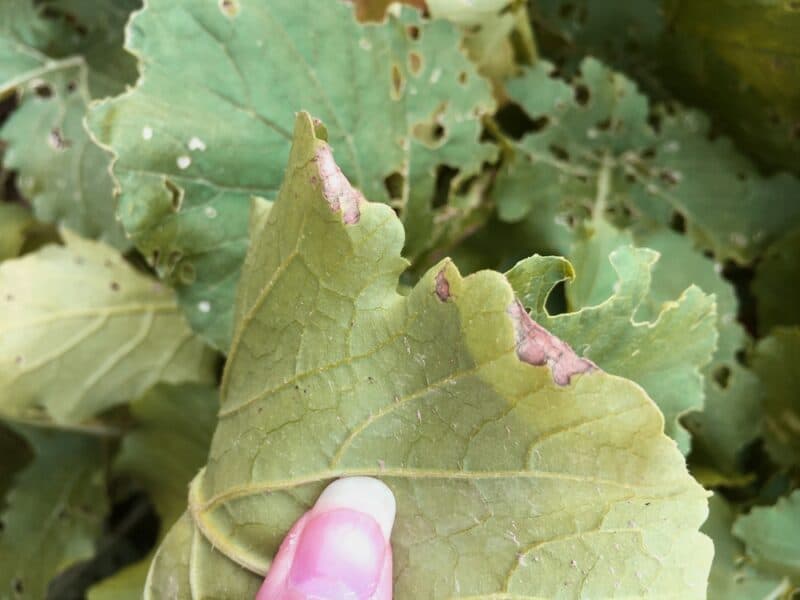
Downy mildew is a common disease that affects many species, including crucifers like radishes and cucurbits like melons.
Since this mold lingers on the soil surface, you can prevent its spread by allowing the sun to kill it. Work your garden and let the spring or summer heat kill the spores before planting anything in that area. Keep the soil surface free of leaf litter and dead plant matter, and thin out dense foliage to allow for better air circulation.
4. Fusarium wilt
Fusarium oxysporum f. conglutinants And F.Raphani is a fungal pathogen that thrives in warm, moist soil and will cause your plants to fall and die. There is no cure or treatment for it, so your best bet is prevention.
Improve soil quality by ensuring good drainage and good health. If you see signs of Fusarium wilt in your plants, such as yellowed or browned leaves and droopy branches, tear up that plant and burn it.
Sterilize all your gardening tools between uses and don’t overwater the soil. If you discover that you are in fact struggling with this type of wilt, do not replant the same crop in that area for at least ten years.
Instead, dig up about a foot, pull out the soil, and sterilize it with boiling water and sunlight or safely dispose of it.
This disease infects many plant species. Learn more in our guide.
5. Rust

Rust is a fungus (Albugo candida) which thrives in warm, humid conditions and likes to hide in and around soil detritus. It does not look like some of the other rusts with dark orange spores. It causes white, raised spores, which is why it is often called white rust.
You can avoid it by removing all dead leaves and fallen plant matter from the surface of the soil and watering only at ground level. Do not water your garden during periods that are too wet and destroy any plants that show early symptoms of rust.
If this disease attacks, treat your plants with a copper fungicide. Copper fungicide is a smart thing to have for treating several radish diseases.
6. Scabies
Unlike some of the radish fungal pests on this list, scab is a bacterial infection that doesn’t kill the plant: it just makes the roots look really ugly. It might not matter to you if you’re just growing radishes to eat, but if you plan to sell them, they’ll be too unsightly to be marketable.
The best way to control scab is to avoid it through regular crop rotation. In fact, planting legumes like soybeans in an area that has been affected by root scab has been shown to reduce the strength of the pathogen!
7. Black rot

It is a bacterial disease (Xanthomonas campestris pv. campestri) which feeds almost exclusively on members of the Brassicaceae family. This includes cabbage, kale, broccoli, mustard and, of course, radishes.
The disease first manifests as yellow V-shaped lesions, which quickly turn brown and begin to ooze a sticky, brown-black substance.
Like other fungal or bacterial pests of radishes, there is no cure for black rot. You can try to avoid this by not overcrowding your plants, especially if you live in a hot, humid climate.
Also, uproot and burn any plants that show warning signs. If black rot is decimating your crop, sterilize the soil after pulling everything out and don’t replant crucifers for several years.
8. Clubroot

Clubroot (Plasmodiophora brassicae) can affect any brassica you’re trying to grow, but it’s particularly attracted to radishes, kohlrabi, and turnips. It makes the roots gnarled and lumpy, prevents them from moving nutrients to the aerial parts and yellows the leaves.
Clubroot can be avoided by raising the pH level of the soil if it is too low. Clubroot thrives in acidic soil, so making it a bit more alkaline will often keep it under control. Try to raise your floor above 7.2. A lime-based compound is usually the best way to raise soil pH.
If you’re not sure what type of product to use, something like this Organic Dolomite Lime from CZ Organics works great.
Additionally, try to find cultivars that are resistant to radish diseases like clubroot, as this can also help keep your sanity in good working order.
The Department of Plant Pathology at the Ohio Center for Agricultural Research and Development has identified ‘Ookura’, ‘Ronde Witte’, ‘Round Scarlet Giant’, ‘Saxerre’, ‘Radar’ and ‘Robino’ as reliably resistant to the hernia.
9. Black Root

Black root is different from black rot. This fungal pathogen, Aphanomyces raphani, affects all cruciferous plants. It’s such a damaging and prevalent disease in some areas that commercial growers have had to pull up their plants and plow their fields to grow something else.
This disease causes a brown or black discoloration at the cracks and inside the roots. The affected area will stop growing, so you will see sunken spots or even a belt of the entire root.
‘White Icicle’ is particularly susceptible, and all white radishes tend to be more prone to this problem than other types. ‘White Spike’, ‘Red Prince’, ‘Fuego’ and Belle Glade’ are all resistant.
Rotate crops so that you only have one plant in the same location every four years. Crop rotation is a great way to avoid most radish diseases.
Was this article helpful?
Yes No ×
We appreciate your helpful feedback!
Your response will be used to improve our content. The more feedback you give us, the better our pages will be.
Facebook pinterest