
He White color It arouses the passions of many gardening enthusiasts, since they see it as a symbol of purity and an ideal attraction for their garden. This color is predominant in many flowering shrubs. In gardening, white flowers are highly valued for their elegance and simplicity, making them a popular choice for many plant lovers. white is a clean and versatile color that fits well in any environmentand can also bring a sense of peace and tranquility to a garden.
Moreover, the bushes with white flowers They can be used as the perfect backdrop to showcase other plants and colors in the garden. Throughout this article, we’ll explore some of the most popular types of white flowering shrubs and how they can be used to create a beautiful and welcoming outdoor space.
Top white flowering shrubs for your garden
1. Hydrangea (Hydrangea spp.)
The hydrangea is a well-known shrub with white (and other colors) flowers that bloom in early summer. If we are looking for the white color, there are very interesting cultivars, the 4 main ones being the following:
- hydrangea arborescens (smooth hydrangeas)
- Hydrangea macrophylla (large-leaved hydrangeas)
- Hydrangea paniculate (panicular hydrangeas)
- hydrangea quercifolia (oakleaf hydrangeas)
In addition, there is a cultivar highly sought after by professionals which is the STRONG ANNABELLE / INCREDIBALL hydrangea. This shrub produces large clusters of white flowers that last almost into fall.
One of the most important aspects to control the flowering of our plant is the light management And avoid over-watering. As you already know, this plant produces a flowering color depending on the pH of the substrate, which is why you can find specialized substrates for this type of shrub, usually very acidic and made up of blond peat.
The ideal location for most hydrangeas will give them Sun in the morning and shade in the heat of the afternoon. Sowing is preferably done in spring and autumn.
Climatology: average temperature between 16 ºC and 23 ºC, semi-shaded areas, without sun but with a good disposition to light.The type of soil: floors fertile, deep and acidic, this last point being very importantRisks: Maintain constant humidity in the substrate. Frequency of watering in summer, daily or every other day. In winter, every 5 or 7 days.
How to Change the Color of Hydrangeas
- pH 5-5.5 (very acidic soil): blue hydrangeas.
- pH 5.5-6.5: acid soil: red purple, mauve or magenta hydrangeas.
- pH 6.5-7 (slightly acidic soil): pink hydrangeas.
read more: plants you can grow in shady areas.
2. Common lilac (Syringa vulgaris)
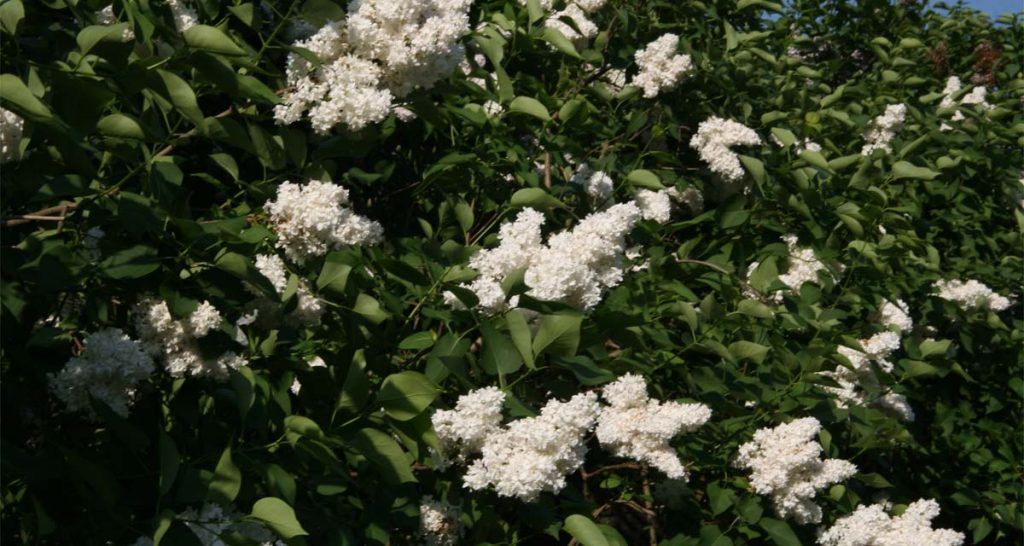
If we are looking for a sweet smell in the garden, hard to beat the scent of the white flowering shrub called common lilac (Syringa vulgaris), which can be found in a lavender or purple version and in a white version. If you’re also looking for an option to gain privacy in your home, the common lilac is perfect when backed by fences, generating such high leaf density that it’s impossible to gossip about neighbors (and for them to gossip). on you). Unlike the Viburnum species, the common lilac blooms in late springbut it’s worth waiting a little longer for the larger clusters of flowers it produces.
In the common lilac we find hundreds of cultivated varieties, where the ‘Alba’ cultivar is one of the most appreciated for its white flowering.
More than most shrubs, lilacs need a well-drained location because they can refuse to bloom if they get too wet. Don’t bother planting them in a swampy spot or be prepared to amend the soil a lot to improve drainage.
- Climatology: good sun exposure (at least 6 hours a day). Spring flowering is stimulated by cold winters (tolerant to -15 ºC).
- The type of soil: sandy and clayey soils, generally dry, and of limestone type (alkaline pH).
- Risks: tolerates drought, but it is usually watered in spring and summer 2-3 times a week by drip irrigation.
3. Japanese Andromeda (pieris japonica)
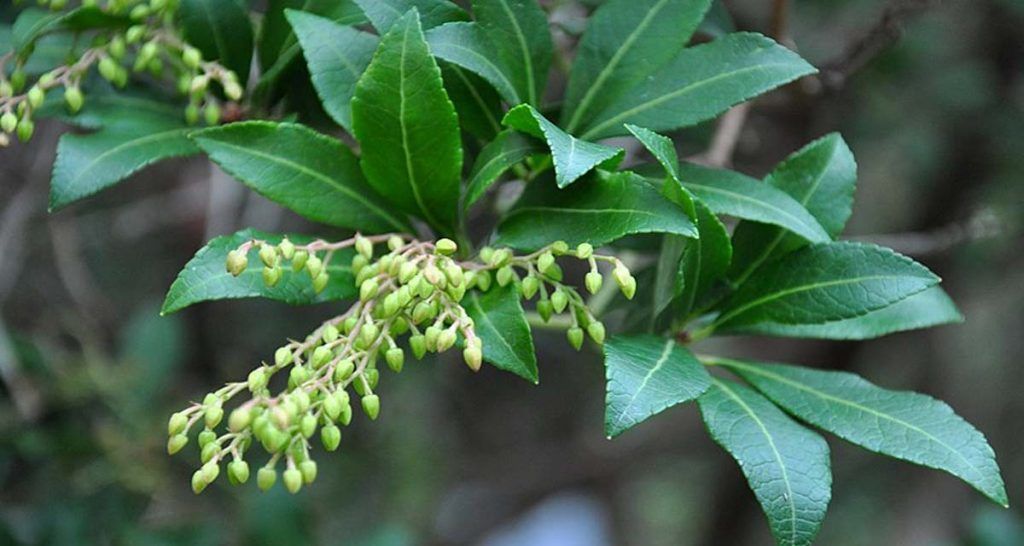
The white-flowered Andromeda shrub, also known as Japanese Pieris, offers a truly attractive (yet unique) scent for the spring and summer garden. And it is that not everyone likes the aroma, although others find it really irresistible. Beyond the bell-shaped flowers, the benefits of growing Andromeda as a perennial are shed the leaves during the wintersome cultivars of which (such as the ‘Mountain Fire’ cultivar) show an interesting red color and an early flowering start (usually in March).
pieris japonica East quite resistant to cold, resistant to temperatures below 0 ºC. However, it doesn’t like the sweltering heat of some areas in summer so much, so it’s a good idea to find a cool, well-ventilated environment out of direct sunlight.
- Climatology: location in partial shade or out of direct sunlight.
- The type of soil: It likes well-drained soil and an acid pH, with a good organic matter content and a good ability to retain some moisture.
- Risks: constantly maintain moisture in the soil, without allowing the soil to dry out.
4. Azalea (Rhododendron spp.)
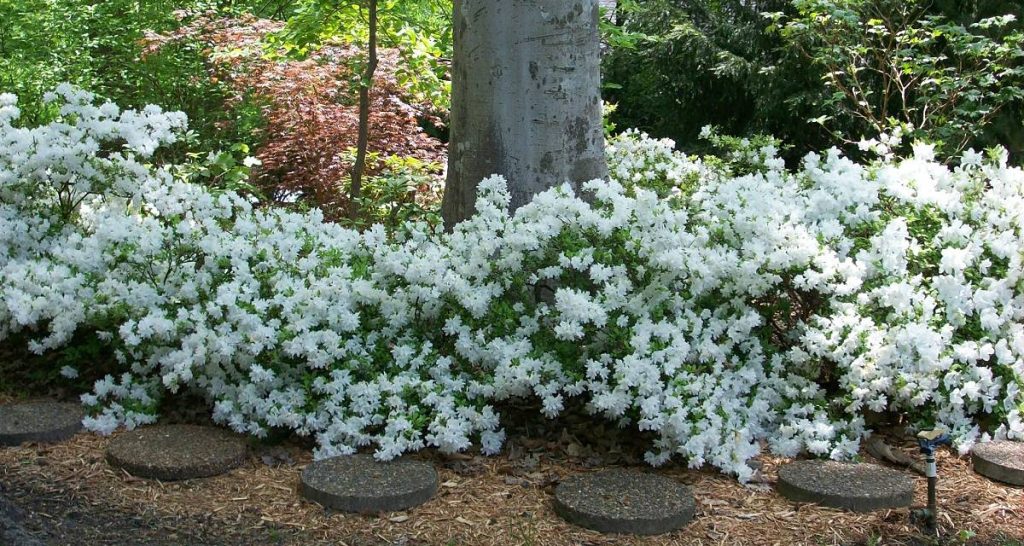
White-flowering shrubs called azaleas can bloom in early or late spring, depending on the cultivar and variety chosen for your garden. The best known white varieties are ‘Blooom-a Thon’, ‘Cascade White’, ‘Delaware Valley White’, ‘Northern Hi-Lights’, ‘Pleasant White’, ‘Snow’ and ‘White’.
And it is that, in what stands out the most, the rhododendrons are in the beauty of its flowering. A bushy port that adapts to all types of landscapes, fences, paths and to form hedges, since they admit pruning very well. The genus is widespread throughout the world, with specific varieties predominating in Europe, America and Asia. Many of them they are ornamental hybrids They are very popular in nurseries and specialty stores.
The most characteristic of the azalea is the large volume of flowers it produces. They are quite large, have very attractive colors and are located in the leaf axils. There flowering occurs in spring, although it will depend on the planted sub-variety which is ahead or behind depending on time and earliness.
- Climatology: Its optimum temperature is slightly cold, between 10 ºC and 20 ºC. Cultivation in partial shade in areas with some ambient humidity.
- The type of soil: It is important to have acidic soil (pH between 5 and 6.5), rich in organic matter and with good drainage.
- Risks: continuous watering and constant maintenance of soil moisture.
5. Viburnum (Viburnum carlesii)

Viburnum (Viburnum carlesii) is an example of a shrub with white flowers (and other colors) In early spring (April) . The buds are pink but then open into clusters of white flowers. If you want to avoid the pink color of the flower buds, you can choose pure white cultivars, such as Viburnum plicatum var. tomentosum ‘Mariesii’.
read more: Viburnum lucidumcreate your perfect hedge.
To obtain better flowering, it is important to arrange it in a area with good lighting, providing a phosphorus-rich fertilizer before flowering. Additionally, the soil should be slightly acidic for optimal growth results.
Climatology: It can withstand frost and freezing temperatures. Plant in full sun or partial shade.The type of soil: Consistent and cool soils, even clayey, but without excess humidity.Risks: moderate watering in summer and spring so that the substrate does not dry out, and in autumn-winter limit watering to 1 time every 7-10 days.
6. Spirea (spirea spp.)

As is the case with roses, which are somewhat related to white-flowering shrubs of the genus Spirea, they also bloom in early summer. Although some of the more popular types of spirea have pink flowers, there are specimens of shrubs with white flowers, such as Spirea ‘Vanhoutte’ (Spiraea × vanhouttei). This plant grown in full sun and grows between 1.5 and 2.5 meters in height and 2 and 3 meters in width. Its flowering takes place between the months of April and May.
Other white flowering shrubs that are cultivars of Spirea are:
- ‘Snow mound’
- “Snow storm”
Spireas have a fairly good tolerance to drought conditions once adult, but while young, it is important to keep the plants with a permanently moist substrate.
Climatology: good light exposure, tolerates cold, blooms in early spring. It grows best at temperatures between 10 and 25℃, but can survive temperatures as cold as -20℃.The type of soil: very hardy shrub suitable for all types of soil. Abundant, well-drained organic matter is recommended.Risks: every 3-4 days in spring and summer, every 10-15 days in winter.