The beautiful colors of bromeliad leaves are a feast for the eyes. Bromeliad belongs to the Bromeliad family.
Simply put, it belongs in the pineapple family. Bromeliad has many properties and size is one of them.
It can be tricky to grow a bromeliad to its full size, but with the right light, water, and temperature, you’ll easily get the size plant you want.
With the wide variety of bromeliad species, the average span is 1 inch to 3 feet, but the largest bromeliad is a Puya Raimondii which can reach 15 feet.
The size of your bromeliad will depend on the variety you have and how you care for it.
In general, to care for bromeliads, give it bright indirect light, place it in a temperature between 60 and 80 Fahrenheit, and water it once a week. Do not water the plant.
Southern Brazil and Paraguay are the cradles of this fascinating plant. But now it occurs in all tropical and subtropical areas. There are approximately 3,590 known species present.
Bromeliad comes in many colors, such as pink, purple, orange, red, and yellow. The large size of bromeliads also varies from species to species, but care is almost the same for them.
Let’s dig into this content to highlight more facts about a bromeliad and its size.
How big can a bromeliad grow?
 Generally, a bromeliad will grow up to 3 feet in the right environment. The size of a bromeliad depends on the care and variety of the plant.
A bromeliad has more than ten varieties and each of them grows to a different size.
For example, if you bought Aechmea conifera, a beautiful species of bromeliad, it will be able to reach 3 meters in height. But some other species grow up to 6 feet, such as Dyckia maritima and Hechtia melanocarpa.
But a Billbergia amoena can reach 1 meter in height, but it is not the smallest variety of bromeliads.
There are many other Bromeliads that only reach 50 cm in height. But universally, an indoor bromeliad size extends up to 3 feet and has fully colored leaves and an aesthetic appearance.
How fast does a bromeliad grow?
Bromeliad has a relatively slow growth rate, unlike other houseplants.
If you purchased a baby bromeliad, it may take 1-3 years for it to grow into a flowering plant. Once it begins to flower you will see colorful leaves.
These colorful sheets are available in colors like red, pink, yellow, green, purple, and orange. You may even see two different colors in the same bromeliad species. Everything you need to expose your plant to bright, indirect light.
Additionally, a bromeliad thrives in a home environment. It has no special requirements to grow. Most bromeliads have a lifespan of 3 to 5 years.
The best way to give your plant more life is to add the right amount of water and fertilizer when needed. Second, transplant the bromeliad when you need it.
You may also be interested in: Light Requirements of Bromeliads
How to grow a bromeliad?
For a bromeliad to grow, it must maintain light levels, soil texture, temperature and humidity, and water volume.
Apart from this, you also need to know what variety of bromeliads you have in your home.
Because the size it can reach depends on the variety/species/species/genus of bromeliads.
Whether you purchased terrestrial or epiphytic bromeliad varieties, both require well-drained soil.
A well-drained potting mix will help the bromeliad have a vertical drainage system. Poor potting soil interferes with water uptake and can lead to plant death.
Terrestrial bromeliad species thrive in the soil. On the contrary, epiphytic species of Bromelia grow attached to other plants, mainly trees.
The type of bromeliad depends on the light it needs, some like bright indirect light. Conversely, some bromeliads like very little light.
If you are unfamiliar with bromeliad species, you can adjust the light level after checking the texture of the plant. If you have soft-textured leaves and thornless bromeliads, you need low light.
While those bromeliads with strong thorns and thick leaves need a moderate level of light or bright indirect light. Never expose a bromeliad to direct light, as this slows the growth of the bromeliad.
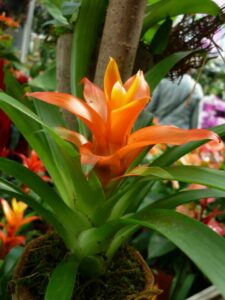 The best way to grow a bromeliad is to create artificial tropical conditions. For example, a bromeliad thrives with some moisture, a shady spot, under or on a tree, such as in the woods.
It is best to set the temperature around 60-80 Fahrenheit and set the humidity around 60%. Bromeliads that are mature and have thick leaves can tolerate up to 20 degrees Fahrenheit in winter.
On the other hand, some bromeliads do not tolerate lower temperatures. And you have to be a little more careful with immature bromeliads. It is advantageous to plant them at high temperatures.
To get a great bromeliad, you need to carefully set up the watering routine. If you are using the pot to grow your bromeliad, you will need to water once a week during summer and spring, depending on light and temperature.
The amount of water is directly related to these two factors. In winter, add water when you feel the soil is drying out, check the soil with your finger, up to two inches into the soil to check the water level.
Bromeliads like to thrive in slightly moist soil, but they don’t like waterlogged soil.
Conversely, if you want a large aerial bromeliad in the form of a plant. Then spray the plant twice a week. Again, don’t soak the bromeliad, but spray it whenever you notice its leaves are a little dry.
Diluted fertilizer is also important for getting a good bromeliad. A bromeliad does not need fertilizer like other houseplants. It is enough to add fertilizer once a year.
But don’t add fertilizer to your bromeliad as winter approaches.
If you like this article, check out our article on the 6 great benefits of a bromeliad at home.
What can you do if your bromeliad is getting too big?
Everyone loves their plant to bloom and grow, but what do you do if your bromeliad gets too big? You can easily choose the repotting option.
First, cut the old and damaged thorns from the plant. Similarly, repeat the process with the diseased roots.
Select the appropriate pot or container up to 10-15cm high and you can choose the width of the pot according to the space you have for your plant in your home.
After transplanting them, you will have the new look of your Bromeliad and you can customize them to your liking.
If you also see dead old flowers on your bromeliad, cutting them back is beneficial. First, dead flowers can become poisonous to you.
Second, you can consume the nutrients in a large volume. By cutting them, you allow the new parts of the plant to absorb nutrients and grow well.
final thoughts
 A large Bromeliad isn’t hard to find, all you have to do is be a little careful with the plant. bromeliads thrive $10-11. Also, it likes to grow in acidic soils, around 5.0 to 6.0.
Bromeliads grow best indoors. If you want to thrive in the outdoor environment, you need to create an artificial environment like they have in nature to grow.
But if you live in a tropical area, the Bromeliad will be happy.
Bromeliad has another benefit for you. It doesn’t cage your level of creativity. You can grow them in any container/pot or you can grow them as an air plant. You can place them anywhere in the house.
As a houseplant, you also benefit from bromeliads by protecting your pets. A bromeliad is not toxic to pets, including dogs and cats.
Before you go, here are some other related articles that I encourage you to read below to solve more of your gardening problems:
Why is my bromeliad plant turning brown?
Why are my bromeliad leaves turning yellow?