Suppose you own a Pilea Peperomioides, also called Chinese money plant, or are thinking of buying one.
In this case, you might be wondering what the ideal humidity level for the plant might be, as it is known to be picky when it comes to humidity.
But don’t worry because we have provided you with all the necessary information you need to take care of your money plants.
Pileas are tropical plants native to southern China. Pilea grows best at 65-75°F (near 18-24 degrees Celsius) and prefers a humidity level of around 40-60%.
The plant needs more humidity if you live in a dry environment. You can increase the humidity to benefit your Pilea. This can be accomplished by using a humidifier or directly misting your Pilea twice a week.
Although the requirements may seem simple if you’re new to plant care, adjusting the humidity may not be a piece of cake.
If you want to know all the tips and tricks in detail to keep your Pilea healthy, green and growing, keep reading.
How do you know what the humidity level is in your home?
 If you want to measure the humidity of your plant quickly and reliably, you can use a hygrometer. A hygrometer is a device that records indoor temperature and measures humidity at the same time.
Of course, this device is useful if you want to maintain the exact humidity of your plant in your home. This is for those with a green thumb who want to keep their plants happy.
Other methods to test for humidity include checking windows for condensation in the winter or excessive mold in the bathroom.
Indoor mold growth, peeling paint and cracks in the paint are all major visible indicators that you have high humidity in your home. The ice cube test is a specific test for determining humidity.
If you put a few ice cubes in a glass and no moisture forms on the outside of the glass, this indicates that the air is too dry and you may need a humidifier to provide your plant with the ideal humidity level.
On the other hand, if water has condensed on the outer surface of the glass, this indicates that the humidity is high.
Humidity changes with the outside temperature, so you need to measure the humidity regularly. You can control the humidity by using a humidifier or a dehumidification system.
How to increase the humidity in the house?
Higher humidity is good for many houseplants. In addition, most plants native to tropical regions require higher humidity.
There are many ways to increase the humidity in your home. Some of the methods are:
1) Humidifier
A simple way is to use a humidifier. Humidifiers increase the relative humidity of the surrounding air by adding humidity, and they do this by adding mist, which increases the level of water droplets, which increases the relative humidity.
2) Add indoor plants
Another way to increase humidity is to add indoor plants to your home. Plants release water through transpiration and evaporation.
3) Adjust daily water activities
Using shower steam, boiling water on a stove, letting bath water sit for a while, or using vases of water will also increase humidity.
Not using a dryer and hanging clothes to dry is also an easy way to increase humidity.
4) Place the plant in a humid place
If you want to increase the humidity around your Pilea plant, you can place the houseplant in the bathroom, laundry room, or kitchen where the humidity is already high.
5) Group the plants
You can also group your Pilea pots and place a water dish in the middle. This also helps the plants, as evaporation from the tray combined with transpiration will increase the humidity.
6) Mist the plant
Another common and easy way is to spray the plant, although this is temporary. With misting, only the top of the plant is sprayed with water.
Remember that sprinkling is not the same as watering. Watering means adding water to the soil only when the top half inch of soil is dry.
Otherwise, the carrot may be susceptible to root rot. Irrigation can also be top irrigation, also wetting the leaves.
Just make sure the leaves don’t drip or retain water for long, making them susceptible to fungal attack.
7) Bucket of gravel/pebbles
You can also increase humidity by placing a layer of pebbles or gravel in the container, adding water to the pebbles or gravel, and placing plants on top.
The pebbles keep the plant out of the water. As the water in the tray evaporates, the humidity of the air around the plant increases.
8) Use a terrarium
Placing plants in a terrarium is also a great way to increase humidity for houseplants. In a terrarium, plants are placed in a closed or semi-open glass container.
A terrarium is a great way to grow water- and moisture-loving plants because the enclosed environment increases humidity dramatically.
Also, placing a plastic bag or wrapping the plant after spraying the leaves increases humidity.
What are the signs that the humidity is not ideal for your Pilea?
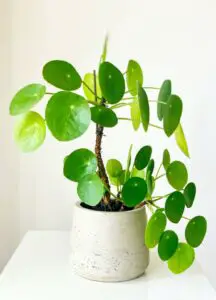 Certain cardinal signs indicate that the humidity is probably not ideal for you Pilea. The leaves of the Pilea plant develop browning at the edges under low humidity conditions.
The edges also curl, become crispy and brown (see this article here) help prevent pilea leaves from turning brown). Extremities dry out, just as our skin reacts to low humidity. New leaves that have sprouted may not show sufficient growth.
The plant may wilt if the humidity is too low. The leaves are starting to turn yellow. The stems and branches of the plant also begin to shrink and wilt and may turn brown.
Leaves can also fall (see our article on why my pilea depends For more information). Turgor pressure, commonly referred to as water pressure at the roots, shoots, or stems, keeps the plant and its leaves upright.
When the plant is flooded or in low humidity, the plant begins to lose this water due to the pressure difference between the plant and the atmosphere.
The process of water evaporation from the leaves of the plant occurs through the process of transpiration. In summer, more water evaporates from the leaves due to the heat.
Does Pilea like being misted?
Pilea Peperomioides is a tropical plant and tropical plants like high humidity because that is the environment they usually have in the forest and are adapted to.
The environment in our homes does not come close to the humidity in which the plant normally grows. Therefore, the Pilea plant undoubtedly likes to be misted regularly, as misting increases humidity.
The Pilea plant prefers heat to room temperature and dislikes cold. Even in cold climates, the humidity is low.
Humidity fluctuations make it difficult to precisely control conditions, but knowing that Pilea likes higher humidity makes it easier to maintain conditions.
Misting is easy, but you have to be mindful of the weather to know when your plant needs misting. It’s even easier to use a humidifier to maintain the proper humidity level for the plant.
How to spray your Pilea?
Misting is very simple but essential to do. It’s like watering the other leaves of a houseplant.
Basics include using a mister or mister with a light spray to mist the plant, as you don’t want to soak or soak the Pilea leaves completely in water.
Do not wet the leaves too much so that they are soaked with water. Instead, mist the plant lightly whenever you suspect the humidity has dropped.
Pick a spot near your Pilea to place the spray bottle so you’re constantly reminded to spray your plant every time you pass by.
You can also craft a humidifier by using a container of water near a plant. You can turn on a fan near the container so that the water evaporates and the plant becomes sufficiently moist.
Keep in mind that you should continually mist Pilea and other houseplants with filtered or distilled water, as tap water contains a lot of salts which are unnecessary and may even be harmful to your plant.
You can also use rainwater for this. However, hard water leaves marks on the leaves, ruining their aesthetics.
Can you keep Pilea in the bathroom?
You can definitely keep your Pilea plant in the bathroom, as it is the most humid place in the house. If the plant is placed there, then it also does not need frequent watering.
Do not place a Pilea plant near a heat source, radiator or fireplace. Any plant placed near a heater can burn and dry out quickly. Be very careful with Pilea, as it loves humidity.
This means not even decorating doorways or hallways with the plant, as drafts can reduce humidity and cause the plant to turn brown and other damage. You can also place your Pilea near the kitchen as it is also humid.
final thoughts
 Pilea is a moisture-loving plant. The plant requires 50-75% humidity. To place the Pilea plant indoors, the humidity of the house must be adjusted to the needs of the plant.
Using a hygrometer is a great method of monitoring indoor humidity if you want to protect your plant from the effects of low humidity.
Signs of low humidity include browning, curling and crisping of the leaves. Misting the plant with a light spray bottle is a good way to maintain proper humidity levels for your Pilea, as it loves to mist it.
You can keep the Pilea in a bathroom or near the kitchen, as the humid environment favors the plant.
Related Items:
How to fix a long-legged pilea and how to prevent it in the future
What are the most common problems with a pilea?
Requirements for Pilea Light: what type, how much and more
How big can a pilea grow: how fast and tips for growing them
About the Author:
sad gosling
Saad is an avid gardener and a great lover of plants, animals, photography and people. He currently focuses on indoor plant photography and capturing beautiful landscapes. Write and rewrite feature articles on nature and science.