Although basil plants are fairly easy to care for, certain factors can cause this herb to lose its beautiful green color.
The most common reasons why basil leaves turn white are nutrient deficiencies and fungal diseases. In addition to these factors, too much water, pests, or too much sun can cause basil leaves to turn white. To solve the problem, it is important to identify the cause and then take the necessary measures.
In this article, you will find out why your basil leaves are turning white and the solutions to the problem.
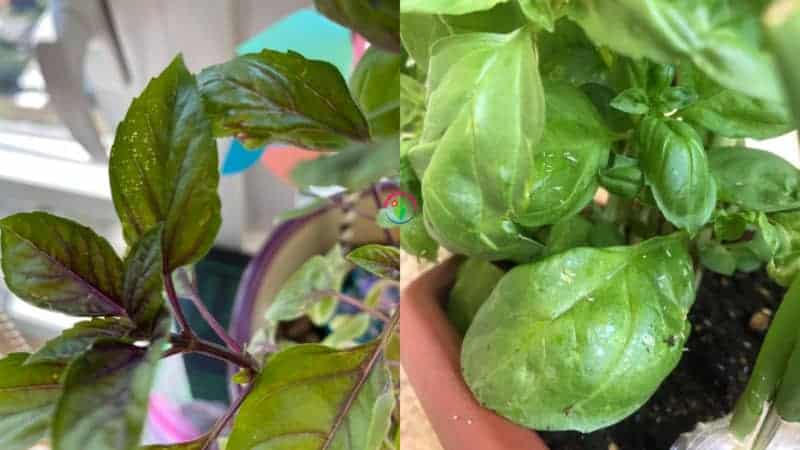
thermal stress
Basil needs warm temperatures for good growth and is very sensitive to cold. Cannot tolerate temperatures below 50°F (10°C). It is recommended to store it at temperatures between 20 and 27°C (68 and 80°F).
If your basil is exposed to too high a temperature, its physiological activities will be altered. This can manifest as:
- Leaf yellowing/whitening
- distorted growth
- withering
The solution:
- Do not plant your basil seeds until there is no danger of frost.
- If possible, adjust the temperature settings of your home or the room where you have your plant.
- Maintain a stable temperature, ideally between 72 and 82°F (24 and 28°C), for the basil plant. Temperature fluctuations can shock the plant and stunt its growth.
mildew
Downy mildew is a common basil plant disease caused by: Peronospora Belbahriic mushroom. Here are the symptoms of late blight:
- Yellowing or whitening of leaves (chlorosis)
- Intense yellowish color around the midrib of the leaf
- Fuzzy gray growth on the underside of the leaves.
- Basil leaves eventually curl, shrivel and turn brown
The solution:
- If you think your plant has mildew, it’s best not to try home remedies.
- The only way to control mildew is to purchase a fungicide labeled for mildew.
Fusarium wilt
Fusarium wilt is a common basil disease caused by a ground-born plant Fusarium oxysporum f. sp. basil mushroom.
In the early stages, Fusarium wilt can manifest as chlorosis, which means yellowing and whitening of the leaves.
As the disease progresses, the plant turns brown, wilts and eventually dies.
The solution:
- There is no cure for Fusarium wilt of basil. The only remedy is to remove the infected plant and disinfect the pot.
parasitic infection
aphids
Aphids are tiny insects that suck juice from basil leaves, depriving the plant of water and nutrients. They are usually light green or brown in color. The first sign of an aphid infestation is yellowing and drying of the leaves due to lack of water and nutrients.
The solution:
- A small number of aphids on basil can be crushed by hand or removed by pruning.
- Insecticidal soaps are very effective against aphids.
- Coca-Cola in a spray bottle works great against this as they choke on the sugary liquid.
nematodes
Nematodes are microscopic worms that damage basil roots and compromise the plant’s ability to absorb water and nutrients from the soil.
Infected plants may show symptoms similar to a nutrient deficiency: leaf yellowing and wilting. Due to the lack of nutrients, the leaves will lose their green color and turn pale green.
The solution:
- In healthy soil, a small number of nematodes is not a problem. The effective solution is to use a resistant variety.
white fly
They are small flying insects on the leaves. They may look like some kind of white stuff on basil leaves, but they are flying insects. These insects also damage the leaves by sucking the juice and giving them a light green color.
excess salt
Excess salt dries out the basil plant. Salt buildup causes the plant to retain water, which can manifest as dry or white leaves. The reason for this may be water quality and excessive fertilization.
The solution:
- Place your plant in a pot with drainage holes. Excess water is washed away, reducing the risk of salt buildup.
- Use rainwater, filtered water or distilled water. Tap water often contains chemicals that can cause salt buildup.
- Don’t over-fertilize your plant. Too much fertilizer can cause salt buildup.
nutrient deficiency
- Nitrogen lack leads to uniform yellowing of old leaves.
- potassium the deficiency manifests as large yellow areas along leaf margins and also scattered yellow spots between leaf veins.
- Magnesium the deficiency appears as a yellowing between the leaf veins.
- Sulfur deficiency shows uniform chlorosis over the whole leaf, affecting the whole plant.
- Iron a deficiency causes yellowing between the veins of the youngest leaves.
The solution:
- Apply a smaller dose of balanced, water-soluble liquid fertilizer every two weeks during the growing season (spring-fall).
- Put fertilizer in the soil before planting or transplanting your basil.
insufficient light
Basil prefers full sun, preferably 6 to 8 hours of sun per day.
All plants need light to produce chlorophyll (the green pigment), which is crucial for making their own food. Without light and without chlorophyll, the plant loses its color and this can cause the leaves to turn pale or yellow.
The solution:
- Place your basil in a place with direct sunlight for 6 to 8 hours a day.
- Keep your basil plant 6 to 12 inches away from two 40-watt cool white fluorescent bulbs for 14 to 16 hours.
too much sun exposure
Although basil thrives in direct sunlight, too much at the wrong time can damage the plant.
Too much direct light can dry out your plant and lose water and nutrients, which can manifest as dry, white leaves.
The solution:
- Do not place your plant in direct midday sun on very hot days (usually during the summer months).
- Instead, place your plant in full sun in the morning and partial shade around noon.
give too much water
Too much water and excess moisture can cause root rot, which damages the root system and prevents it from transporting food and water to the rest of the plant.
Overwatering (root rot) can manifest as whitening/yellowing of the leaves as they do not receive enough water and nutrients from the soil.
The solution:
- Remove your plant from the pot and check for rotten roots.
- If root rot has become established, remove the affected parts. They look brown and soft.
- Move the plant to a new sterile container with a new fresh soil mix
- Cut the rotten roots with disinfected scissors.
- Place it in a pot with drainage holes so that no excess water or moisture gets into the soil.
Submarine
If you don’t water your plant enough, it won’t be able to make its own food or receive moisture and nutrients from the soil.
As with overwatering, basil simply does not get enough water in its tissues, which can cause dry, white leaves.
The solution:
- If your basil is under water, water it thoroughly and it should recover within the next few days.
- Water your basil when the top 1 to 2 inches of soil feels dry to the touch.
Useful advice: When watering basil, water at the base of the plant to ensure the foliage stays dry.
This reduces the risk of fungal and bacterial infections.
Wrong type of soil
Basil thrives in well-drained soil that allows air circulation and oxygenation.
Basil grows well in soil with a pH of 5.5 to 6.5. Incorrect pH can make some of the essential nutrients unavailable to basil.
It would also be nice if the basil added some sort of organic matter to the soil. This can help prevent nutrient deficiencies and help produce lush, healthy plants.
If there is something wrong with your soil, basil leaves will turn yellow or white. This can be due to several reasons:
- The soil does not allow air circulation or drainage, so excess moisture is trapped, making the roots more susceptible to root rot.
- Your basil is nutritionally deficient.
The solution:
- Mix organic matter, such as compost, into the soil before planting or transplanting.
- Add the recommended dose of a balanced fertilizer to the soil each month.
- Basil loves nitrogen-rich fertilizers, but be careful not to over-fertilize and cause salt buildup.
Near a heat source
Basil is generally not very sensitive to heat, but keeping it too long near a heat source can have consequences. An electric heater or radiator, for example, can cause the leaves to dry out and turn them yellow/white.
When your plant is exposed to too much heat, it can increase transpiration. As transpiration increases, your plant loses more water than it should.
Without water, the leaf tissue loses its chlorophyll pigments and turns white.
The solution:
- First, water your plant well if you suspect heat damage.
- At a minimum, keep your basil plant away from heat sources.
- Do not keep the plant outside if the temperature exceeds 85°F (29°C).