
Dittrichia viscosa is the scientific form under which the olive grove is known, a plant classified as medicinal of the family Asteraceaeof natural growth in many parts of the Mediterranean.
This herbaceous plant also has other characteristic names, such as flyweed, and it is known as such in some areas because the leaves have glandular hairs that produce a viscous, sticky resin that traps many insects. In fact, its scientific name also clearly refers to the stickiness of its leaves.
Its ability to grow allows it cover large areas in rural areas. In addition, the toxicity of its leaves makes it rejected for livestock feed. The medicinal components of this plant also have inhibitory action on seed germination, so your survival in different wasteland environments is more than guaranteed. All of this has led it to be considered an invasive species in some countries.
Ecologically, it supports a wide range of temperatures and is able to survive in environments where water and nutrients are scarce. Even its seeds have a cover that provides some fire resistance, leaving offspring even after forest fires.
From an environmental point of view, Dittrichia viscosa It is considered a very important plant because there are few plant species options that blooms in fall or winterallowing bees and other insects to feed before taking shelter, generating enough reserves to spend the whole cold season well protected.
Characteristics of Dittrichia viscosa
botanically, Dittrichia viscosa it’s a herbaceous plant or small shrub less than a meter high, with alternate leaves, oblong-lanceolate and serrated.
It presents inflorescences of radiate, heterogamous flower heads, united in racemiform panicles. Hemililate peripheral flowers and female, the centrals are floscular and hermaphroditic. Androecium with 5 stamens, anthers fused into a tube.
The fruits are pappus achenes with scabrous hairs.
flowering period
As if that were not enough, in addition, the olive grove blooms from September and in autumn. A time of year when nectar and pollen are scarce, providing food for many pollinating species as well as the adults of parasitoid insects.
the flowering of Dittrichia viscosa starts in october and remains throughout November and even December in warmer regions. In the middle of winter, the olive grove loses the upper part of its stems, although if it does not dry out completely, it grows easily with the arrival of higher temperatures.
Common names: olive grove, mosquera grass, atárraga, altabaca, mosquera, flyswatter.
Most common locations for Dittrichia viscosa: mainly the Mediterranean basin. Also distributed throughout the Canary Islands, Central and Northern Europe, located in rural habitats, road beds, wastelands, stream beds and areas of disturbed soil.
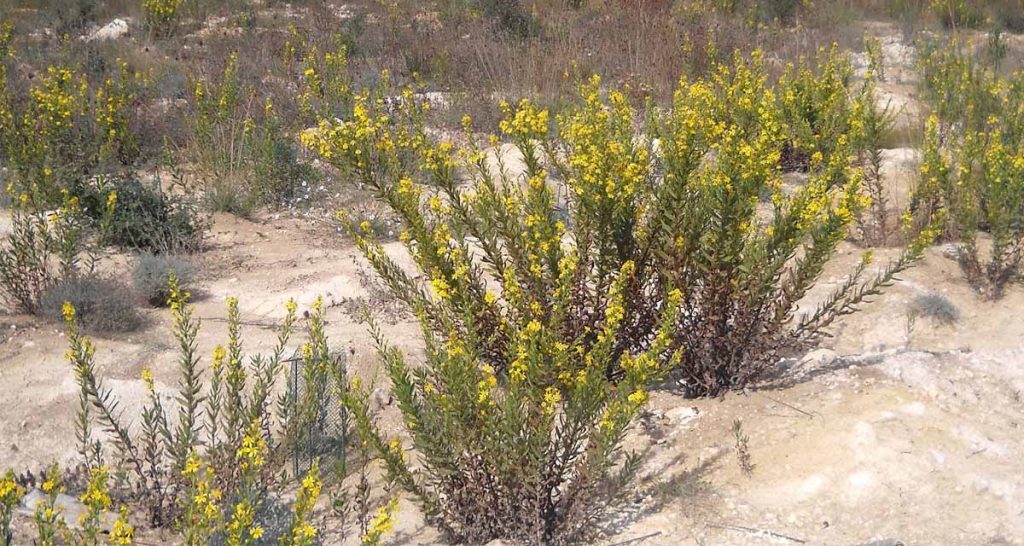 Photography: Raymond GIMILIO
Benefits for agriculture
Many farmers are familiar with the olive grove (Dittrichia viscosa) and appreciate it, as it offers great benefits both for insect control and for the ability of its roots to extract heavy metal pollutants for agricultural soils.
Its sticky leaves are a natural trap for small insects like aphids, which stick to its leaves. In addition, it provides good shelter for various predatory insects such as Macrolophus caliginosus That is Nesidiocoris tenuisvery interesting mirids for biocontrol.
A common use of the olive grove is that of recovering contaminated soil. Like other herbaceous plants like mustard, it is used wisely to extract and accumulate heavy metals.
read more: guide and properties of Russian comfrey.
Main medicinal uses
Main medicinal components: sesquiterpene essential oils (mainly nerolidol and fokienol).
Although it is used less and less Dittrichia viscosa What medicinal planthas been used for years as a home remedy for urinary diseases and malaria.
On the other hand, the infusion of its leaves, rich in terpene oils, was used for its astringent properties as a remedy for rheumatism and arthritis. These essential oils also have the ability to reduce bleeding in minor wounds, using their leaves as a poultice.
Other uses of the olive grove
- Food use: the branches were used in the past as a preservative for raisins and potatoes.
- Use as a tincture: a yellow dye used for clothing and other materials can be obtained from the root.
- Industrial use: frankincense is used as an insecticide, the same hanging plant is also used to catch flies.
Cover photo: Raymond GIMILIO – Personal work