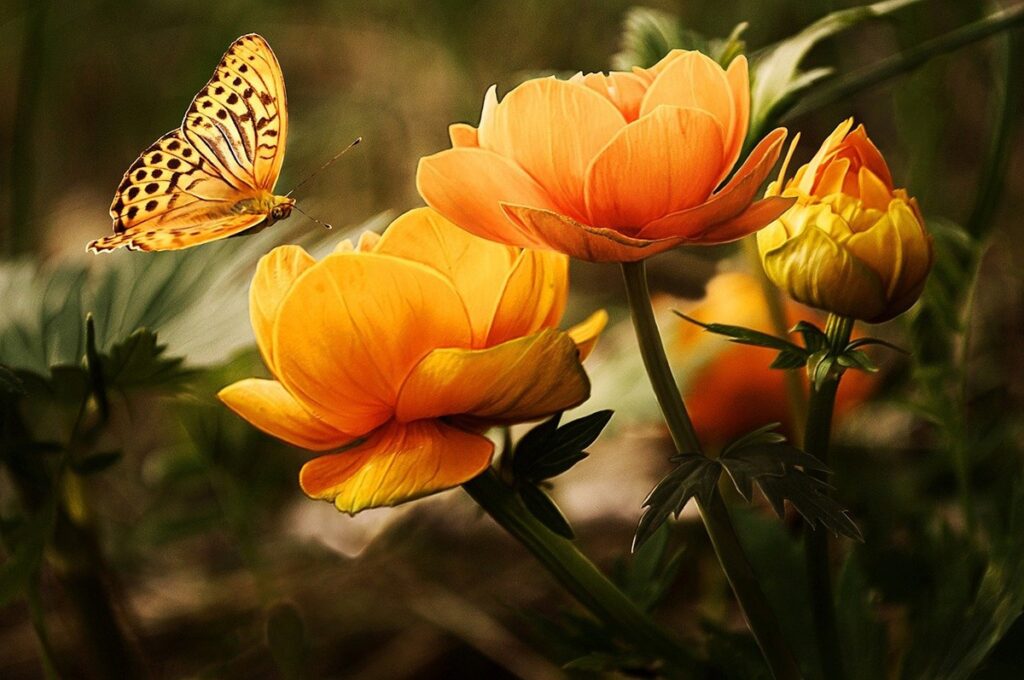

We will all agree that flowers have a special beauty. For this reason they are very popular for decorating homes, gardens, streets and parks. Some may appeal to us more than others, but their importance goes far beyond aesthetics. We will clarify this fact by talking in this article on the importance of flowers in nature.
In order for us to understand it well, we will also explain what exactly are the flowers, what are the different types and what are their functions and importance in nature.
What are flowers in nature?

Before talking about the importance of flowers in nature, we must first understand what they are. It is basically a structure whose main objective is the reproduction of its species. They usually look very pretty, colorful and striking, which makes flowering vegetables very decorative items. Nature did it on purpose, because the great attraction of flowers not only attracts us, but also many insects and birds that help spread pollen and flower seeds, thus promoting plant reproduction. .
It should be noted that the flowers have different parts, depending on the sex to which they belong (male, female or hermaphrodite). These are the most important:
- Sepals: These are leaves whose function is to cover and protect the flower when it is still very young. When it flowers, the sepals remain below.
- Petals: They can have different shapes and colors. Its function is to attract pollinators, such as bees. However, some flowers do not have petals. These are called apetalas.
- Gynoecium or pistil: It is the female part belonging to the flower. It houses the ovules which generate the seeds after being fertilized. The pistil is shaped like a bottle and consists of three parts. The top is the stigma, where the pollen enters. The bottleneck would be the style, then comes the ovary, where the eggs are.
- Stamens: The stamens are the male part of the flower. These are filaments that support what is called the anther, which is the organ responsible for the production and storage of pollen grains. These buttons are the male sex gametes.
What types of flowers are there in nature?
When it comes to differentiating between the different types of flowers in nature, it is important to note that plants can be divided into two major groups: Angiosperms and Gymnosperms. The latter are mainly characterized by not producing flowers. They are generally more primitive than the former and reproduce mainly by spores. A good example for this type of vegetable would be ferns.

Related article:
Angiosperms and gymnosperms
Instead, plants that are part of the angiosperms they produce flowers. In fact, there is a wide variety: between 250,000 and 400,000 different flowers. This large group of plants can be divided into two subgroups:
- Monocotyledonous plants: As the name suggests, they have only one cotyledon, which is the first leaf that arises after the seed germinates. In this type of vegetable, the leaves have veins that run parallel to them, without starting from the same central vein. The roots of monocotyledonous plants have a similar structure, as they do not start from a main root and develop into many individual fibers. These would be some examples: Lilies, daffodils, tulips and orchids.
- Dicotyledonous plants: On the other hand, dicot plants have two cotyledons. The leaves of these have a central vein from which the others depart in a branched manner and cover the entire leaf. The structure of the roots is very similar, since the small ones start from a main root, branching out until they cover a lot of ground. Among the dicotyledonous plants are, among others, daisies, roses and begonias.
There is also another way to classify the different types of flowers: Complete flowers and incomplete flowers. The first are hermaphroditic and have all the main elements, like roses. On the other hand, incomplete flowers are of only one sex, since they do not have all the elements, but only stamens or pistils. Some examples would be sunflowers and daisies.
What is the importance of flowers in nature?

As we have already mentioned before, flowers are the reproductive structures of plants. Therefore, its importance in terms of the multiplication of this type of plants is obvious. However, its usefulness goes much further, although it should not be underestimated. Thanks to the reproductive aid they provide, many plant species are able to multiply and not die out. Therefore, they can continue to provide certain services that we animals and other living things can enjoy, such as food.
And so we also come to the next point in which the importance of flowers in nature stands out: food. These plant structures serve as food for many species and in different ways. For one thing, some animals eat them whole, like rabbits. But there are also living things that feed on nectar, such as hummingbirds, butterflies, bees, and even some types of bats, among others. In addition, we also consume flowers. It is becoming more and more fashionable to cook with its petals and to make infusions.
Another extremely important feature that we should mention is the use of flowers in medicine. As you probably already know, some drugs are made with these plant structures. However, they are not only useful for us to treat health problems, but also for animals. Many of them are able to distinguish between different types of flowers based on the effects they may have on their organisms. Therefore, they consume one or the other according to the needs they have at that time.
Undoubtedly, flowers are extremely decorative elements that delight the eyes. However, its uses, functions and properties are essential in many aspects of life as we know it today.