
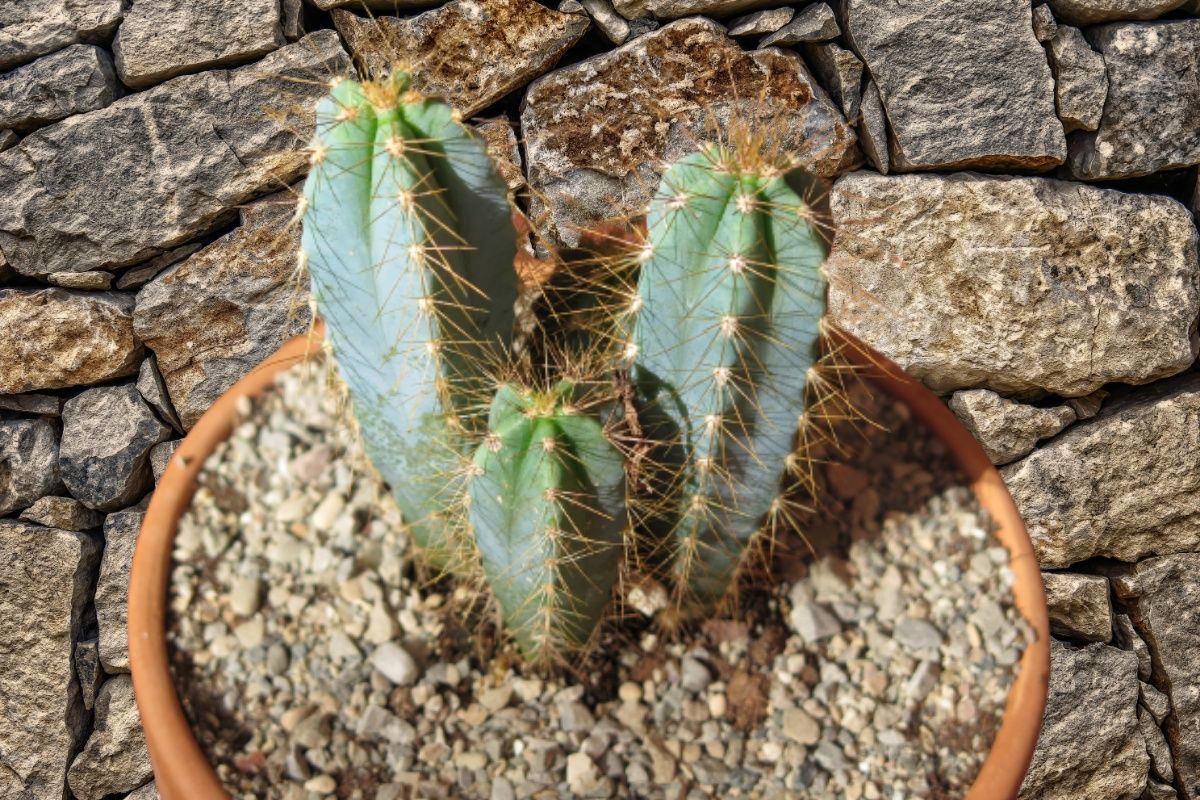
Cacti fan? Afterwards I’m sure you know the genus Pilosocereus. These shrub type cacti are very eye-catching in pots as well as planted in the garden.
But what do you know of them? Below we have prepared an article to tell you about the characteristics they have as well as the general care you should give them in case you are going to buy one (or already have it).
How are the Pilosocereus?

As we have already told you, the Pilosocereus are shrubby or arboreal cacti. They usually branch from the base and you know that they can reach 10 meters in height (although it is normal that, if you have them in a pot, they do not exceed two meters). The stems have a diameter between 8 and 12 cm, but can be much thicker. In addition, they will consist of three to thirty ribs. These will have circular (or elliptical) areolas that will be covered in long white, red or even black hairs. And from them will emerge between 6 and 31 thorns, more or less long, some between 10-15 and 40mm. They are golden (yellow), but there will also be brown, black…
Regarding the flowers, you know that these are tubular or bell-shaped. They will grow directly from the stems and their size is between 12 and 15 cm long. (its diameter will be between 5 and 12 cm). You can find them pink or white, although you will only see them at night.
If it manages to pollinate, after the flowers you will have the fruits, spherical in shape and quite large. They can be around 20-45mm long and 30-50mm in diameter. These at some point will burst releasing a white, red, magenta or pink pulp. This is where you will find the seeds.
In the plant kingdom, and more specifically within this family, there are some 38 recognized species of Pilosocereus.
Pilosocereus care

Now that you know the genus Pilosocereus a little better, How do you feel about knowing the general care you should provide? Keep in mind that we leave them to you in general, but then each species that is part of it will have its peculiarities.
location and temperature
The best place to place the Pilosocereus is in partial shade. These are cacti that grow on average (neither too slowly nor too quickly). These are going to need a few hours of sun, but they don’t like it too much, so when it hits too hard they should be in partial shade. Of course, the more indirect light you provide, the better.
You can place it both in a pot and in the planted garden. Some could even be kept as houseplants, always near a very sunny window.
One of the signs that can help you know if it’s good where you put it or not is to touch its trunk. If you notice that it is very soft, or even seems to be twisting, This can indicate that there are problems with irrigation, but also a lack of lighting. So if you move it (if you caught it in time), you might save the plant.
As for temperature, like a cactus that tolerates high temperatures quite well. But as for the cold, if it is accompanied by high humidity, it will be fatal for these plants. This is why they should be protected in these cases.
Substrate
Although the Pilosocereus can adapt to any type of soil, if you really want it to feel good, it is best to make a mixture so that it has a light substrate.
Our recommendation is to use a cactus substrate and add some extra drainage to get the perfect base. You can use it both in pots and in the garden.
Irrigation
The watering of Pilosocereus is concentrated mainly in spring and summer, when it will be necessary to water moderately, and always let it dry between waterings. On the contraryyou may find that the roots rot easily.
And what happens in autumn and winter? From autumn it is preferable to lengthen the risks until their total disappearance. During the winter, it is not practical to water the cacti, because with the ambient humidity they will have enough. Additionally, this is a time when it is easier for it to rot, so keeping the soil dry will help the cacti have a better chance of withstanding low temperatures and ambient humidity.
Subscriber

Although you don’t need to fertilize them, a little fertilizer every once in a while won’t hurt. Of course, choose the one that is ideal for cacti and above all do not apply the full dose that the manufacturer indicates to you, but it is better that it is half the dose.
Besides, if you transplanted it that year, it is better not to give it fertilizer because it already has the necessary nutrients and does not need more.
Plagues and diseases
In general, Pilosocereus are not cacti that are usually affected by it, but you should watch out for some common pests such as snails and slugs. Also, and the one that particularly affects it, is the cottony mealy bug.
However, if this happens to you, adding a little diatomaceous earth will be enough to keep them at bay and keep them away from these plants.
Multiplication
Depending on the type of Pilosocereus you have, multiplication will happen one way or another. But in general, spreading it will be really easy.
You can do this by using sprouts or by dividing the plant when transplanting it.
It goes without saying that you will need to wear gloves to avoid digging into the thorns.
Another way to reproduce Pilosocereus is through seeds. However, it is slower and there is not much chance of the seeds germinating. That’s why not many use it.
Of all the Pilosocereus you can find, Pilosocereus pachucladus along with Pilosocereus azureus and Pilosocereus minensis are the easiest to find (and the cheapest).. Do you have any in your collection?