Cow dung is a fertilizer rich in components appreciated by plants such as nitrogen, phosphorus and potassium. It is recommended never to use fresh manure as it will burn the plants and may bring in harmful substances from feed additives or medication given to cows. That is why it is important to compost cow manure, because in this process many substances that can be harmful to the earth are eliminated.


Benefits of Cow Manure Compost
- It is true that cow manure does not contain as many NPKs as horse or goat manure, but these are sometimes difficult to obtain and expensive to buy in stores. There are many more cattle farms or farmers who sell manure from their cows at low prices.
- Manure compost is the best way to add fertilizer to our garden and one of the most direct benefits for the farmer is that the crops will grow much faster thanks to this supply of nutrients.
- The finished compost is not reheated, thus preventing the plants from dying.
- It improves the microbial activity of the soil since the compost provides a lot of microbial life.
- Helps improve soil structure by facilitating drainage.
To offer
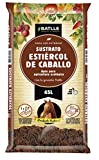
Horse manure – 45l
- horse manure substrate
- Natural product that can be used on all types of plants
- The amount of bacteria the horse needs for its digestive process forms the basis of its unique effect.
- Its use is recommended as an organic amendment
What is compost?
Composting is carried out with fresh and raw manure that we have collected from herbivorous animals such as cows, goats, sheep, horses… which we transform through natural decomposition processes in a composter, a compost or in a compost heap. The heat produced by the composting reactions sterilizes the raw manure and once the process is complete it is ready for use. One of the main characteristics of composted or dried manure is that it has no smell.

Comparison with other types of manure
- Chicken manure: It is a very nutritious fertilizer that also needs to be composted because it has a lot of acidity. This fertilizer works best when we add it in the fall for the next growing season. A disadvantage of this type of fertilizer is that it contains too much nitrogen, attracts more pests and burns the plants if we do not use it correctly.
- Pig manure compost: Any self-respecting private farmer usually has pigs on his farm and he will surely have wondered if his manure is good for the garden. It must be composted well because pigs are carriers of E. coli and salmonella. It takes at least 12 weeks to break down and should be odorless when applied in the orchard.
- Horse manure: It is a well-balanced fertilizer that works great for garden vegetables. A downside is that they don’t digest it as well as cows and can have weed seeds that have passed through the horse’s stomach quickly but haven’t been inside long enough to spoil.
- Sheep manure: It is one of the richest and most balanced with a large amount of nutrients.
- Cow manure compost: It is a well-balanced compost since the cow digests the cellulose of the plants well, facilitating its subsequent decomposition.
Why use cow manure compost?
After years of cultivation after cultivation, the soil depletes its nutrients and microbial life is reduced. Besides nutrients and minerals, composted cow manure will provide the soil with a large amount of microbial fauna which will improve the soil structure over time.
Another benefit is that if you have very sandy or clay soil, adding this compost will also help, as over time it will become more spongy and with a high amount of nutrients. To get it, you just need to talk to the local farmer and get options on how to get cow manure regularly.
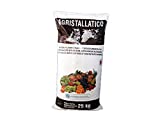
Pellet manure (Agristallatico) (25 kg), fertilizer for…
- Heavily moistened cattle manure. It promotes the development of microorganisms. Provides humic acids and carbon.
- Old and moistened manure.
- Totally natural and complete organic fertilizer that nourishes plants and maintains soil fertility. Based on heavily moistened cattle manure, it improves the structure of the soil, promotes…
- Authorized in organic farming.
How to Compost Cow Manure
Depending on the space available and the composting equipment, several compost piles can be made:
- Small stack: They are usually made 1 meter high by 2 meters wide and one downside is less sanitation. Not all seeds are removed and the outer layer is not fully composted. As for the turning, it is done after one month of the beginning of composting and the external layer must remain inside the central part so that the heat can clean it. By this method, it takes 6 months to complete the compost.
- Large Stack: This system is for those who allow the mechanization of the system. It would be a pile about 2 meters high, 2-4 meters wide, and any length you want. In 30 days it would be sanitized and in 3 to 5 months completely composted. The reversal would take 7 to 15 days depending on the temperature it reaches. And a second shooting after 45 days since it is cow manure.
how to stack
It consists of providing a first layer of fibers about 2o centimeters from the fibrous soil (straw, dry grass, ferns), a second layer 20 cm high of cow manure, a third layer of fibers and so on until reach the height of about 1 meter. It is important to place the driest manure in the center of the pile so that it hydrates with the manure around it.

Factors to consider
For composting to be done properly, these factors must be controlled for satisfactory composting.
- Humidity: It is very important to control the humidity of the manure. To do this we will take a handful and squeeze it, if it drips a few drops it means it has the right moisture, if a trickle comes out it means it is too hydrated so we should add some dry matter and mix well, if nothing comes out it is that it lacks water, it must be hydrated with water at low pressure. It is important not to apply too much water pressure as this can compact the material and decrease aeration, producing bad odors.
- Aeration: The microorganisms that break down the material need oxygen to do so. That’s why we put layers of manure and layers of fiber. If the pile smells bad, it must be turned over to air it.
- Carbon-nitrogen relationship: Microorganisms require a balanced relationship between these two elements.
- Materials containing carbon: paper, shavings, thin branches, straw, dry grass, ferns.
- Nitrogen-rich materials: fresh excrement, fruits, green grass, dry leaves, horticultural waste. There are C/N relationship tables that you can consult for more details. For example, a ratio of 100:1 would be 100 scoops of carbon to 1 scoop of nitrogen.
- Temperature: This indicates that the battery was well made because a few hours after the battery was made, the temperature should reach 45-60 ºC, 55 ºC being the optimum temperature. If kept for 15 days at this temperature, sanitation is guaranteed. If all goes well, after 15 days it must be returned so that the outer part is also sanitized. If it does not heat up, something is missing. On the other hand, if the temperature is very high, exceeding 60°C for 5 days in a row, it is advisable to turn it over to prevent it from drying out. If it has been very hot, you can add water, but not too much.
- Particle size: The material we provide as a rest size, the bigger it is, the more difficult it will be to compost because microorganisms cannot digest it, therefore it is ideal to shred it with a shredder.
- Platform: It is important to cover the compost pile with a porous material such as a geotextile net or straw, so that the air circulates well. It is inconvenient to use plastic.
- Area where we will make the stack: It is important that it is kept away from watercourses because it can contaminate it. About 50 meters.
What do you think ? Was this article helpful to you? Yes Do you have doubts Where do you want leave a comment you can enter the forum and if it works for you you can still support the channel with a donation or help me spread it, by sharing it on social networks. If you want to follow me, here are some of the social networks I use Facebook , instagram , pinterest That is subscribe to my youtube channel
HERE I LEAVE YOU A POSTER IN CASE YOU WANT TO SAVE IT ON PINTEREST
