
If you purchase an item through links on this page, we may earn a commission. Our editorial content is not influenced by commissions. Read full disclosure.
The first sign that spring has arrived is when you spot eye-catching forsythia shrubs bursting with color. It’s hard to miss those bright yellow forsythia growing there, especially when the rest of the world is still in its winter dormancy.
Ever since 1908, when the first horticultural variety was brought to America, gardeners have been obsessed with growing this plant in their gardens.
Looking for a spring color? Then keep reading to learn more about forsythia and growing it at home.
What is Forsythia?
Forsythias are fast-growing shrubs belonging to the Oleaceae (olive) family. The first known species brought to Europe was the Hanging Forsythia var. sieboldi. Then a second species was imported from China called the Forsythia viridissima in 1844.
Many cultivars of this plant were developed in the following years.

Here are some of the most common forsythia varieties.
Bronxensis
This dwarf F. viridissima The cultivar is perfect for creating a low border around your garden, as they only grow a foot tall and a few feet wide. It flowers in March or April and the leaves turn purple in the fall.
Party
‘Fiesta’ is a hybrid (F. x intermediate) that can grow up to three feet tall and four feet wide. This variety blooms in late winter, making it one of the earliest bloomers among the forsythias.
You can spot ‘Fiesta’ shrubs by their distinctive red stems and yellow, green and cream foliage. The leaves turn purple when the growing season ends in the fall.
Frontier
Like a cross between F. suspense var. sieboldi and F. viridissima, this hybrid is famous for its considerable height, bright color and rounded shape. It can grow up to ten feet tall and 12 feet wide, with beautiful arching branches.
For people looking for an expansive shrub with vibrant flowers, this is a good option.
Kumson
Unlike other forsythia varieties, ‘Kumson’ (F. viridissima var. Korean) is unique. It has green leaves with contracting veins of cream and almost silvery tones.
The leaves turn brown in the fall and have dark purplish-brown stems. So even when the plant becomes leafless in winter, you can still admire the pretty branches.
Meadowlark
This forsythia shrub is one of the most cold hardy of the entire species. It is a hybrid between F.ovata and FEuropeea and can be grown in zone 3. Other varieties of forsythia typically grow in zones 5 through 8, where the climate is more temperate.
‘Meadowlark’ can also grow up to ten feet, making it an excellent hedge.
Sunrise
A “semi-compact” grower, this forsythia is selected from late winter to early spring. The branches grow vertically which distinguishes them from other varieties.
The foliage on F. x intermediate ‘Sunrise’ turns deep purple in the fall.
Lynwood Gold
This shrub reaches a height of six to eight feet and has branches that grow upwards. The golden flower gives a splash of color to your garden and is excellent as a standalone plant.
you can grow F. x intermediate ‘Lynwood Gold’ near other plants to create contrast in texture and color.
Some other favorite forsythia cultivars are:
- gold of the north
- Karl Sax
- Goldilocks
- Beatrice Farrand
Forsythia planting
These shrubs are best planted in the fall or early spring.
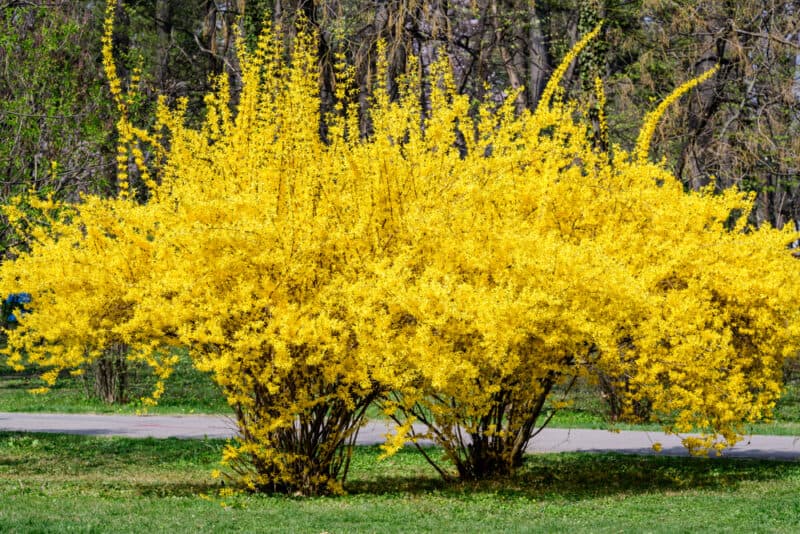
Forsythia shrubs should grow in a location with at least six hours of direct sunlight per day. They can survive in less light, but they won’t flower well.
Floor
The best type of soil for growing forsythia is well-drained and loose. It is also possible to grow forsythia in clay soil. This plant thrives in soil pH levels between 6.8 and 7.7.
The soil should drain well, so amend the compacted soil with compost or mulch.
Temperature and humidity
Ideally, forsythias should grow in moderately humid environments. If the humidity is too high, the risk of disease is higher. These plants grow in USDA plant hardiness zones 5-9.
However, there are a few hardy varieties that can handle colder temperatures.
Planting
Most people like to plant forsythias in the spring after the last frost. However, early to mid fall is also ideal when the weather is not too hot.
Depending on the size of your shrub, you need to leave enough space from one plant to another, or between a structure. Generally, an eight-foot space is perfect for larger varieties.
When you order online, you will most likely get bare root forsythias. Plant them with the root ball below the ground and the crown at ground level.
To plant, dig a hole twice as wide and deep as the root ball or growing container.
Place the plant in the ground and cover it with soil and organic compost. Water well.
Caring for Forsythia Plants
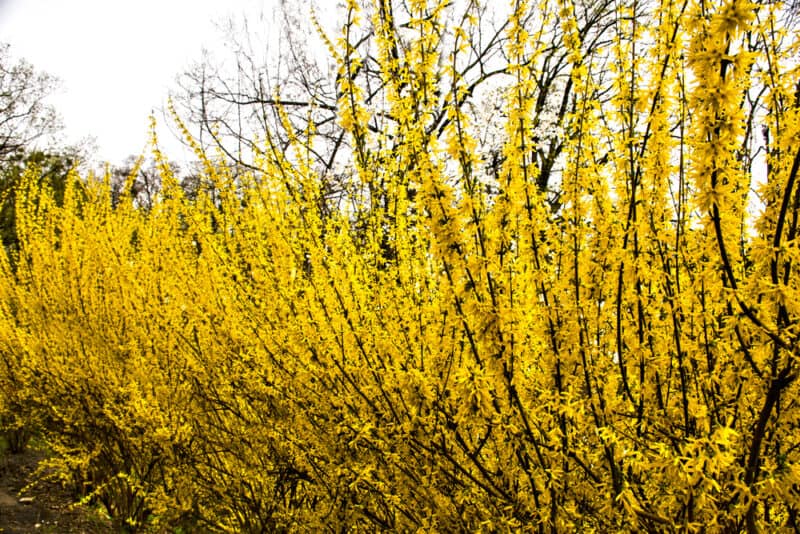
Forsythia does best with moderate humidity, so watering should be part of your regular schedule when caring for this shrub if Mother Nature doesn’t provide it.
When your plant is young, keep the soil evenly moist but not soggy or wet. Humidity levels are more crucial when the plant is young or recently planted.
When forsythia is established and has been growing for a while in one location, it can survive a brief drought.
Fertilizer
Fertilizing should not take place until your forsythia bush is one year old. After one year, apply a mild all-purpose fertilizer to the base of the shrub once a month in the spring and summer.
Common pests and diseases
Forsythia shrubs are generally hardy and free from many pests and diseases. There are only a few issues to consider when growing this plant at home.
pests
Brightly colored flowers attract butterflies, bees and other wildlife, good and bad.
The best way to keep pests from destroying your forsythia plants is to do some general maintenance around your garden to pick up any remaining debris. This removes breeding areas and places where insects can hide.
Tarnished bugs
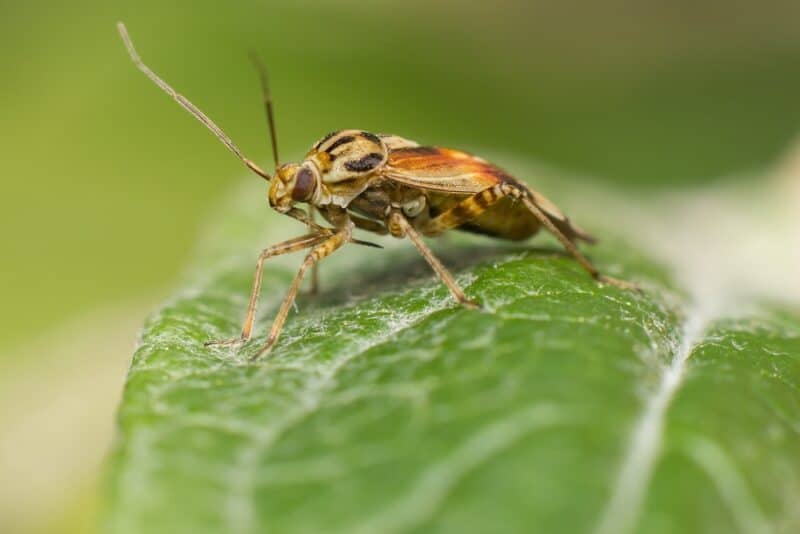
Watch out for tarnished bugs (Lygus lineolaris). They like to eat the flowers when they are in full bloom.
These insects are copper-brown and have white markings behind their heads. It’s hard to miss them. They lay their eggs in plant tissues and the eggs hatch after five days. Then they feed on the plants using their sucking mouthparts.
This feeding causes stunted growth, distorted new growth, and ragged leaves and flowers.
Keeping weeds and debris away is the best way to prevent these insects. There is no good control method, so pick the ones you find and drown them in soapy water. A happily growing forsythia won’t die from an infestation, but it may look ugly.
Japanese two-banded weevils
Another insect that can damage your forsythia is the Japanese two-banded weevil (Pseudocneorhinus bifasciatus). The first signs of this pest are when parts of the foliage are missing and there are holes in the leaf margin. These pests are most active in the spring.
Weevils fall from the plant when disturbed, so use them to your advantage. Place a tarp or rag under the plant and shake it vigorously. The weevils will fall off and you can pick them up and drown them in soapy water.
Diseases
The main disease that can infect forsythia plants is crown gall, caused by the bacterium Agrobacterium tumefaciens or a mushroom in Phomopsis gender.
You can spot this disease when tumor-like lumps appear on the stems. Growth beyond the galls is usually stunted and weak.
There is no cure for this disease, but you can remove galls or heavily affected branches on established plants. Dig up and dispose of severely infected plants.
Use of forsythia
Surprise! Forsythia is edible. Most people grow forsythia for the decorative element, but you can eat the flowers and young leaves. Both are quite bitter, so taste a little before filling an entire salad with them.
Sprinkle them on a salad for lunch or use them as a garnish for evening meals.
Once the flowering season is over, small, nut-like capsules will remain on your plant. As the fruit is rich in oleanolic, it is said to help maintain healthy blood pressure.
Weeping Forsythia (F. suspense) is an important herb in Chinese medicine, which uses the fruits of the plant. Forsythiae Fructus (FF) is the dried fruit of the forsythia shrub and the most used part in Chinese medicine.
The fruit, called Lian Qiao in Mandarin, is believed to cure colds, fevers and sore throats.

The flowers contain rutin, a nutrient compound with powerful antioxidant properties, as shown in a study in the journal Molecules.
The flowers can be used to brew tea when you have a cold or the flu. Additionally, you can use the flowers to make syrup. To do this, follow this recipe:
- 3 cups of forsythia flowers
- 3 cups of water
- 3 cups of sugar
Boil the sugar and water together until the sugar dissolves. Leave to cool, add the flowers and leave to infuse in the sugar water for 24 hours. Strain the flowers before using the syrup.
Was this article helpful?
Yes No ×
We appreciate your helpful feedback!
Your response will be used to improve our content. The more feedback you give us, the better our pages will be.
Facebook pinterest