
If you purchase an item through links on this page, we may earn a commission. Our editorial content is not influenced by commissions. Read full disclosure.
Journaling is one of the most rewarding hobbies. Each journal is a beautiful and unique way to record your thoughts, plan your dreams, or track cyclical events. I use journals as reading logs, weekly planners, and property management tools, as well as keeping a simple diary of daily thoughts and reflections.
One of the most useful journals I keep is my garden journal.
Every year I spend the winter planning next year’s garden. I put together a layout, review my saved seeds, order new seeds, and map out a game plan for starting seeds, building soil, weeding, harvesting, and canning. I do everything in my garden journal.
Function and purpose of logging
Of course, everyone approaches gardening (and journaling) a little differently. For some of us a garden journal is a great place for sketches or watercolors of the garden through different seasons, for others it’s a great way to analyze the cost-benefit ratio.
I know of a gardener who uses his journal to compare the cost of supplies to the current market price of his total yield. I know another who fills his garden journal with excerpts of poetry and watercolors of the garden at sunset every month of the year.
Your journal exists to serve your purposes as a gardener. But I find it useful to use it in some way as a record keeping and planning tool.
Think about how you took notes in school: did you illustrate your notes, use a lot of charts, or just write them down? Did you tell stories in your notes to keep them interesting? It’s likely that the way you took notes is similar to how you’ll want to keep your journal.
Next, think about the type of planning that will best help your garden thrive. Do you want to rotate your garden every year? Nothing helps me plan rotational gardening better than reviewing my garden journal each spring.
I can see where the cabbages were planted last year and the year before. I can see the garlic has grown twice in the same bed and should be moved in the fall. Choose to record aspects of your garden that are important to you and ignore aspects that are not a priority.
Choose a journal
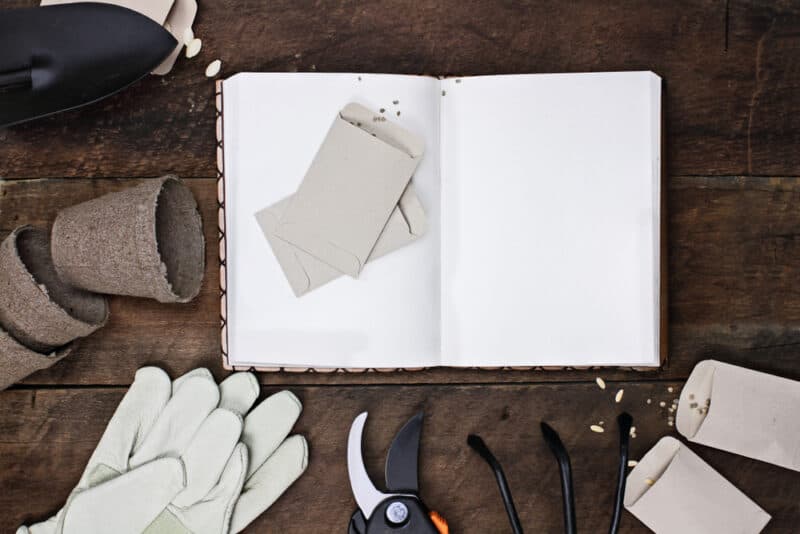
There are so many journals to choose from. Of course, there are specially designed gardening journals on the market. Most of them come with many common logging categories ready to fill out, such as seed information, garden maps, and planting dates.
For example, Gem Publishing’s Garden Life Planner has all of that plus a place for each week of the year to jot down notes.
The Gardener’s Journal lets you track each plant year after year, so it’s best for perennials.
Many journals are beautiful, well-made books that can get you started with minimal effort on your part.
Sure, they tend to be a bit more expensive than DIY options, but you’re paying for convenience and organization. These pre-designed gardening journals have a few drawbacks, however.
The price is only the first limitation. Professional gardening journals can start at around $20 and go up fairly quickly to over $60.
These journals are also usually designed to cover a year, which means you’ll need to keep buying new journals every year and keep track of your old ones. Since one of the best things about a garden journal is the ability to track your garden over the years, it can be frustrating to keep changing journals.
Another downside is that pre-printed gardening journals don’t offer much variety. If your garden is much smaller or much larger than expected, the newspaper may not fit your plans. If your garden includes year-round plants, an orchard, or specific cultivation techniques, a commercially made journal may not be enough for you.
Other Options
Many DIY journals make an excellent base for a fully personalized garden journal. If you’ve followed the bullet journal trend, you may have seen exciting and artistic bullet journals covering every possible aspect of gardening.
I like to keep my gardening journals in a travel journal system that gives me both the space and the freedom to focus on the aspects of my garden that need the most planning.
Others prefer to use a basic blank or lined notebook. It all depends on what and how you hope to save your gardening.
Don’t forget that you can also go digital. There are many templates that you can use on your tablet or laptop. Keep in mind that you probably won’t want to use these options in the field or risk dirtying your expensive gadgets.
A basic gardening journal
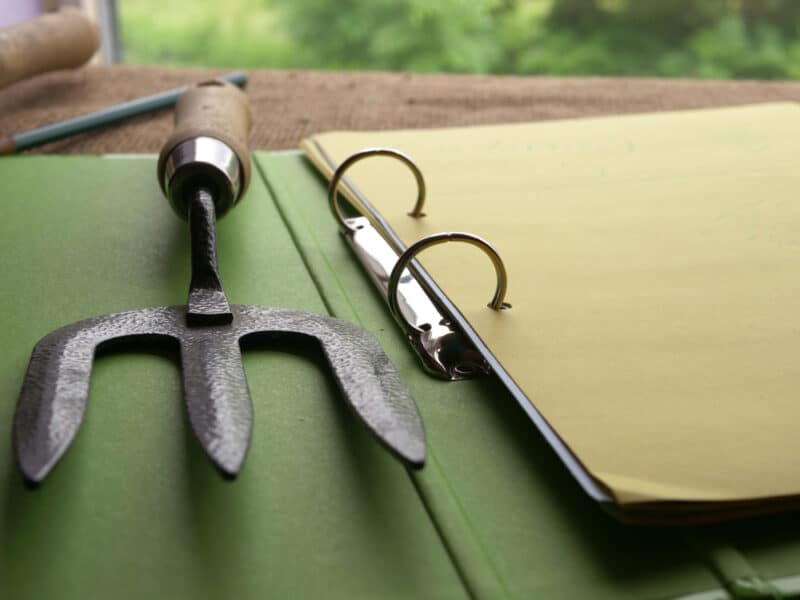
Although each journal is unique, there are some fundamental aspects of the garden that most people will want to keep track of. These are the fundamentals of your gardening journal.
Layout
Whether sketched, painted, traced or simply described in words, a basic layout of the garden (or gardens) is extremely useful.
Layout pages allow you to see at a glance what to expect from each area of your garden. An annual layout will help you rotate your crops, apply fertilizers, and even keep track of weeding.
Landscaping planning can also help if you want to design more ornamental gardens or build cold frames later in the season. A simple layout page provides a quick view of the garden from the top, but a more elaborate layout can give you a variety of perspectives.
Seed records and planting times
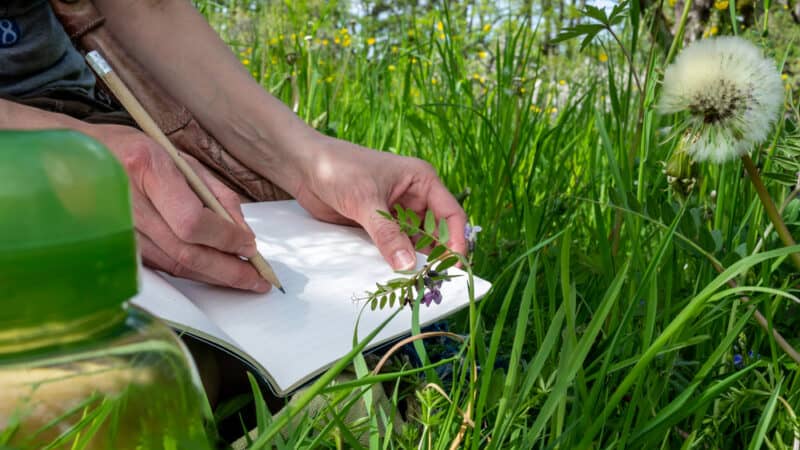
Not all seeds grow in all gardens. When I find a variety that is easier to grow or better suited to my needs, I record the type of plant, the variety and where I found the seeds. I also record the best time to plant, expected harvest time and any other relevant information.
At some point, my seed records helped me realize that a once favorite seed supply catalog was declining in quality. I was able to detect the declining viability of their seeds early on and switch to a new supplier before it had a profound effect on my garden.
And every year when spring is on the horizon, I can check my planting times and remind myself to wait another week.
Recording your seed notes is an important part of successful garden journaling. If you are also purchasing seedlings, note where you got your plants and how they performed to avoid repeat disappointment and maximize quality control.
Seasonal Notes
As the growing season continues, use your diary to track when you’ve weeded, watered, and fertilized. What pests have attacked your garden and how have you dealt with them? What kind of harvest did you get and when did you harvest each plant?
These simple, seasonal notes are often the most important part of a gardener’s journal. They are also some of the most useful to look back on. A few lines every day, or every other day, will do wonders for keeping you up to date with everything that happens in your garden each year.
Fun additions to a garden journal
My garden diary is not just about over-planning every aspect of the garden. I also like to keep track of fun things. Nothing says your garden journal has to turn into an essay – keep it nice, or you’ll never want to take it again.
Canning Recipes

From violet jelly in the early spring to cranberry and fir jam in the fall, I keep some of my garden journal just for fun, “must-try” recipes. I always manage to make one or two new ones every year.
These recipes also help me when I feel overwhelmed by a summer glut of zucchini or a fall glut of pumpkins.
Craziest Vegetable Prices
I like to draw or photograph my weird vegetables and fruits. There are always a few funny-looking carrots, tomatoes, and squash. Pears and apples can also have odd shapes.
This year the prize went to a melon that tried to grow between the fences. Try adding a “Collection of Oddities” section to your garden journal to remember your weirdest harvest.
Trackers
Bullet Journal enthusiasts love creating elaborate trackers for mundane tasks. If you find it hard to motivate yourself to weed the garden or process the tomatoes, try a tracker. Any design you like can be used in a garden journal!
Wildlife sightings

Whether you live in the suburbs, on a farm, or deep in the woods, gardens attract wildlife. Some of them are pests, others are welcome guests. It’s fun to keep track of who stops and why.
My own journals record the time a moose wandered into my pumpkin patch as well as the more common visits of scarlet tanagers and gray squirrels.
Weather models
I like the weather. It’s one of my favorite things to follow in my journals. Partly, I like knowing weather patterns and seeing signs of change on the horizon. But weather tracking can also be deeply practical.
It is important to know when you are approaching the first fall frost or the last spring frost. It is useful to know if we are tending towards dryness.
Weather notes in your garden journal will help you keep tabs on the climate around your home. The more aware we are of small changes, the better we will know how to support our gardens.
Books and articles
Of course, any gardening journal should have a resource list. If you found a book or article that helped you, write it down. Since articles can be hard to find, I like to either cut them out of magazines or print them out and then stick them in my journal.
Having your favorite resources at your fingertips is incredibly useful because it’s time to put them to use.
Was this article helpful?
Yes No ×
We appreciate your helpful feedback!
Your response will be used to improve our content. The more feedback you give us, the better our pages will be.
Facebook pinterest