

If you are a plant lover, some that are surely not missing in your garden or at home are the succulents. These are plants that practically take care of themselves, as long as you take care of their needs. For this reason, this time we want to focus on Kalanchoe thyrsiflora.
You know which one is? What are their characteristics ? And the care you need? Don’t worry, we’ll answer all of these questions below. Take note!
How is Kalanchoe thyrsiflora

First of all, you need to know exactly what Kalanchoe thyrsiflora looks like. It is a perennial plant of the Crassulaceae family. Native to Madagascar. However, you may find it with other names like “elephant ear”. The reason for this nickname is due to its leaves, which have a soft and velvety texture and are dark green. These leaves grow in rosettes at the base of the plant, and don’t be surprised that they easily reach 15 centimeters in length.
In addition to these characteristic leaves, he will also throw flowers at you. Are they will be in clusters and may be red, pink or yellow. They will always do this in the spring and summer.
It is actually very easy to care for and can be kept both indoors and outdoors. However, he needs a series of requirements to fulfill in order for him to grow up healthy and happy, which we’ll talk about next.
Care Kalanchoe thyrsiflora
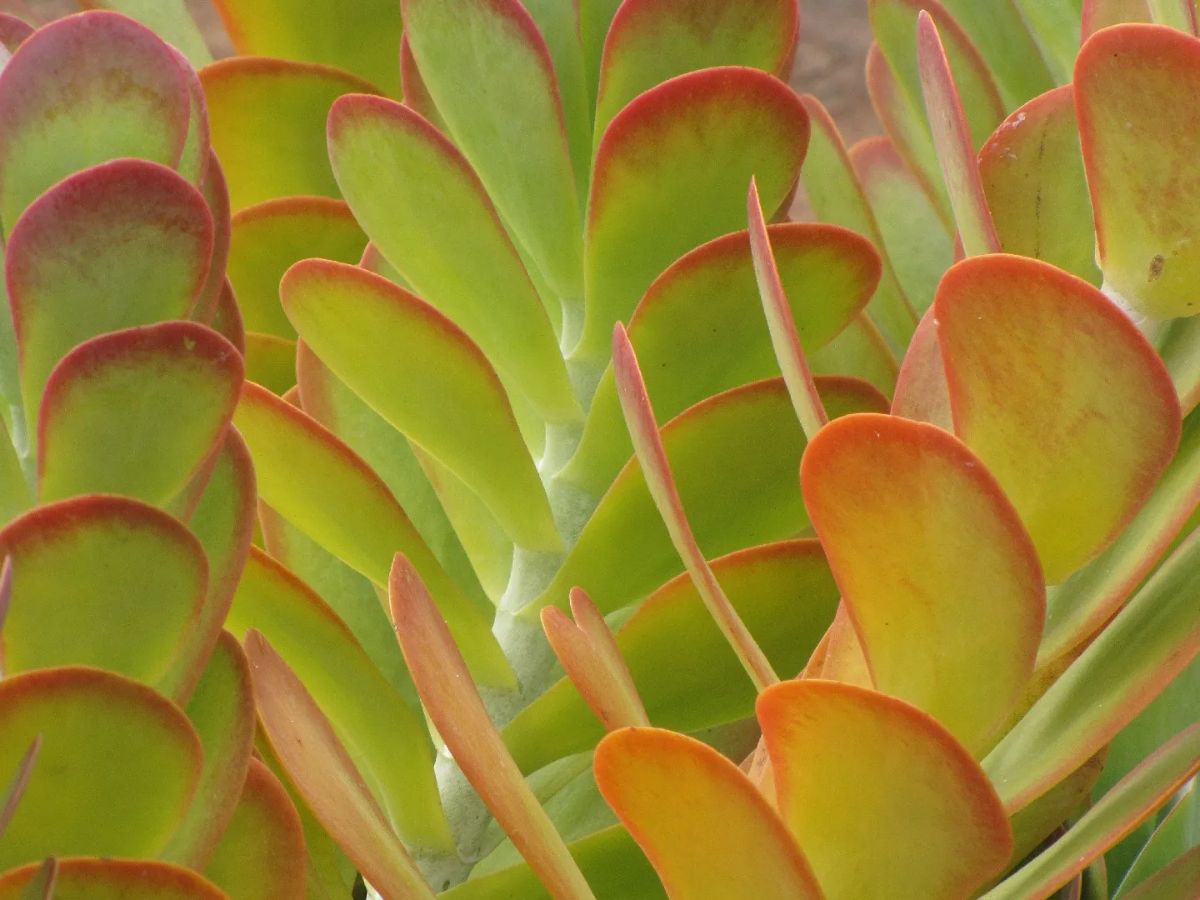
If you have a Kalanchoe thyrsiflora or are thinking of buying one, what we indicate below can help you cover all its needs. Remember that the more you offer him to get closer to what he needs, the more he will thank you (beautifully).
Location, lighting and temperature
Let’s go with three important guidelines for your plant to do well. As for the location, you can Place it both indoors and outdoors. It is said to be placed in a place where it does not receive direct sunlight, since its leaves are very sensitive and this can cause them to burn. In addition, Depending on the weather you have, there may or may not be more hours in the sun.
For example, if you live in a hot climate and the sun burns even in winter, it will be better to put it in partial shade so that it receives the sun early or late in the day, and the rest is protected.
As for the light, it takes a lot, always indirectly. Finally, the temperature is essential. And it is that the Kalanchoe thyrsiflora does not tolerate extremely low temperatures. try to keep it always above 10°C. It prefers high temperatures to low ones.
Transplantation
When you buy your Kalanchoe thyrsiflora, you may not have to consider putting it in another pot. But if the one he’s wearing has the roots in it and they come out, then yes you should. You will have to put it in a bigger pot and for that the best substrate to use is a mix of cactus and succulent soil.
If you can, add a little perlite or similar to prevent the soil from settling too much and the roots to be better oxygenated.
Irrigation
One of the most important cares for Kalanchoe thyrsiflora is irrigation. And it is that if you spend with irrigation you can load the plant. In this case, scarcity is preferable to abundance.
That said, keep in mind that you have to water it only when the soil is completely dry. Don’t worry about thinking he’s going to suffer; in fact, it will not be because it is drought resistant. And it is better to water little, even if you have to watch it more often, than to abuse it and rot the roots.
Subscriber
Unlike other plants that need monthly fertilizers, in the case of Kalanchoe thyrsiflora this is not the case. you can throw it away once a month, or every two months, in spring and summer. But instead of the dose recommended by the manufacturer, in this plant you need to use half of this dose.
Cut
Kalanchoe thyrsiflora will need help to stay healthy and promote flowering. We refer to the need you will have for you cut the dried flowers, as well as the leaves, to keep it from looking sloppy.

Plagues and diseases
One of the problems that worries us the most when we have plants is not knowing if they have pests or diseases (until it is unavoidable). In the case of Kalanchoe thyrsiflora, you should know that the most common are the following:
- Mites: Mites are a type of arachnid that feed on plant sap. You will notice that the plant has brown spots on the leaves and a rough appearance. To remove it, you have to clean it with a damp cloth and use a pesticide.
- Whiteflies: It also feeds on the sap of the plant. Its treatment is the same as the previous one, except that the pesticide must target this pest.
- Powdery mildew: Powdery mildew is a fungus that appears as a white or grayish coating on the leaves and stems of the plant. To treat it, you must clean the plant and use a fungicide that prevents its appearance.
- Mould: You will notice this because a white or grayish layer will form on the surface of the earth. What you will need to do is remove the top layer of soil and replace it with a fresh layer of soil. Of course, we recommend that you also use a fungicide because this way you will prevent it from reappearing.
Multiplication
Finally, be aware that there are several ways to propagate your Kalanchoe thyrsiflora. We tell you.
- For the cuttings: This is the fastest and easiest way. It consists of cutting a cutting about 4 to 6 centimeters long. You will need to remove the bottom leaves and put it in a pot with potting soil for cacti and succulents. For best success, place it in a somewhat sunny and warm place. And keep the soil moist (not wet). After a few weeks, the cutting should root.
- By division: Another way to propagate a Kalanchoe Thyrsiflora is to divide. That is, when you take the plant out of the pot (to transplant it, for example), you can cut the plant with a knife, making sure that each part has some leaves and roots, and plant directly in separate pots with soil for cacti and succulents.
As you can see, caring for Kalanchoe thyrsiflora is not difficult. Would you dare to have one in your home?