
Have you ever let a snake plant get so big it falls off? When snake plants are grown for a long time, their leaves often become too long and weak.
In this article, I will discuss the causes of excessive leaf growth in snake plants and countermeasures for those dealing with overgrown plants. Once you understand why, taking action is easy.
What causes snake plants to overgrow?
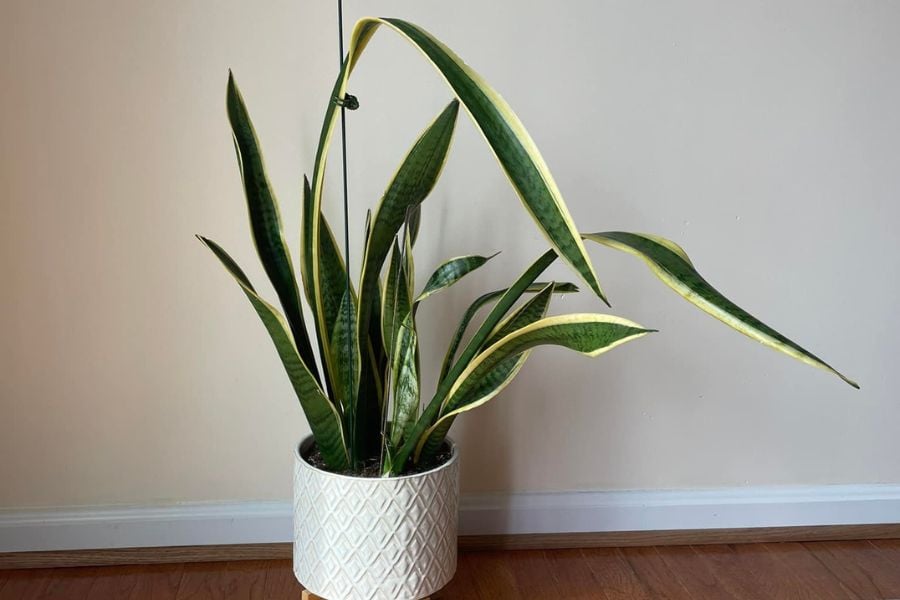 Long-legged snake plant droops due to etiolation: lack of sunlight disrupts cell growth
Cause 1: insufficient sunlight
When a snake plant grows tall and thin, the most likely cause is “etiolation” due to insufficient sunlight. Native to hot, dry regions of Africa, snakes love sunlight.
They can grow indoors due to their shade tolerance, but tend to grow weak and tall if they don’t get full sunlight. Learn more about how much light snake plants need.
Cause 2: Overwatering
Snake plants are heat and drought resistant, but weak to cold and humidity. Overwatering can lead to overgrowth.
Overwatering will cause the snake plant to swell and grow larger than necessary. Learn how much water snake plants need and how to save overwatered snake plants.
Two solutions for overgrown snake plants
Now you might want to know what to do with overgrown snake plant leaves. Here I will introduce two top solutions for overgrown snake plants.
Solution 1 – Use a support pole or tie the sheets together
 Tie up the leaves of the long-legged snake plant; promotes stability and promotes healthier, stronger growth
The leaves of an overgrown snake plant will begin to droop due to etiolation. In this case, you can use a ring support post.
Although not the best solution, slowly allowing the plant to receive more sunlight can make the dead leaves stronger.
You can also gently tie the leaves with a ribbon or string. Move the attached leaves to a sunnier location.
It takes a while, but the plant gets smaller and the leaves are less likely to drop. Try.
Solution 2: propagation by leaf cuttings (from May to September)
Another option for dealing with overgrown snake plants is to propagate them using leaf cuttings.
Leaf cuttings involve cutting the Sansevieria leaf near the base, pruning it back to about 4 inches (10 cm), then planting it in the ground to propagate new baby plants.
This can increase the number of snake brood and rejuvenate the plant. For a step-by-step guide on how to propagate your snake plant, check out this article on how to propagate Sansevieria.
Keep in mind, however, that snake plants propagated by leaf cuttings can “regress” back to their original green form and lose their variety.
For example, in the case of the Laurentii variety pictured, the yellow edges of the leaves would disappear.
Additionally, propagating snake plants via leaf cuttings is time consuming – young plants can take around two years to reach maturity.
Another option is to wait for the seedlings to sprout. Snake plants spread by underground rhizomes and produce baby plants alongside the parent plant.
The growth of snake plants is particularly vigorous from May to September. During this time, place the plant in a warm place with good sunlight, provide fertilizer and maintain slightly dry conditions to promote the growth of young plants.
I use an all-purpose fertilizer for my snake plants and to speed up the growth of young plants. You will usually see quick results within two weeks as evidenced by the growth of the plant.
I like to use this water soluble fertilizer every time I water my plant. If you’re wondering how much to apply, read the recommended dosage on the package or use ¼ teaspoon in a gallon of water to water your snake plant.
It can be difficult to restore a faded leaf to its original condition. In this case, one option is to promote the growth of young plants and divide them later.
3 tips to prevent the proliferation of snake plants: Prevent discoloration beforehand
So how can you prevent snake plant overgrowth from overgrowth? Here are three tips for preventing etiolation in snakes:
1- Manage the plant from May to September in a sunny place outdoors
Snake plants are native to dry areas with strong sunlight. If you want to grow a sturdy and healthy snake plant, you may need to let go of the idea that “foliage plants = houseplants”.
In addition to the cool season, place your snake plant outside on a balcony or under eaves to allow it to absorb plenty of sun, preventing overgrowth from etiolation.
To better understand the light needs of snake plants, read my article How much light does the snake plant need?
Do not suddenly expose the plant to strong sunlight!
However, if the plant is suddenly exposed to direct sunlight while being moved indoors, it can cause sunburn on the leaves. By gradually accustoming the plant to outdoor sunlight, sunburn can be avoided.
Start by placing the plant near a window, then gradually move it outside. Sufficient sunlight is essential for growing a healthy, upright snake plant.
* Avoid direct sunlight during summer and western afternoon sun.
2- Bring the plant in when the temperature drops below 10°C
Snake plants are sensitive to low temperatures and grow slowly even above 15°C. So if you are growing your snake outdoors or on a balcony, bring it indoors when the temperature drops below 10°C.
Remember that when the temperature drops below 50 degrees Fahrenheit (10 degrees Celsius), the snake plant will enter a “dormant period” when growth stops. Water the plant sparingly during the dormant period.
Additionally, the risk of plant death increases when temperatures drop below 5°C (41°F). Learn more about snake plant temperature tolerance.
Pay special attention when placing a snake plant in front of the window.
Be careful when handling snake plants near the window. While windows can be warm and sunny during the day, they can get much cooler in the evenings and mornings.
That’s why it’s a good idea to place the plant at least 1 meter away from the window at night.
Overwatering in winter can cause snake plant leaves to drop
The leaves of snake plants tend to drop during winter and spring dormancy.
Then you may be overwatering the plant. In winter, growth is minimal and the plant does not need much water. However, overwatering the pot can cause root rot, so be careful.
3- Keep them dry
Snake plants are very tolerant of dry conditions. Therefore, it is advisable to keep them a little drier than other houseplants.
During the spring and fall growing seasons, water the plant as soon as the soil is dry, then wait another 2-3 days. When watering, make sure there is enough water to drain from the bottom of the pot.
Be careful not to leave water in the saucer, as high humidity can lead to root rot. Periodically discard the water from the saucer. To learn more about proper watering techniques, read How Much Water Do Snake Plants Need?
Below 15°C, growth slows down so almost no water is needed
If the indoor temperature is above 10°C, you can water the plant once a month while you monitor the condition. Then start watering again when the minimum temperature is above 15°C (60°F).
If you’re wondering when to water your snake, don’t worry, it’s simple and you don’t need fancy tools to determine the level of moisture in the potting mix.
Just touch the surface of the soil and feel if it is wet. If so, you can delay watering a little longer.
However, sometimes the soil surface can be dry, while there is still enough moisture in the soil.
To be sure, just stick your fingers into the ground. But if you don’t feel any dryness in the top 1-2 inches of soil, it’s time to water your plant.
Key learning points
In this article, I have described the causes and solutions for snake plants that are too tall. Adequate sunlight is essential to prevent overgrowth due to etiolation.
Consider transplanting the plant when the pot is full of leaves, as shown in the photo above. Transplanting is more than solving root problems; old soil can compact over time and clog drainage.
In addition, replenishing the soil by transplanting provides the necessary nutrients for the plant. Use this information to observe your snake plant and identify causes and remedies for its overgrowth.
Two main causes of overgrowth in snakes:
- Etiolation or long legs due to insufficient sunlight
- excess water
Two solutions for snake plants that are too tall:
- Use a support ring or tie the leaves together, then gradually move the plant to a sunnier location and monitor it until it gets support (avoid temperatures below 15°C).
- Cut only the leaves that are too tall and try to propagate them by leaf cuttings.
It is difficult to thicken etiolated leaves that have become elongated, thin and weak. Instead, adjust the location of the plant and wait for healthier leaves to grow.
Tips to prevent the proliferation of snake plants:
- Place them in a sunny location outdoors.
- Bring them in when the temperature drops below 10°C.
- Keep them dry (water only when the soil is dry).
Sharing is caring!