
We all had to learn how to level it at some point in our country. Learn how to level land manually can be simple and with great satisfaction. Unlike using machines, the floor will not suffer, even if it takes much longer. We need to know the fundamental steps so that all the work is not in vain.
For this reason, we are going to dedicate this article to telling you how to level land manually, what aspects we must take into account and what are the steps to follow.
How to level land

Select a slope. There are three ways to do this. Cut directly into the slope and use a retaining wall to hold the ground in place or place a retaining wall on the lower slope and fill it. In this case you will need at least one dirt truck, and once in place it will take about a month to settle. Generally, heavy rain will help in this process.
If there is an existing structure, install umbrellas as there may be a risk of sunstroke. Leveling the ground is hard work and there is a risk of heat stroke. The key here is to use a low-tech tool called a fork. All you have to do is sink the roots of the grass, pry and pull. Put all the grass you have removed in a wheelbarrow and bring it to an unused part of the land. Even if the grass doesn’t settle (which requires a lot of water to settle at first), it will at least help rejuvenate the soil.
Use a laser level and a pole (if you don’t have one) to mark the exact level on the ground. Mark the end of the level with masking tape.
Tools and steps to learn how to level land

Cut from behind. Use a sturdy pickaxe, the heaviest pickaxe you can lift above your head and comfortably touch the ground. break the earth with a hoe. After touching the ground, bring the earth back towards you. There are many techniques for manipulating the beak. With the right shot, you will be able to remove a fair amount of dirt from the terrain. The stones you remove can be used for foundations. Try using the side pick and other moves to use different muscle groups.
Move the loose soil to the bottom of the slope. Put the soil in a wheelbarrow, turn it over so you can flatten it with a hand compactor. If you just want to level the bottom, you don’t need to modify it much. A good rain will take care of the filling. Perform final pressing after leveling and rutting. If soil must be restrained, place retaining walls. Retaining walls can also be used as main walls.
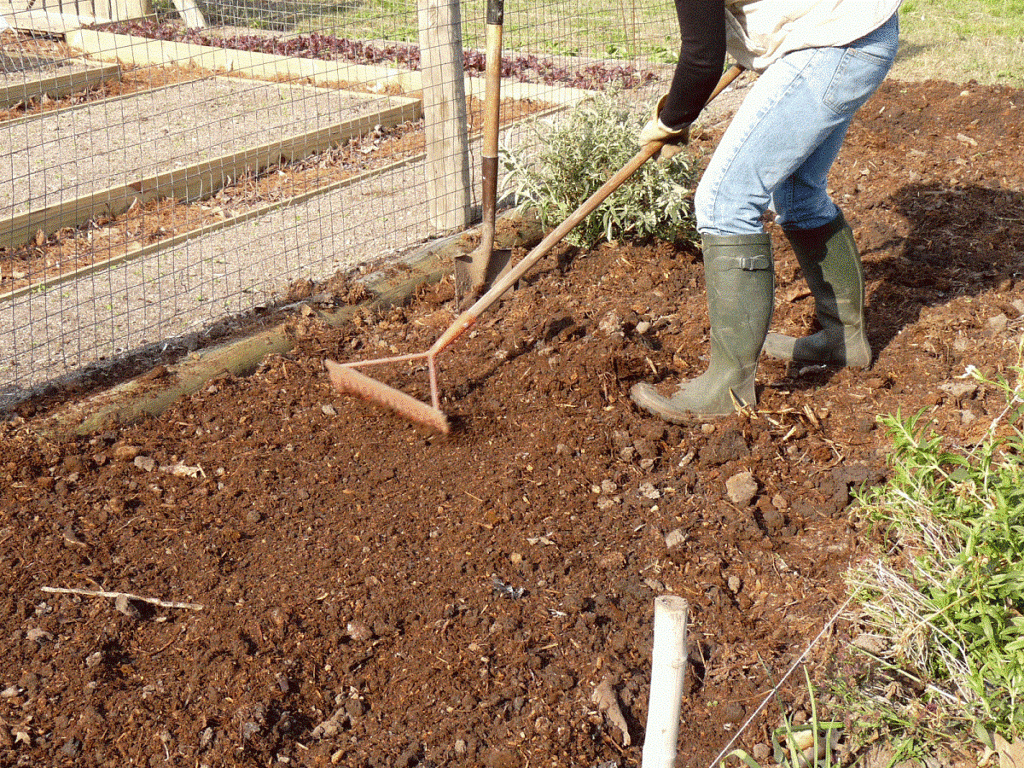
Rake the slope and level it. Extend the board 10cm across the area you are working on, so that the surface is smooth and level. Soil compaction is not very important if the soil is going to be exposed to weather conditions for a period of time. All the hand pressings in the world can’t compare to the decanting effect you get after a few rains.
Permits and requirements for grading rural land
Rural land leveling work may require planning permission. These authorizations require the Environment Department of the Town Hall, which is the competent authority. In addition, the application may also require the submission of a technical project. It is a document prepared by a technical or senior agronomist or a forestry engineer who must include a plan of the field in action, indicating the height, dimensions and the presence of trees or buildings.
The project will be accompanied by an explanatory report detailing the work to be carried out, the modifications that the land will undergo and the work safety measures. The documentation must be exhaustive and explain in depth the type of transformation to be carried out. These reports may also require positive environmental impact reports from the competent bodies of each Autonomous Community. These analyzes guarantee that the natural environment is not irreversibly affected.
Once approved, the work can be carried out. If they are large, it would be beneficial to have a construction company that specializes in this type of work. These companies have earthmoving specialists who will ensure that the work is carried out accurately and in the shortest possible time. In this sense, it is very important that the company has experience and qualified personnel for measuring the heights of land. These personnel must also be qualified to carry out the blasting, of course, if explosives are to be used to blast certain rocks during the project, an explosives transfer and handling permit is also required. Construction companies are used to managing this type of mandate.
Finally, if the farm is located in a protected natural area, such as a national park or natural park, it must be authorized by the governing entity. If they affect watercourses or groundwater, the corresponding hydrological syndicate must also be notified and approved.
Legislation applicable to the leveling of rural land

Given the transformation of rural land, it is necessary to know the legislation that affects this activity. In general, the autonomous communities are responsible for determining which lands are rural and which lands are urban and approve the urban plans of the various cities. On the other hand, environmental regulations, also of a regional nature, limit what can be done and its impact. Among these rules, those that protect the environment in a particular way are highlighted, such as those for the management of national parks. In this case, it is a particularly restrictive legislation that must be respected with the greatest caution.
In general, learning to level land should not be a very complicated job, but it is very important to do it with all the guarantees. For this, it is necessary to obtain all the necessary permits and licenses and to trust only qualified professionals to carry out the transformation actions. With these basic precautions, they can have peace of mind and ensure successturning rustic soils into perfect crops or ideal builds in nature.
Hopefully with this information you can learn more about how to level land and what aspects to consider.