
If you purchase an item through links on this page, we may earn a commission. Our editorial content is not influenced by commissions. Read full disclosure.
Sunny spaces in your summer garden are easy to color because many plants love the sun and bloom in the summer. But what about shady places? Or winter color? If you are growing hellebores in your garden, then you have both covered!
This wonderful evergreen thrives in shady spots and begins blooming as early as November, depending on where you live and where you grow. In colder regions, they will appear before just about anything else, providing late winter color.
Let’s look at growing hellebores.
What are hellebores?
Often seen at the edges of woods, hellebores are reliable plants of the genus hellebore in the Ranunculaceae family. This group also includes delphinium, anemone and aconite.
Hellebores are herbaceous perennials native to the Middle East. They grow well in USDA plant hardiness zones 3 through 9 and typically bloom in early spring.
Hellebores tolerate a wide range of temperatures and with a little protection in very cold winters will produce reliably season after season.
There are around 20 species of hellebores with countless hybrid versions to choose from. You may also know them as Christmas rose, winter rose or Lenton rose.
Best varieties of hellebores
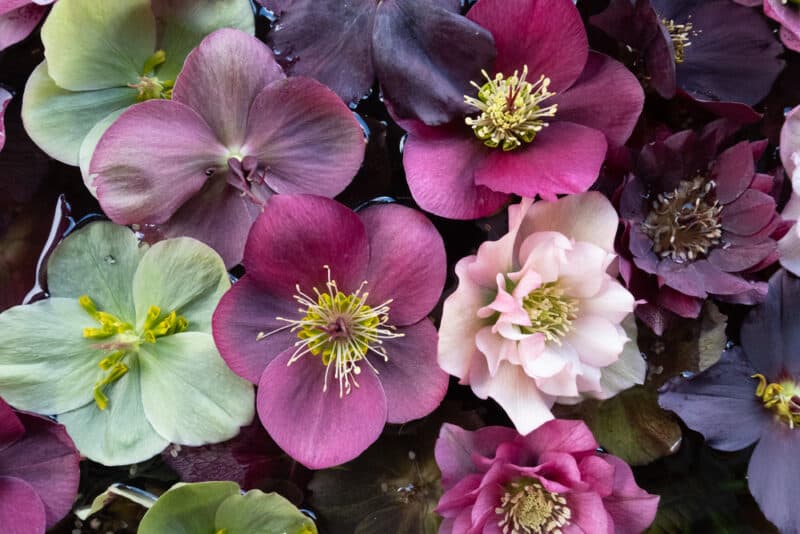
By far the majority of hellebores to be grown in the home garden are hybrids which as a group are known as hellebore X hybrid. You may also see plants labeled as H orientalis or H.nigeras these are two of the most common species.
They provide color from winter to spring, from when most of the garden is still dull and colorless. There are so many different colors, flower shapes, and sizes that you have tons of options.
Here are some favourites:
- Philippe Ballard: This variety has intense dark blue flowers which sometimes appear black in the sun. Zones 6 through 9 are suitable for this variety.
- Winter Jewelry: Suitable for zones 5-8, the gold blooms are beautifully edged in pink.
- Angel glow: Grow this one in zones 6-8. The pink flowers turn light green as they age on the plant.
- Anna’s red: The flowers are deep red and rich purple in color. The leaves often have pink veins. Plant in zones 4-9.
- Onyx Odyssey: This hybrid has purple-black double blooms that make a stark contrast to a blanket of snow. Grow in zones 5-8.
- Harvey’s Red: Those in zones 4 through 9 can grow this vigorous hybrid with single pinkish-red flowers.
- Winter sun: Bring winter color to your garden with this single-flowered hybrid. Each flower is ivory and yellow on the face with a pink back. Grow in zones 4-9.
- Silver Shadow: This plant, happy in zones 6 through 9, has single pastel pink and purple flowers.
- Yellow Lady: The flowers of this hybrid are a beautiful yellow mottled with brown.
- Best of Bob: This pretty plant has flowers that first appear pink before gradually turning ivory with green streaks. Plant in zones 6-9.
See what’s available in your area. Hybrids come in single, double, and semi-double flower forms, but if you plan to attract pollinators, they prefer a single form.
How to Propagate Hellebores
There is some disagreement about the division of hellebores. Some hybrids don’t react well, but I haven’t had any issues with Helleborus x hybridus.
The advantage of dividing seed collection is that the resulting plant is like the mother plant. Growing hellebore hybrids from seed is an assumption what they will look like.

Do this in late fall before the flowers appear. Always wear protective gloves when handling hellebores due to the sap they contain.
- Dig up the whole plant and carefully remove all the soil from the crown. If you have compacted soil, water around the plant an hour before you start digging it up.
- Cut between the growing buds, making sure you have at least two buds in each new division, but three is even better.
- Once divided, place the divisions in a bucket of water. They should not be allowed to dry out.
- Replant in the new location.
Seeds
Start with fresh seeds because hellebore seeds don’t stay viable for very long.
- Collect the entire seed head by cutting it over a paper bag.
- Lay some newspaper on a table and empty the bag on it.
- Using your thumb and forefinger, rub the seeds from the seed head onto the newspaper.
- Pick up the easily recognizable seeds and discard the straw.
Another way to collect seeds if you don’t have much time or don’t want to go through the above method is to use organza bags over the plants.
- Buy organza bags large enough for a four-inch flower.
- When the flower head forms and the sepals (the outermost green part of the flower) turn brown, place the bag over the flower head of the plant and pull the string to close it.
- Shake the bag gently every day for a few weeks.
- When you hear the seeds rattle inside, cut off the flower head.
- On newspaper, divide the seeds and chaff and store the seeds in a paper envelope.
Plant the collected seeds immediately, otherwise they form a hard surface that must be stratified as they become dormant. Plant the fresh seeds in containers and leave them outside all summer. Keep the soil moist and the seeds will germinate next spring.
Don’t let the soil dry out.
Stratify hellebore seeds
If you are using old, not fresh hellebore seeds, you will need to go through a stratification process in order for them to germinate. If you don’t do this step, the seeds will not germinate.
- Soak the seeds in cold water until you see them swell. It can take up to two days, but is often over after one.
- Sow the seeds in a good quality potting mix and store them in an area around 35°F for six weeks.
- Move containers to an area where they can be maintained at around 50°F.
- Germination should begin in about six weeks, but may take longer.
How to care for hellebores
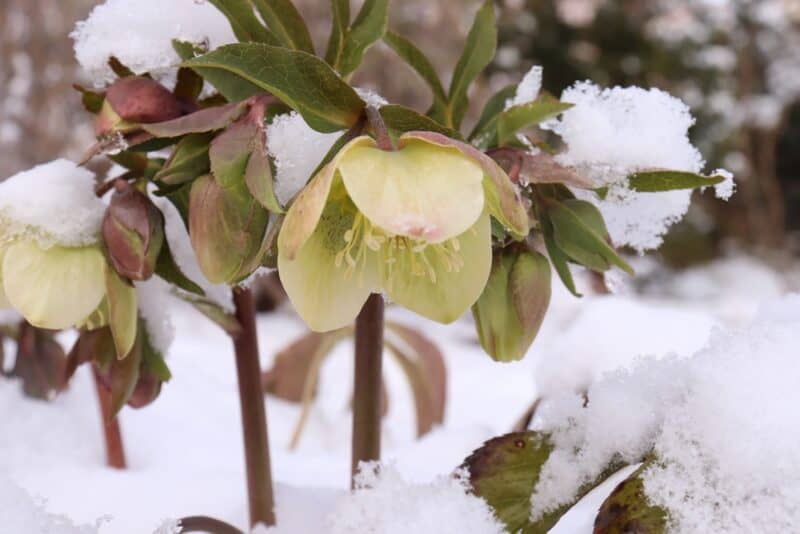
Hellebores tolerate most temperatures in USDA growing zones 3-9. In areas with very cold winters, protect the plant from winter conditions with a windbreak, frost-proof fabric, or other protection.
The soil should be rich and loamy. It should drain well, but be able to retain moisture. The pH should be between 7.0 and 8.0. The perfect soil retains moisture but not for too long.
Dig in well-rotted manure or other organic material before planting. Do this at least two weeks before planting.
Once a plant is established, it can tolerate slightly dry soil. For the first few months, make sure the soil stays moist. Dig into the ground with your hands. If the soil is an inch deep dry, it’s time to water.
Plant in a partially or fully shaded area in summer that receives winter sun when cooler weather hits.
Under the deciduous trees is a perfect spot. They shade the hellebore from the summer sun, then let in the winter sun once their leaves have fallen.
You do not need to fertilize hellebore if the soil is rich in organic matter. Add another layer around the plant in spring and fall and water well.
Size of hellebores
Proper tidying up at the right time will do hellebores good. Cut any foliage to shreds in winter or early spring. Do this once new growth begins to appear. Cut off old shoots as close to the base as possible.
Wintering
Besides the basic pruning and storage above, hellebores will naturally overwinter and rebound when spring arrives next season. In very cold regions, protect from the harshest winter conditions. Even in these cold regions, hellebores will push through cold soil when it’s ready.
Best Companion Plants for Hellebore
Hellebores go well with many plants. Here is just a sample:
Annuals
- Begonia
- Impatiens
- Cleomes
- Thought
Perennials
Trees and Shrubs
- Rhododendron
- Azaela
- Mahonia
- Dogwood
- Maple
- Beech
- Oak
Problems and solutions for growing hellebore
Although hellebores are quite hardy plants and, if cared for properly, usually don’t have many pests and diseases, there are a few issues you should be aware of:
Hellebore Black Death
Might as well start with the most serious. It is a relatively new disease caused by the Helleborus net necrosis virus (HeNNV).
You will see deformed plants, black lesions and dark rings on the foliage. This is more common from spring to mid-summer. This is also due to the fact that hellebores like shady positions.
Unfortunately, you will have to dig up and destroy infected plants. Burn them or put them in the trash.
Control aphids as this can help prevent this disease. Make sure the plants you buy show no symptoms of this disease.
leaf spot
Also called fungal leaf spot, this fungal disease manifests as brown mottled leaves. Fungal spores settle on wet leaves in humid weather. Small circles form into larger ones that meet and eventually kill the leaf before it falls to the ground.
Poor air circulation is one of the environmental causes, so be sure to plant hellebores with enough space between them and other plants.
For a natural treatment, mix 1/2 teaspoon of baking soda with a gallon of water. Spray liberally until disease stops spreading.
If that doesn’t work, use a copper-based fungicide. A generic fungicide will also work.
aphids
Aphids suck the life out of hellebores and cause other problems like hellebore black death. Read our article on aphids here to learn how to identify and treat this common pest.
Mildew
It is a common fungal disease, especially in wet and humid conditions. Make sure you don’t overwater or wet the leaves. This article explains powdery mildew in detail.
Was this article helpful?
Yes No ×
We appreciate your helpful feedback!
Your response will be used to improve our content. The more feedback you give us, the better our pages will be.
Facebook pinterest