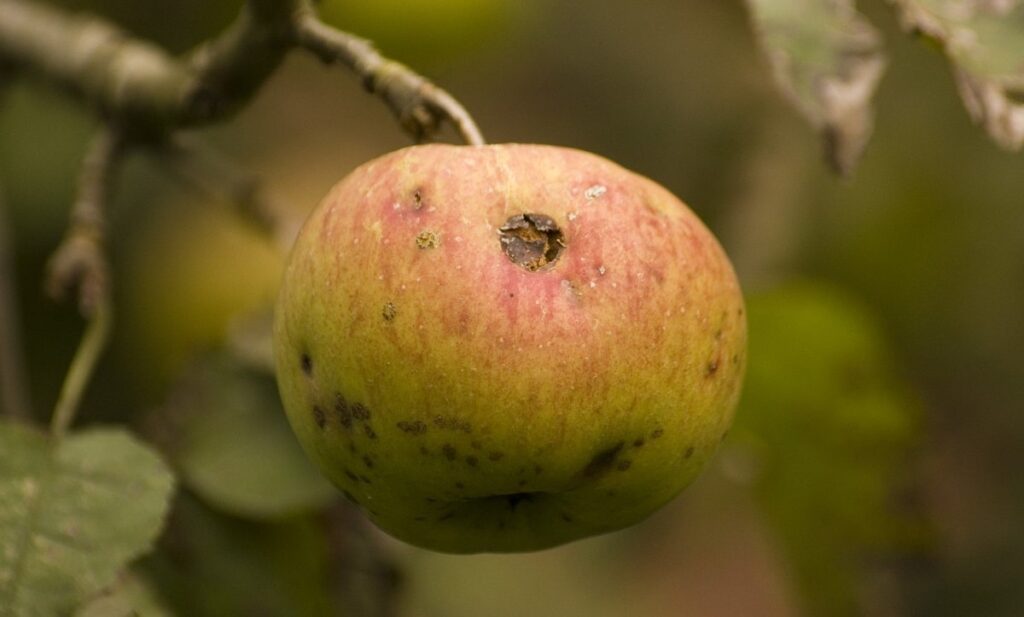
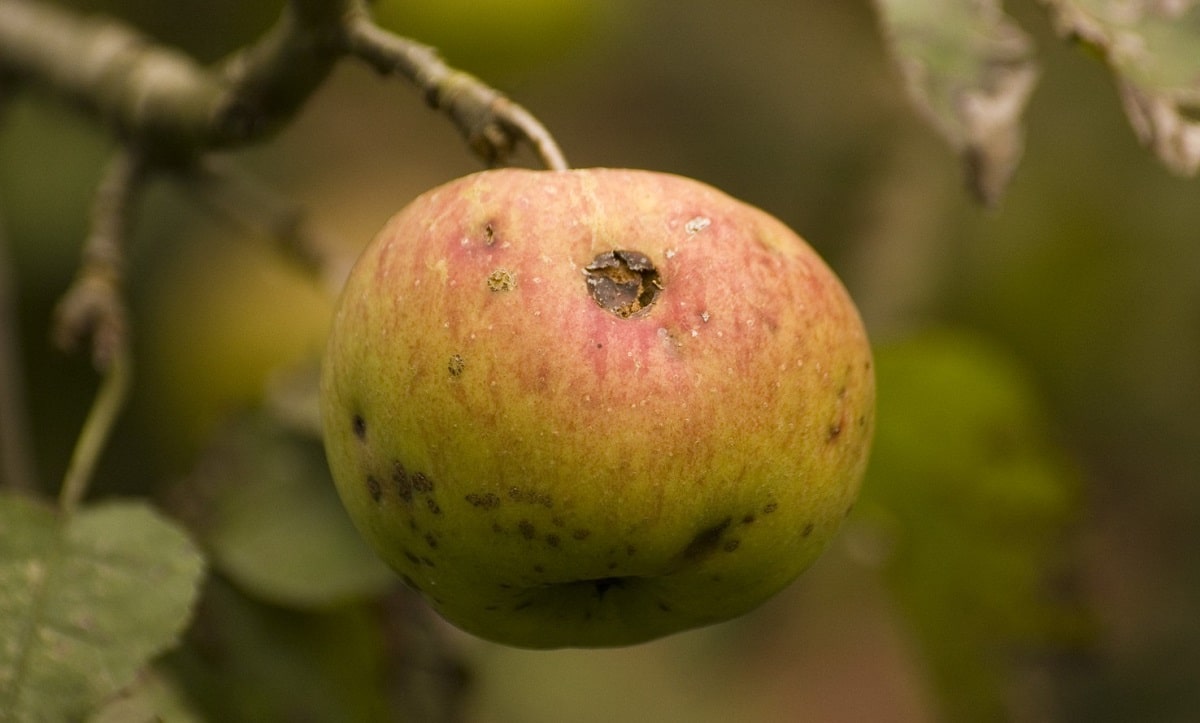
The apple tree is a widespread crop that is also vulnerable to certain diseases and pests. One of the most common is the apple mottle. It is a fungal disease that can seriously affect both the tree and the fruit.
In this article, we are going to tell you what apple tree mottle is, what are its characteristics, symptoms and treatments.
What is apple mottle

Apple tree mottle is the most important fungal disease caused by the fungus Venturia inequalis What affects the production of all varieties of apple trees.
Its appearance occurs at the end of the season, strongly influenced by the spring weather and the rains. Therefore, a humid climate with moist leaves and fruits favors its development in the early stages of the vegetative cycle.
The leaves that fall to the ground are attacked by the fungus between September and November and survive during these months. Later in the spring, when the fungus resumes growth and begins to produce ascospores, the ascospores are dispersed by wind action and reach the leaves and fruits, infecting them again.
For all these processes, precipitation and a certain temperature are necessary. The optimum temperature for ascospores is 20°C. For germination, they are shaken between 15 and 22 ºC, as long as the humidity in the leaves lasts between three and four hours. The incubation period of the disease is 17-18 days at temperatures of 8-10ºC. and 8-14 days at temperatures of 20-25ºC. In addition, the minimum relative humidity required is 80-100%.
It has an incubation period of 9 to 18 days, with symptoms appearing later on leaves and fruits.
symptomatology

Venturia inaequalis can affect all green plant organs, but its most noticeable symptoms, such as leaf spots and scabs, occur on leaves and fruits. In the case of leaves affected by Venturia sp., olive green spots develop first, followed by blackening below due to the production of conidia. If attacked several times, it can end the defoliation of the tree.
Although its action on the leaves can affect yield, the greatest damage occurs when it attacks the fruit. On the fruit, the resulting spots turn black as the spores form. If the disease occurs when the fruit is small, the affected part will stop growing and the fruit will crack, allowing entry of other microorganisms, which promotes dehydration. If this occurs during fruit development, this can affect its aesthetic qualities, as well as its indoor storage and, therefore, its profitability.
Leaf spot fungus overwinters as mycelium on dead leaves and in early spring forms small fruits called “peritheca” which contain the sexual seeds of the fungus, or “ascospores”. These are expelled from the peritheca when ripe and are carried by wind and rain to the leaves and blossoms of apple trees. They penetrate and therefore cause contamination or a primary attack. After 1 or 2 weeks, depending on the temperature, the fungus produces asexual fruiting bodies called “conidia”, which contribute to the spread of the disease and create what is called the secondary attack.
Each spot can produce conidia for 4-6 weeks. Mild temperatures, abundant rainfall and high ambient humidity favor the development and propagation of disease spores or germs, characteristics that are frequent in our climate.
Apple Mottle Control
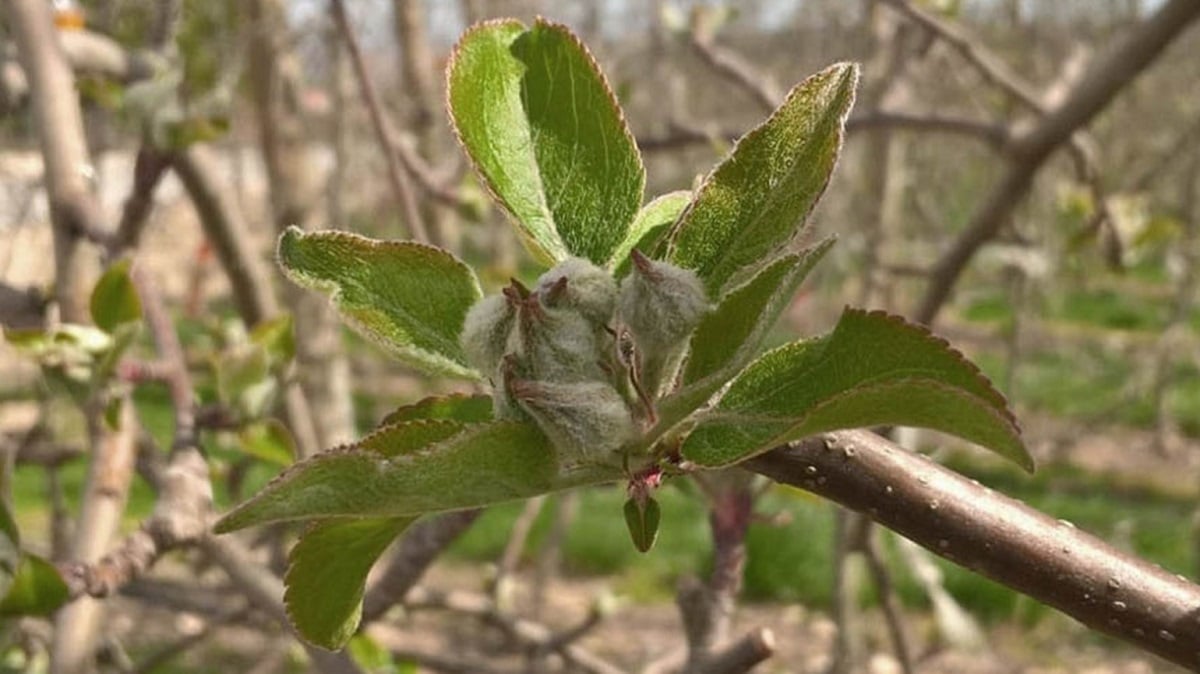
It is important to have plant varieties that are resistant to spotting. Avoid planting in shady or excessively humid areas. It improves the aeration and light of the tree by carrying out a correct pruning, thus, in addition to facilitating the penetration of phytosanitary products, it also shortens the drying time of leaves and fruits. Keep the grass short and remove any leaves that have fallen to the ground in late fall.
Today, effective localized control is carried out chemically to control the primary infection and successive secondary infections. The primary inoculum comes from the ascospores, which are produced inside the enveloped shells that form on leaves that fall to the ground in winter, so to reduce the severity of primary infection one should:
Minimize the formation of envelopes on the leaves in quantity of earth; this can be achieved by picking them up from the ground or by accelerating the process of decomposition of leaf litter by treating them with 5% urea when about 85% of the leaves have fallen.
Prevent infective vernal ascospores from infecting apple receptor organs (leaves, flowers and fruit) as they are easily colonized by the fungus under conditions of constant humidity for a few hours. The ascospores are not expelled abruptly, but rather undergo a gradual maturation process and are expelled from the envelope within 6-8 weeks.
Aspects to take into account the mottle of the apple tree
In our conditions, the flight period of ascospores is generally from the beginning of April to the end of May, depending on the weather conditions of the specific year. Good control of the primary infection is essential to minimize subsequent secondary infections. Tree protection should begin as soon as susceptible organs appear, therefore, in the absence of reporting stations for detailed monitoring of the disease, it is more convenient to treat according to the phenology of the crop. Here are the most important moments:
- Protection from flowering to fruit set with systemic and/or penetrating fungicides.
- During the remainder of the cycle, when the necessary moisture conditions exist, continued secondary infection occurs.
Application should be made after the onset of infectious conditions, taking into account the protection period of the previously applied fungicide. Above all, it is recommended to apply a contact fungicide within 24 hours. Apply a therapeutic antiseptic after the appearance of an infectious state or within 48 hours.
Before the end of the harvest, depending on the severity of the infection in the plot, treatment with a systemic fungicide may be an option to reduce future winter inoculations in the plantation.
Hopefully, with this information, you can learn more about apple mottle and its treatment.