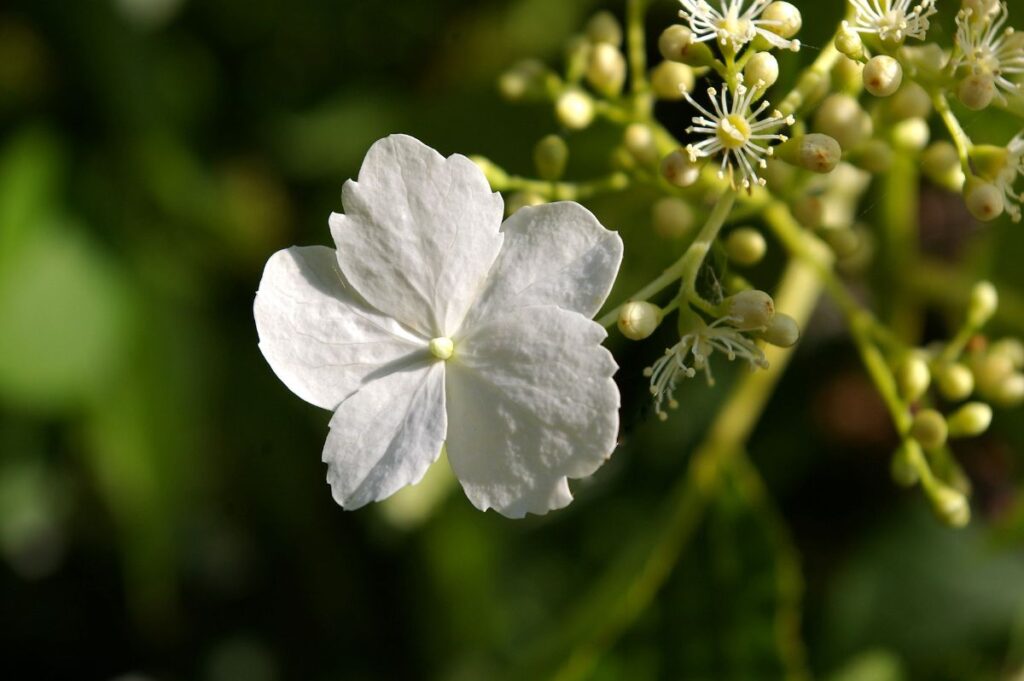

Among the hydrangeas there is one that stands out for its size and also for its characteristics. We talk about the hydrangea petiolarisbetter known as the climbing hydrangea.
But what do you know of her? Beyond the fact that it is a climber, there are certain aspects that you must know. And that’s what we’re going to talk about next. Take a look.
How is the hydrangea petiolaris or climbing hydrangea
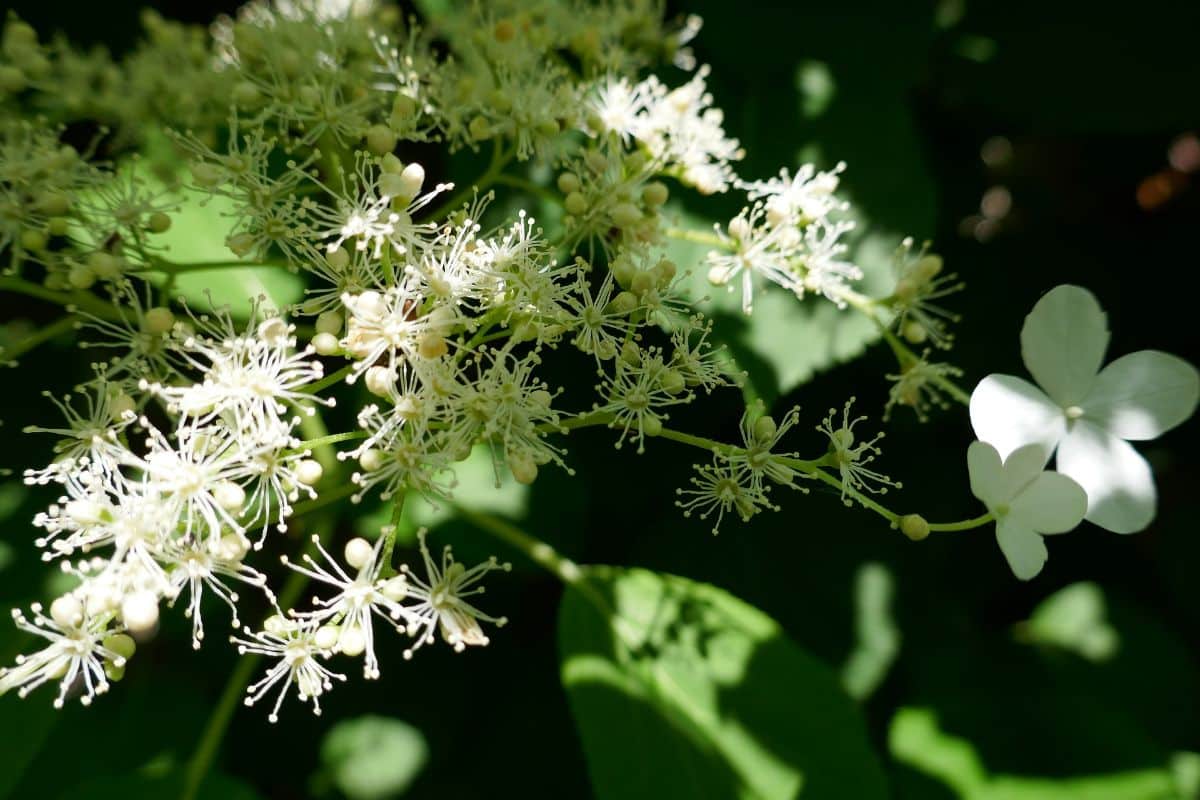
The first thing you need to know about the hydrangea petiolaris He is from Korea and Japan. This plant grows along streams, wooded valleys, rocky slopes… Yes, it grows in the ground. However, due to its characteristics, it is able to climb without the need for help.
Digging a little deeper into each element of the plant, we have the following:
Stem
We start with the stem of the hydrangea petiolaris and we can tell you that it has a woody appearance and a rough, scaly texture. It can reach a height of 20 meters in ideal conditions. while its diameter varies according to the variety and the care given to it. In general, it is not too wide.
This has dark brown bark and as the plant grows the stem branches out, forming secondary branches that extend in various directions.
What makes the stem of the climbing hydrangea so interesting is the presence of heart-shaped roots. which develop along the stem (which we will discuss later).
Leaves
As for the leaves of hydrangea petiolaris are an important feature. They are oval or heart-shaped (although some call it almost heart-shaped), 7-12 cm long and 5-8 cm wide. Its color is shiny dark green above and lighter below.
These are opposite, meaning they face each other in pairs along the stem.. Each leaf has a 2-3 cm long petiole that holds the leaf in place.
Regarding the texture of the leaves, you should know that they have a smooth texture, although the edges are slightly jagged.
What you might not know is that the leaves themselves help you know the health of the plant. If they turn yellow or wither, this can be a sign that the plant is getting too much or too little wateror that there is a problem with the soil or plant nutrition.
aerial roots

Aerial roots are one of the most attractive features of the plant. hydrangea petiolaris. These grow along the stem of the plant, emerging from the nodes of the branches, and adhere to the surfaces on which it climbs, such as walls, trees and rocks. In reality they do not need the aid of a trellis or the like, the roots themselves act as hooks, hence it is said to be a “self-contained” climbing hydrangea “.
These aerial roots are called cord roots and form in response to the growing conditions of the plant. In nature, the hydrangea petiolaris found in areas with steep and rocky groundtherefore its aerial roots allow it to cling to and grow on these surfaces.
They are light brown in color and have a rough, fibrous texture. As the plant grows, they thicken and cling more firmly to the surface. AND this can be a problem as they could damage surfaces such as walls (especially brick) or painted surfaces.
flowers
The flowers of the hydrangea petiolaris they are one of the most distinctive and attractive features of this climbing plant. The flowers appear in large corymbo-shaped clusters in late spring. and early summer, and are quite large, up to 15 cm in diameter. Blooms from June to July only.
They are usually white or creamy, although some varieties may have a slightly pinkish or pale tint. They have a compound flower structure, with many small flowers forming a large, dense head. The individual flowers have four or five petals and are quite simple, with a flat, rounded shape.
But what makes the flowers so distinctive is the way they are arranged on the plant. Because the plant climbs, the flowers are placed in large groups and they often stand in an elevated position, which makes them very eye-catching and easy to see.
Also, be aware that the color of these can vary depending on the pH of the soil. In acidic soils the flowers may be more bluish, while in alkaline soils the flowers may have a more pinkish hue.
Care for Climbing Hydrangeas
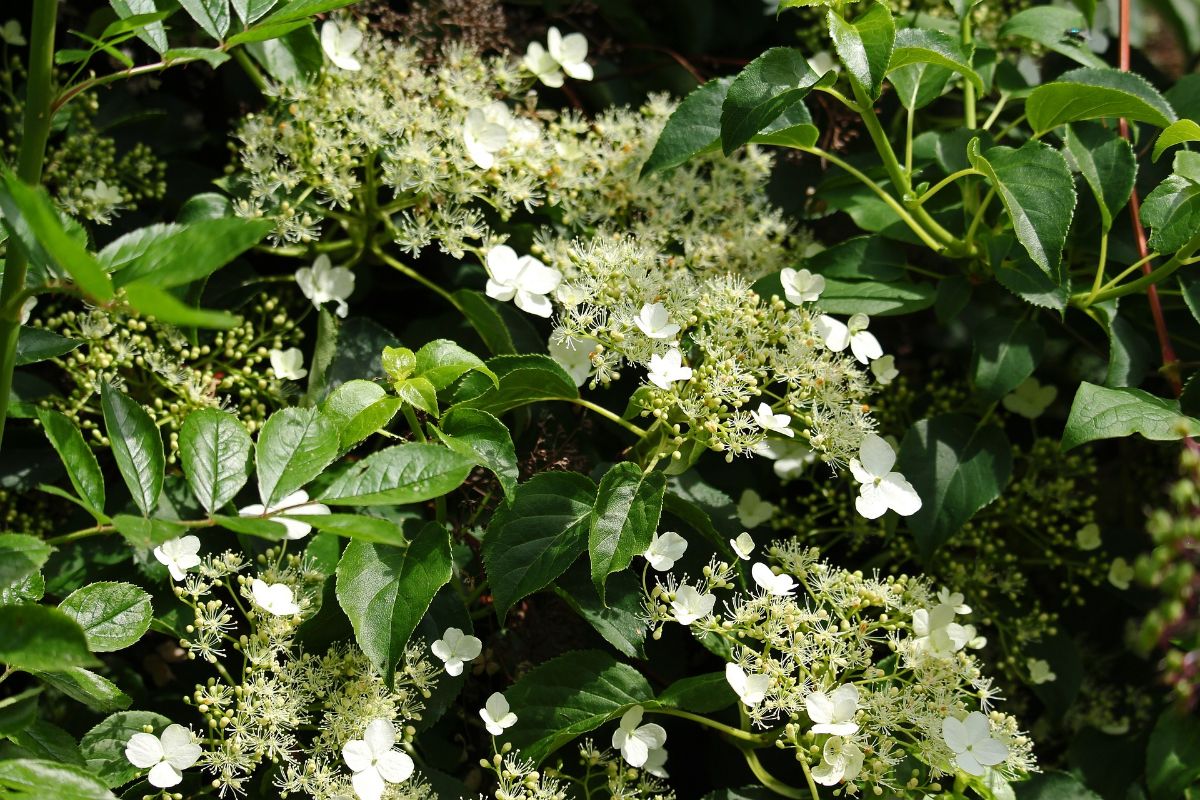
Now that you know more about the hydrangea petiolaris, you might want to have one in the garden. If so, here we leave you with the most important care you should provide.
- Location: It can be in full sun or partial shade. If you live in a region with a warm climate, prefer partial shade. It also tolerates shade, but this slows down its growth, which is already slow in the first years.
- Temperature: It resists both cold and heat. Frosts are also tolerated as long as they are not too frequent and of long duration.
- Substrate: try to use one that is rich in organic matter and retains moisture. Also, remember that it drains well.
- Irrigation: it needs regular watering to keep the soil moist. Allow to dry out between watering and watering to prevent root rot.
- Subscriber: If possible, from late spring to early summer, it can be fertilized with a slow-release fertilizer.
- Plagues and diseases: They usually don’t affect you and even that doesn’t cause serious problems.
- Size: you will have to regularize it after one or two years of planting because it grows very quickly. Better maintenance pruning than drastic pruning.
As you see, the hydrangea petiolarisor climbing hydrangea, it can be a good choice as a climbing plant. Do you dare to have some in your garden?