
The poinsettia (Euphorbia pulcherrima) is one of the most famous Christmas plants, being able to find it in countless places and decorating it with its fantastic red leaves as a houseplant. Despite what you might think, this plant does not need as much water as other flowering plants, so too much moisture often leads to the appearance of different types of diseases.
In this article, we will see which are the main fungi and bacteria that affect the poinsettia.
The poinsettia is a perennial with large, showy flowers that is grown primarily as a houseplant. It’s called “poinsettia” because it usually blooms around Easter, but it can also bloom at other times of the year. Some people buy poinsettias to decorate their homes during the Christmas holidays because they tend to have large, colorful flowers that can add a splash of color and cheer to your Christmas decorations. Additionally, the poinsettia is an easy-care plant and adapts well to indoor living, making it popular as a holiday gift.
Poinsettia Disease Chart
Virtually all of the diseases from which the poinsettia flower suffers are related to excessive moisture in the substrate. Therefore, it is advisable to water just and necessary, not to water again until we notice that the substrate is almost dry.
| bacterial canker | Longitudinal waterlogged streaks on the stems and spots on the leaves. Defoliation and plant death ensue. | poinsettia curtobacteria | Destroy infected plants. Avoid overhead irrigation. |
| bacterial stem rot | The cuttings develop a soft rot at the base which quickly moves upwards and kills the cutting. Wounded stems of older plants develop soft rot and lodging. | Erwinia carotovora | Use sterile propagation medium. Discard infected cuttings and infested media. Destroy infected plants and crop debris. Disinfect tools. |
| flower burn Botrytis | Brown spots form on the tissues of the flower, leaf or stem. | Botrytis cinerea | Avoid damaging plants. Remove damaged tissue. Space the plants to ensure good air circulation. Heat and ventilation to reduce humidity. If these practices are followed, fungicides can help with management. Apply a fungicide to protect the plants. |
| Stem canker by Botrytis | Large, slightly sunken light brown to tan cankers form on older stems, especially near large branches or crotches. Defoliation and branch death occurs above the cankers that surround the stems. | Botrytis cinerea | Avoid damage to established, well-branched plants. Apply a fungicide to protect the plants. |
| FIG leaf | Defoliation. | Root rot, over-fertilization, low light intensity or lack of moisture. | Avoid root rot and over-fertilization. Clean the greenhouse cover well and space the plants well. Maintain even soil moisture levels. |
| powdery mildew | Yellow spots form on the upper side of the leaves. Patchy white fungal growth is observed on the leaves and bracts. | powdery mildew | Frequently scout mother plants and inspect cuttings as soon as they arrive. Continue scouting throughout the season, especially as the plants are spaced out. Apply a fungicide to protect plants as soon as mold is detected. Control should prevent disease before bracts form. Fungicides do not cause white fungus to disappear after death. |
| Root and stem rot caused by Phytophthora | The base of infected stems appears soft and moist. The roots are brown and waterlogged. Cuttings dry out and die quickly. Under dry conditions, the lower pith of the stem is brown and the stem has a gray canker. | Phytophthora nicotianae | Discard infected plants immediately. Use pasteurized soil and clean pots and tools. Keep the ends of the pipes off the ground. Apply a fungicide to protect the plants. |
| Pythium root rot | Early in the season, rooted cuttings are stunted, yellow and wilted. The roots are dark brown in color and the outer layers of root tissue fall off, exposing a bare strand of inner vascular tissue. Later in the season, plants lose their leaves and flower prematurely. | Pythian | Use only sterile soil and clean pots and tools. Keep the ends of the pipes off the ground. Do not over water or over fertilize the plants. Apply a fungicide to protect the plants. |
| Rhizoctonia root rot | Early in the season, the cuttings wilt and turn yellow. The roots are rotten. Lower stems below ground may have a ragged appearance. Later, stunted plants lose their leaves, flower prematurely and die. The dark brown sunken areas on the stem may reach slightly above the soil line. | Rhizoctonia solani | Use only sterile soil and clean tools, and hook the ends of the pipes. Do not over-fertilize. Apply a fungicide to protect plants at planting time. |
| Crust | Small, round, light-colored spots with yellow halos form on the leaf, especially along the midrib. Infected stems extend several inches above the normal crop. | Christmas Eve sphaceloma | Keep relative humidity in the canopy low. Do not wet foliage when watering. Apply a fungicide to protect the plants. |
| Thielaviopsis root rot | At the end of the season, the roots turn black. Wilting of plants. Longitudinal divisions are formed at the base of the stem at and below the soil line. Yellow and fallen leaves. | Thielaviopsis basicola | Use only sterile soil and clean tools, and hook the ends of the pipes. Apply a fungicide to protect the plants. |
 Botrytis in poinsettia bloom Source: Gary W. Moorman, Professor of Plant Pathology
 Powdery mildew on poinsettia: Photo: Scot Nelson
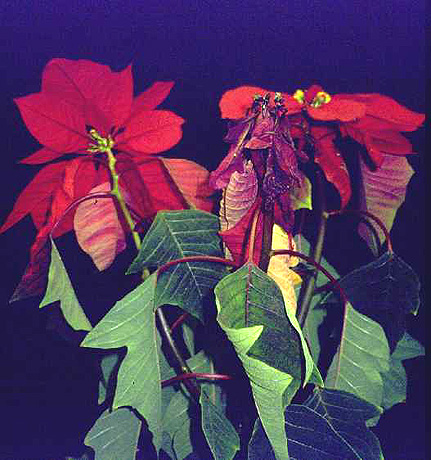 Phytophthora sp on the poinsettia. Source: apsnet
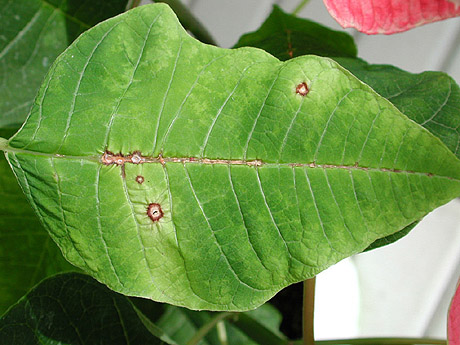 Poinsettia anthracnose. Source: apsnet
 Poinsettia Nutrition Problems
| Ammonium toxicity | Root and top growth is limited. The lower leaves turn yellow while the edges of the leaves are burnt. | Favored by low light and low temperatures in late fall, acidic soil and the exclusive use of an ammoniacal nitrogen source. | Do not use exclusively ammonia nitrogen sources. Do not overwater during periods of low light and low temperatures. |
| magnesium deficiency | Yellowing develops between the mid and lower leaf veins. | Lack of magnesium. | Use of limestone containing magnesium. Apply a fertilizer that contains magnesium. |
| Molybdenum deficiency | The yellowing is followed by a burning of the lower edges of the leaves. The lower edges of the leaves are hollowed down. | Lack of molybdenum or soils with an acid pH (pH 4.5; 5.5 in certain cultivars) | Lime to adjust soil pH above 5.5. Use fertilizer containing molybdenum or a comprehensive minor element supplement, or add sodium molybdate to soluble fertilizer. |
| on fertilization | Plants are stunted. Yellow, drooping lower leaves. Leaf edges yellow and burnt. | Using a combination of slow-release and soluble fertilizers or using non-leaching soluble fertilizers promotes this. Conductivity readings of 1.0 mS or greater for soil or 2.5 mS for soilless mixes (saturated pasty extract) are excessive. | Do not mix the use of slow release fertilizers and soluble fertilizers. In continuous feeding programs, 10% of the applied soluble fertilizer should be washed off the bottom or clean tap water should be applied for every two to three waterings. If soluble salts become excessive, leach thoroughly, wait overnight, and leach again. |
How often to water the poinsettia
How often poinsettias are watered depends on several factors, such as soil type, air humidity, and light the plant receives. In general, it is recommended to water poinsettias every week or every 10 daysbut it is important not to overwater as the plant can be damaged if too much water is given.
When watering the poinsettia, it’s important to use lukewarm water and make sure the soil is kept moist, but not overwatered. One way to check if the plant needs watering is to stick a finger into the soil to the level of the first joint. If the soil is moist, it is not necessary to water the plant. If the soil is dry, it is necessary to water it.
the volumes of water This will always depend on the volume of the pot. We recommend adding 1/10 of the pot volume. If the pot is 5 liters, we will provide 0.5 liters of water.
read more: How often to water the poinsettia.