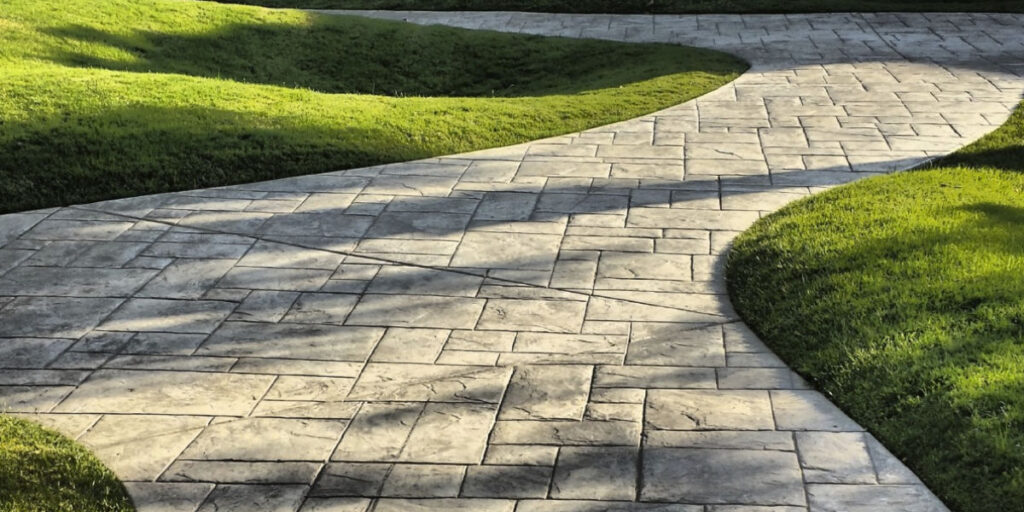
Although you may think stamped concrete is something like a 3D printer injecting concrete, I’m sorry to tell you that it’s not. The concept is not that. Eye! Concrete 3D printers exist but this is not the case here. Let’s see what it is then.
Summer: a time to get out of the routine, enjoy leisure, watch the hours go by, slow down and all you can think about is starting to repair the garden: changing the pergolas, the lighting, painting the fences… I I’m sorry to say it but the human being has no remedy. We can’t find the way… or maybe we do? It can be much easier to find with stamped concrete. You dare?
The concrete. Eternal stuff.
If concrete has something, it is its durability over time (except in cases such as aluminosis), its resistance and its good mechanical properties (compressive strength) which make it perfect for foundations, pillars and structural works of almost all buildings. It resists tensile forces poorly, but for this Homo sapiens imagined reinforced concrete. Iron bars inside the structure that give it this tensile strength.
Another use apart from structural elements is the production of concrete floors. It involves spreading a concrete surface of a certain thickness which, once set, leaves a uniform and resistant surface on the ground in a very short time.
Leaving aside the exciting structural part, concrete has a negative part, although it depends on taste: aesthetics. It is a material, grey, leaden and dull. If true, depending on how it is combined, it can be attractive. In modern architecture, the combination of glass, steel and concrete generates curious environments, cold in my opinion, but sober and bright.
But what is stamped concrete?
Human nonconformity is insatiable. And that’s good because it generates ingenuity to solve such non-conformities. For example, fix the aesthetic part of the concrete. This good material, but gray, leaden and boring, we can turn it into something curious with stamped concrete.
This technique manages to imitate sidewalks, making curious designs as if they were cobblestones, tiles, stone paths or any other shape that comes to mind. You can change the color, the texture, the brightness, the shape of the pattern… The variations are endless.
 Variants of stamped concrete
If at some point it occurred to you to make a frequently used path so as not to destroy the lawn, garden paths are interesting and also decorative if done gracefully. Winding paths, lit, with flowerbeds and flowers on the sides. The design of a garden also goes through its accesses and they are no less important.
And why imitate when you can put stone, tile, cobblestone or wood?
Well, that’s the first and only question you should ask yourself and the answer to which will depend on what you want to “get involved in”. If you are very purist and don’t like imitations, stamped concrete might not be your first choice. Even so, enjoy what we tell you compared to other types of garden paths.
Interview
The maintenance of a paved road has its raison d’être. In the photos everything is beautiful, but the reality is that nature pierces always and plants will begin to grow between the joints of the cobblestones or stones. This implies two things:
- The first is that you may not like weeds in the joints and need to remove them.
- The second is that if you leave them, the roots will eventually lift and loosen the paving stones, stones, wooden planks… This creates a sloppy appearance and care must be taken to repair if you want uniformity and durability in garden paths. .
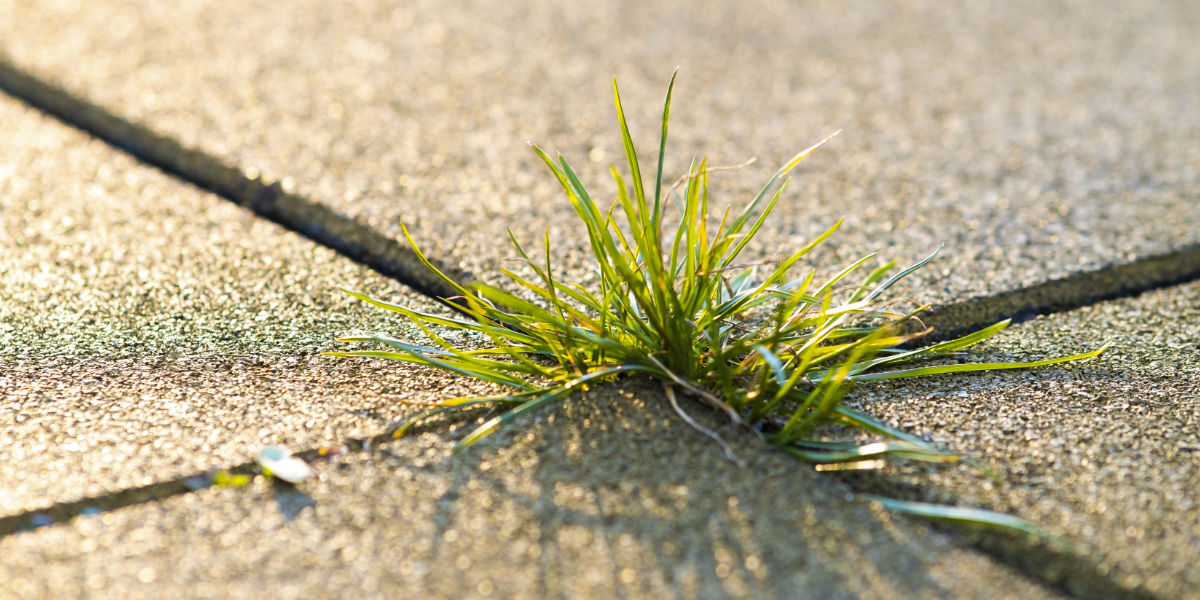 Nature always finds a place to move forward. Even in the joints between tiles or pavers.
 material price
The price of the material, depending on which we put, may be more expensive, equal or slightly lower than stamped concrete. Normally it is more expensive per m2. Although concrete may seem expensive, a stone, granite or slate pavers is more so. And let’s not talk about things like marble. Marble paths are made even if you don’t believe in them and if you don’t believe in them, go to Dubrovnik in Croatia.
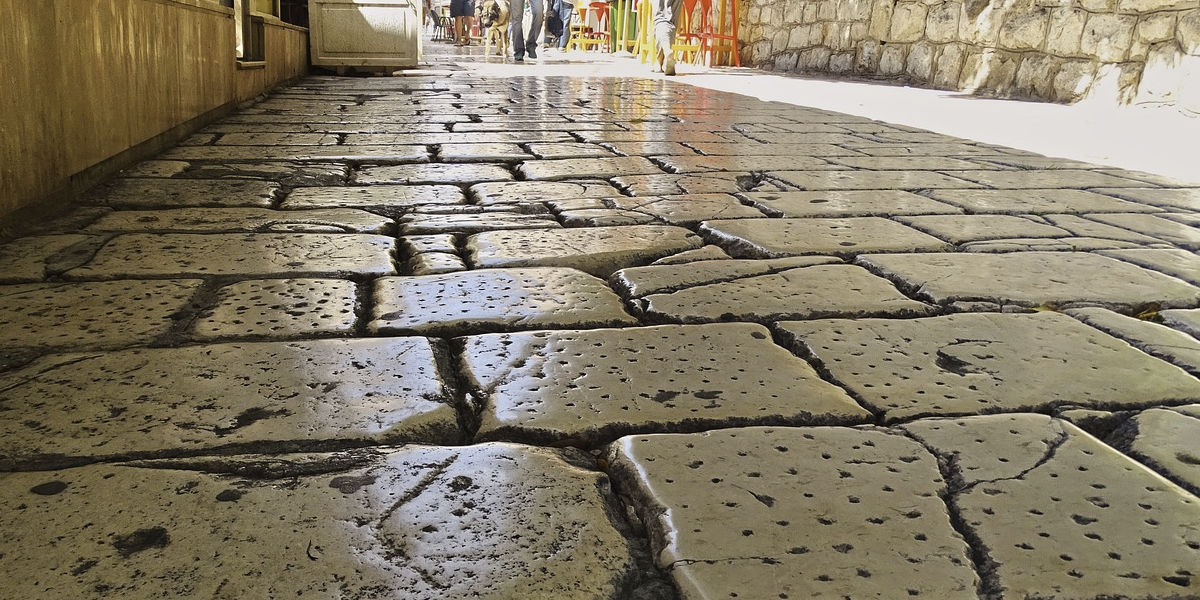
Paving of a street in Dubrovnik (Croatia) in marble.
labor price
Here we will find the substantial difference. It may depend on the material, but in the work there is no discussion. The cost of time to pave, stone, floor has nothing to do with pouring a stamped concrete slab. And this means that the costs per m2 can be considerably reduced, reaching less than half depending on the case.
As always in these things, everything will depend on the work to be done, the surface to be paved, the treatments, the material, etc. but stamped concrete is significantly cheaper.
Finishes become more authentic
The designs we can achieve today with stamped concrete are amazing. Almost all types of materials can be imitated, including wood. Although you know it’s not wood when you approach it or step on it, the overall feeling when you look at the whole garden is extraordinary.