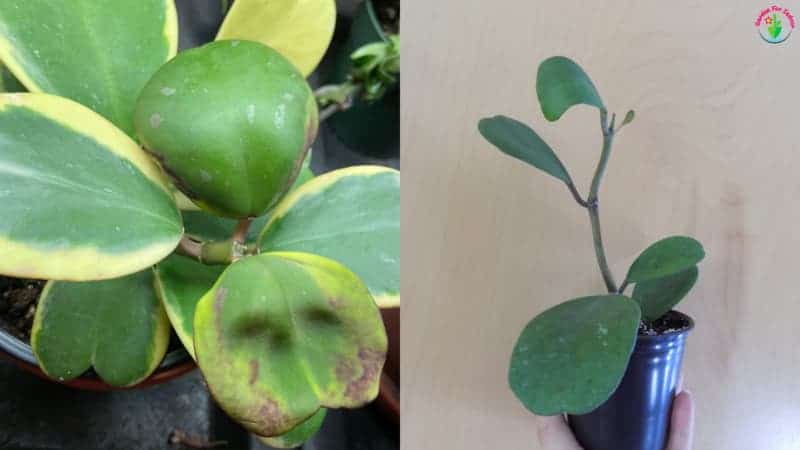
Hoya kerrii is one of the most popular tropical succulents among plant lovers around the world.
You can find it in two forms: the whole plant; or just a very decorative leaf with a small root system.
But it doesn’t matter if you have one leaf or the whole plant, if the conditions aren’t right, you may notice those firm, fleshy leaves start to curl or wilt.
Hoya kerrii curled leaves can be caused by low humidity and improper watering. Stress due to low temperatures or temperature fluctuations is the next possible cause. In rare cases, curling or wilting may be the result of pests.
If your Hoya Kerrii is showing this symptom, stick with me throughout this article and rule out possible causes to save it.
Causes of Hoya Kerrii Leaf Curling
The curling or wilting of Hoya Kerrii includes soft leaves that hang down from the stems.
This doesn’t happen often with Hoya Kerrii because the leaves are thick and waxy, but it can still happen.
In the following sections, I will discuss the most common causes and solutions for wilting or curling hoya leaves.
Submarine
If you flood your Hoya Kerrii, the plant may look tired and weak, or the leaves may wilt or wilt.
If flooding is the cause of curled leaves, you should also be able to see changes in leaf color from green to brown to yellow.
But putting a Hoya Kerrii under water is a chore, as this plant is a succulent that grows well in dry places.
If you haven’t watered your Hoya Kerrii in the past few months, it could be a leaf curl issue (duhh…). If you did, check to see if you didn’t go overboard.
The solution
Speaking of underwatering and overwatering, a Hoya Kerrii better be underwater.
Moreover, this problem has the simplest solution: just water the plant and that’s it.
The best watering schedule for a Hoya Kerii is to water it when the soil is dry. Do the test where you put your finger on the ground.
If the soil is dry a few centimeters deep, your plant needs water. For a Hoya, this should be once a month, more often in summer, less in winter.
excess water
For a Hoya Kerrii, too much water is much worse than submerging it. If you ask me, this is the first thing to look for when you see curled leaves. If the problem isn’t overwatering, move on to pest control.
When the plant is overwatered, the water in the pot prevents the roots from receiving oxygen and promotes root rot.
Over time, the root does not receive enough nutrients and does not supply them to the leaves, which in turn begin to wither and curl.
The good thing about Hoya Kerrii is that it has firm, fleshy leaves, so you can see if they start to curl.
The annoying thing is that it may be too late when you see the curling leaves. In this case, if the roots are rotten enough, the chances of saving your Hoya Kerrii are slim.
The solution
The best remedy to save an overworked plant is to mobilize immediately. Do not leave the plant in wet soil, every hour counts.
First, remove the plant from the ground and pat it dry with tissue paper. Be sure to absorb as much water as possible. Then be sure to remove all the rotten parts of the root.
Once done, leave the plant in the shade until the remaining roots are dry.
And don’t worry, it can happen within days, so all you can do in the meantime is pray for the best.
When the roots are dry, replant them in moderately moist soil. Make sure the new soil isn’t too wet or you’ll start the problem again.
After that, it all depends on the plant’s will to live. Keep track of your Kerrii’s status.
If the leaves start to improve within a few weeks, you’ve saved your plant! Otherwise, you will find that all the parts deteriorate.
thermal stress
Heat stress includes temperature fluctuations for Hoya Kerrii. These tropical plants thrive in temperatures between 65°F and 80°F (18°C and 27°C).
If your Hoya Kerrii has wilted and curled leaves, check that it stays within the desired temperature range.
The leaves can usually curl up if the plant is left outdoors in cooler weather.
And if it’s too hot, the leaves may turn brown or yellow.
Read this article to learn more about the causes and solutions for hoya leaves turning yellow.
The solution
The solution, of course, is to place it in a room with a better temperature. Since cold weather curling is more common in the winter, make sure your Hoya Kerrii is in a heated area.
And don’t forget the light. Every possible ray of sunshine is welcomed by Hoya Kerrii, especially in winter.
In fact, if it is variegated, it is because the variegated parts do not photosynthesize.
humidity level
If the humidity is high in the room where your Hoya Kerrii resides, the leaves may curl up as a result.
Too much water and high humidity can cause leaf curl. If you water too much, you will damage the lower parts of the plant: the roots and the lower part of the stem. This can result in curled sheets after some time.
High humidity, on the other hand, first affects the leaves. Hoya Kerrii has succulent properties and does not require a lot of water (in liquid or vapor form).
It is a tropical plant that is accustomed to a lot of rain, but nevertheless constant high humidity is unpleasant for a Kerrii.
Leaves may become limp and curl. Additionally, high humidity conditions are the perfect environment for fungus gnats. We will come back to this in the next section.
The solution
If you find the humidity is high, please change the location of the plant. Be careful not to make a sudden change of circumstances.
For example, moving from a damp, shady location to a very sunny, dry location can stress your Hoya Kerrii and cause further damage.
If you have a humidifier, make sure it’s further away or in a different room.
insect plague
Insects like fungus gnats, spider mites and aphids are some of the worst pests your Hoya Kerrii can have.
They feed on the plant and cause wilting, yellowing and eventual loss of leaves.
If you don’t take precautions, these pests will start inhabiting the soil of other suitable plants and you risk losing your plant kingdom.
Fungus gnats are small, black-bodied insects that taste like damp earth. Mature specimens do not harm the plant, except that they lay their eggs in the ground.
The little ones, on the other hand, start feeding on the plant as soon as they are born.
If you have a few of these families in your soil, expect your Hoya to start to wilt as it will feed on the leaves, stems and roots.
If you’ve been overwatering your Hoya Kerrii for a while, you may have created the perfect conditions for fungus gnats in the soil.
Once you remove them, be sure to water less and only water when the soil is dry. And don’t like your plant too much with high humidity.
Very, very small and hard to notice, spider mites can be seen as dust particles on the plant.
Therefore, you should carefully inspect the plant and immediately take precautions, in case you see them.
They feed on Hoyas leaf fluid and can curl, wilt and disfigure the leaf itself.
If new Hoya leaves growing downward are wilted, shriveled and too small, check to see if spider mites are causing the problems.
You also have to act quickly, because the mites can reach other plants in the house.
Oleander aphids are just one of dozens of different types of aphids. They have black limbs and yellow bodies and are most common in Hoya plants.
If you’re looking for oleander aphids on your Hoya, be sure to check the backs of the leaves. The first sign of aphids is the deformation of new, small leaves. (Source: Pennsylvania State University)
The solution
The best way to get rid of pests on your plant is with insecticidal soaps. You can also try neem oil as it is effective in controlling mite and aphid infestations.
Neem oil is made from neem seeds and is used as a natural pest control.
I suggest you start with natural and organic ways to get rid of pests because using insecticides will kill all living organisms in the soil, bad and good alike.
For fungus gnats, you can try making a mixture of 3% hydrogen peroxide to 4 parts water and pouring it on the ground.
This should kill the eggs and larvae. Another thing you could do is make a mixture of dish soap and water. It can also help, especially for fungus gnats and oleander aphids.
Aphids can also be simply pushed with water, but this can only be effective if you catch them at the start of their colony.
If they are scattered around the plant, you may lose a few and have the same problem again.
Mites can be a little harder to kill naturally, so don’t try anything. The best thing to do is check online or talk to someone at your local garden center.
last words
I hope this article helps you find the cause of Hoya Kerrii leaf curling or wilting. Eliminate possible causes of curling or wilting Hoya Kerrii leaves one by one.
The most common causes are water stress, severe temperature fluctuations, vermin, infections or very high humidity. Overwatering is usually the biggest problem, as it can lead to root rot. In addition, humidity creates a good environment for fungus gnats.
If your watering schedule is correct, make sure the temperature is in a good range. Then proceed to check the humidity of the room (or place). Finally, check the plant for insects or mites.