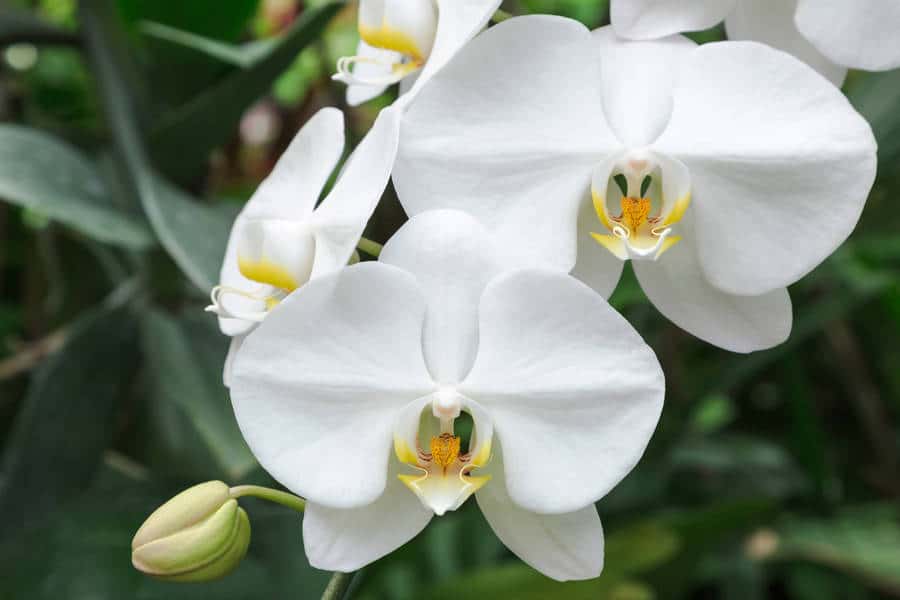
Phalaenopsis orchids are one of the most popular flowering houseplants in the world. Its popularity has skyrocketed over the past 20 years due to its exquisite beauty, falling prices and increased availability.
They are ideal for indoor climates and are surprisingly easy to maintain. This article covers 15 facts about phalaenopsis orchids for your enjoyment and education.
1. Phalaenopsis orchids are also known as moth orchids.
Phalaenopsis orchids are often called butterfly orchids. Phalaenopsis orchids are actually named after the moth species Phalaena because they were thought to resemble moths in flight.
Basically, the name phalaenopsis means the butterfly-like orchid. I don’t know if that really does justice to the beauty of this amazing flower, but there you go.
2. Phalaenopsis orchids don’t need soil to grow.
Although most phalaenopsis orchids that you see as houseplants are grown in containers, they do not actually grow in the ground in their natural habitat.
Moth orchids are epiphytic plants, meaning they get their nutrients and water from the air. They adhere to the branches or trunks of trees. They only use the host tree as a home and are in no way pests of the tree.
If you have phalaenopsis orchids at home, you will soon see them develop aerial roots sticking out of the pots. If you keep a phalaenopsis orchid long enough, it will develop multiple tendril-like aerial roots that emerge from the pot and hang in the air in search of water and nutrients.
Don’t be tempted to cut them, as they are an important part of the plant and removing them can negatively affect the orchid.
3. Phalaenopsis orchids can get sunburned.
Although phalaenopsis orchids are tropical plants, they grow wild under the canopy of trees. They are used to attenuate indirect sunlight and do not perform well in direct sunlight.
If left in direct sunlight for a long time, they can scorch and burn exposed leaves and roots. You will also notice that the tips of the leaves may turn black, the leaves may wilt and turn yellow, and the leaves may also split in half.
If you notice any of these signs, be sure to move your orchid to a location with less intense light.
4. Phalaenopsis orchids are native to Southeast Asia.
Phalaenopsis orchids look really exotic and tropical, so it’s probably no surprise that they are native to tropical regions of Southeast Asia, such as the Philippines, parts of Australia, Thailand , Taiwan and the Himalayas.
There is even an island off Taiwan that has been renamed Orchid Island due to the abundance of phalaenopsis orchids that grow naturally here.
5. Phalaenopsis orchids are old
Phalaenopsis orchids existed when dinosaurs roamed the earth! According to the fossil record, phalaenopsis orchids can be up to 100 million years old. It is clear that they have incredible resistance.
While the orchids that existed so long ago probably looked very different from the orchids we have in our homes today, there is a clear lineage from those ancient ancestors to the common and beautiful moth orchids of today.
6. Phalaenopsis orchids bloom for months.
Phalaenopsis orchids bloom the longest of the orchids commonly grown as houseplants. If you buy a phalaenopsis orchid from a store, you can reasonably expect it to flower for at least 2 months, and often for up to 6 months at a time.
Combine that with the extraordinarily beautiful blooms of these orchids, and it’s not hard to see why they are the best-selling flowering houseplants in many parts of the world.
An important tip for your phalaenopsis orchid to bloom as long as possible is to buy one that still has plenty of closed buds. The flowers appear one at a time towards the end of the flower stalk.
If you can resist the urge to buy a plant in full bloom, you can prolong your plant’s bloom for several weeks.
7. Phalaenopsis orchids are very easy to care for.
Don’t be fooled into thinking that phalaenopsis orchids are difficult to care for just because they look so delicate. Many people are concerned about the care of moth orchids because they look very delicate and beautiful. It is easy to assume that they are difficult to maintain.
In fact, the opposite is true. They don’t need frequent watering, they eat little, and as long as you keep them out of the sun, it’s hard to go wrong too much.
8. Phalaenopsis orchids will produce new plants along their stems.
If you are lucky, your orchid may begin to grow a new baby orchid from the flower stalk of the parent plant. These are often known as keiki and over time they will develop leaves and roots and become full-fledged orchid plants.
Once they have developed 1-2 inches in root length, they can be carefully separated from the parent plant and potted up in their own container. There are several ways to encourage your orchid to have a baby, but that’s a subject for another article.
9. Phalaenopsis aroma is more pronounced at dawn
Not all phalaenopsis orchids produce scent, but among those that do, it is usually most pronounced at dawn. White orchids do not produce fragrance, but many other colored orchids produce a sweet, delicate scent that you will undoubtedly find most prominent in the morning. What a joy to wake up with the scent of flowers in the house.
10. Moth orchids were once rare and expensive.
Moth orchids were once very expensive and hard to find. Part of the reason was that growing them from seed is difficult and time consuming. A new plant can take several years to grow from seed to enough to produce flowers.
Commercially produced moth orchids are grown in large quantities from mature plant tissue. These are grown in the lab for about a year, before being transplanted to a greenhouse for another two years. Only then are they large enough to produce flowers.
11. Phalaenopsis orchids are the most popular flowering potted plants in the world.
Sales of phalaenopsis orchids have grown rapidly since the late 1990s, when commercial cultivation techniques were rapidly refined and expanded. In Europe, between 90 and 100 million phalaenopsis orchids are produced each year.
12. Phalaenopsis orchids will bloom again and again.
Many people enjoy moth orchid flowers for a few months, and once the flowers fall, they assume the plant is dead and throw it away.
However, Phalaenopsis orchids can bloom again and again, once or twice a year, for months. Getting an orchid to bloom again isn’t difficult, so you definitely need to keep your orchids long term.
Phalaenopsis orchids can bloom by exposing them to cooler night temperatures for a few months. This tells them it’s time to produce a new spike of flowers, and before long you’ll be well on your way to another fine display of spectacular blooms.
13. The Phalaenopsis orchid is a status symbol
the phalaenopsis amabilis u Moon Orchid is one of the state symbols of Indonesia, chosen for its beauty, it is a symbol of international pride. Many other countries around the world also have orchids as their official flowers.
14. Phalaenopsis orchids often bloom twice from the same flower stalk.
After your orchid has finished flowering, if you cut the stem above the third or fourth bud and wait, the plant will often begin to regrow from one of the other nodes and produce a second crop of flowers. This way you can keep your orchid in bloom for several months of the year.
15. Phalaenopsis orchids can live for over 100 years.
With good care, a phalaenopsis orchid can live for decades. Today there are even orchids that have lived for over 100 years. So if you buy an orchid as a gift or to brighten up your home, it can become a family heirloom that is passed down from generation to generation!
If you want to learn more about phalaenopsis orchids, download my free guide to phalaenopsis orchid care or check out my other orchid care articles.