
Most of the time when we are looking for a houseplant we are looking for either very showy and long lasting flowering plants or a jungle plant with large bright green leaves that last all year round like this one. For the latter case we have a fantastic tropical plant from Brazil and scientifically known as Calathea louisae.
This indoor plant is perfect for growing in pots indoors, reaching about 80 cm in height in adulthood and with care that practically manages to maintain controlled temperatures and humidity. Usually inside the house we will have a plant of 40 cm, since it is limited by the pot and by the climatic conditions of our house. In this article, we tell you what its main characteristics are and a complete guide to its maintenance.
read more: Strelitzia nicolaiornamental plant of tropical origin.
Characteristics of Calathea louisae
This plant known as Calathea Louisae belongs to the family Marantaceae and comes from the tropical zone of Brazil. Its main characteristics are to have a high leaf density made up of large leaves that have various shades and designs on the upper part (leaf bundle). Its cultivation is common in indoor spaces, especially in rooms or areas where, due to a lack of natural light, other indoor plants do not thrive as well. However, as a tropical plant, it also requires higher humidity conditions than other plants.
Within its genus it is not the best known, but little by little it is gaining followers among lovers of tropical plants.
taxonomy
| Order | zingiberales |
| Family | Marantaceae |
| sex | Calathea |
| Species | Calathea louisae |
Most Known Types of Calatheas
- Calathea ornata
- Calathea crocata
- Calathea zebrina
- Calathea makoyana
- Calathea lancifolia
- Calathea louisae
- Calathea orbifolia
- calathea rufibarba
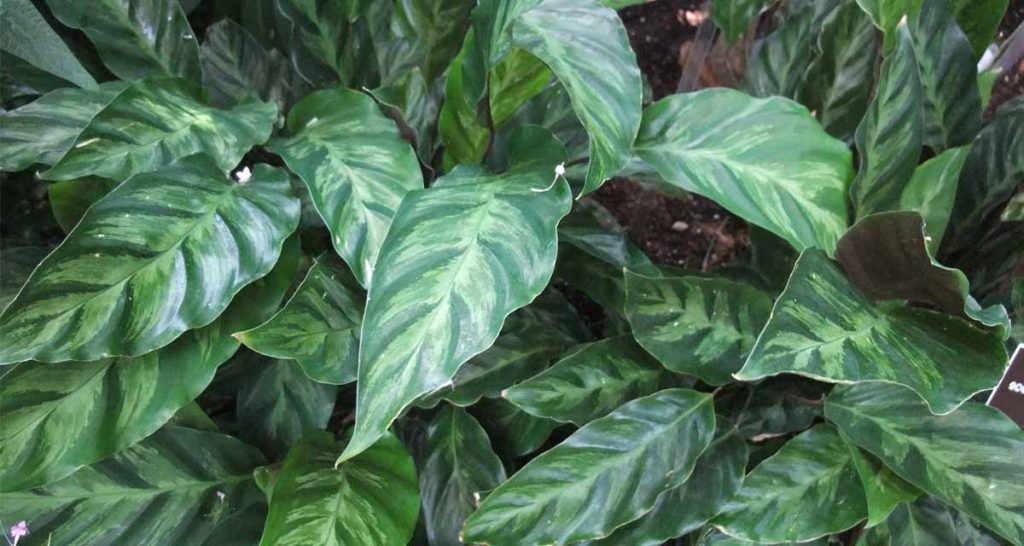 leaf aspect of Calathea louisae. Photography: Chhe (conversation)
How to take care of the plant? Calathea louisae?
We are going to know the best tips for growing Calathea louiseae at home. However, if you live in an area with warm temperatures throughout the year, you can also grow it outdoors.
ideal location
It is located in semi-shaded areas, without direct sun, admitting more shaded areas and with a little more humidity. At home, it can be placed in any room, away from windows where the sun enters or which have a draught, in order to avoid the dryness of its leaves and to allow the greatest conservation of the ambient humidity, which this tropical plant needs for its growth correct development.
temperatures: lives in warm environments, with average temperatures of 15 and 30 ºC. The average house temperature of 18-25 ºC is ideal for its development. The plant can suffer damage and lack of growth with temperatures below 5ºC.
Humidity: Calathea louisae requires an ambient humidity above 60%, the ideal being between 70 and 80%. As it is not recommended for our home or our health, we can mist the leaves twice a week with distilled water or use a humidifier. In very dry environments we will notice how the edges of the leaves turn brown and crispy.
Substrate characteristics
Calathea louisae need fertile substrate and with good drainage capacity. The universal substrate as such can serve as a good support, but we always recommend giving additional nutrients and improving the drainage capacity. For this we offer you the following ideal mixture for this type of tropical plants.
- 60% universal substrate
- 20% earthworm humus
- 20% coconut fiber
We use the universal substrate as a medium, as it also contains certain nutrients, but we increase the fertility with organic matter provided by worm humus, which can be replaced by another type of organic component such as compost. Finally, the coconut fiber improves the drainage and the oxygen content of the substrate, to reduce any type of problem related to waterlogging and lack of oxygen.
how to water Calathea louisae
There is a duality in the way of proceeding to provide water in the plant Calathea louisae. During the warmer months and with less ambient humidity, we water in a sustained way, adding water only when we notice that the substrate is slightly dry. On the other hand, in winter, we will water much more durably since the humidity in the substrate holds much longer. During these cold months, when the ambient humidity increases, we will add water when the substrate is practically dry.
In terms of irrigation intervals, we say that in the warm months we water 1 or a maximum of 2 times a week, and in autumn and winter – 1 time every 7-15 days.
The recommended amount of water It is established according to the volume of the pot. Contributing 8 to 10 times less to the volume of the container will suffice. That is, if the pot has a volume of 2 liters, we will water with 200-250 ml of water.
fertilizer application
Calathea louisae It is a demanding plant in terms of nutrient supply. If we have provided worm humus in the substrate, we will have a good supply of food and organic matter, but gradually it will be lost. Therefore, it is advisable to supplement the nutrition of the plant with fertilizers, which can be mineral or organic.
During the season of greatest growth, in spring and summer, it is customary to provide fertilizer with the irrigation water every 15 to 20 days. It is more practical to use a complete granular fertilizer for maintenance, but if we detect any type of deficiency, liquid fertilizers act faster.
Granulated fertilizer NPK (Mg+S) 12 + 8 + 16 (+3+25) with magnesium and sulfur + microelements. We will bring a dose of 30 grams well distributed over the entire surface of the pot, even slightly buried so that the humidity of the earth accelerates the process of releasing nutrients.

COMPO Novatec Universal Fertilizer Blue, 5 kg
- NPK complex fertilizer (Mg+S) 12 + 8 + 16 (+3+25) with magnesium and sulfur + microelements + nitrification inhibitor, Ideal for all types of ornamental plants, shrubs, green plants, roses, citrus fruits, etc.
- The professional technology with the nitrification inhibitor (DMPP) ensuring the stability of nitrogen in the soil, guarantees the maximum utilization of nutrients in the plants and more abundant flowering. Up to 8 weeks subscription available
- Improved formula, with less phosphorus. Eco-friendly
- COMPO quality: raw materials selected according to the original COMPO recipe, Strict quality controls by independent laboratories and institutes, The best conditions for healthy plant growth
- Contents: 1 x COMPO Novatec universal blue fertilizer, 5 kg
If we use liquid fertilizer, the absorption of nutrients by the plant will be much faster. On the other hand, the dosage must be much more exhaustive because there is a risk of salinizing the water too much and affecting the plant. The manufacturer’s dosage recommendation should be followed or, if unknown, provide no more than 1ml of fertilizer per liter of water.
When to transplant
The transplant of Calathea louisae This is done only for physical reasons, where the root system has no more space to cover and begins to curl up. If we notice that the substrate is very compact and even a few roots appear, it is time to look for a larger container and renew the roots.
We will clean the roots from the substrate using a wooden stick or a thick brush. The roots that we see affected (dark brown color), we can cut them, as well as reduce the length by cutting them with sharp scissors. This process should be done carefully and without significantly reducing the volume of the roots.
Subsequently, we can prepare the substrate mixture discussed in this article and perform the grafting of our Calathea.
When to transplant: It takes place in the spring, after the end of winter.
Multiplication
The most convenient and easiest way to multiply our Calathea louisae has passed division of the parent plant. With great care and skill, it is possible to separate a plant into 2 or 3 parts, depending on its original size. The roots or rhizomes they produce can be independent.
Plagues and diseases
It is unusual for our Calathea be attacked by insects, especially when grown indoors. In some specific cases, it can be affected by cottony or ribbed mealybugs, white in color and easily identifiable by their contrast with the green of the plant. They are easy to remove if we use a damp or alcohol-soaked cloth.
At the level of the disease, things get complicated. Excess humidity in the substrate can activate facultative fungi which take advantage of the lack of oxygen in the substrate to enter the plant and clog the sap channels. Fungal species that affect the root and neck of the plant like Phytophthora They can affect the plant and usually have a difficult solution.
Cover photo: by Daderot