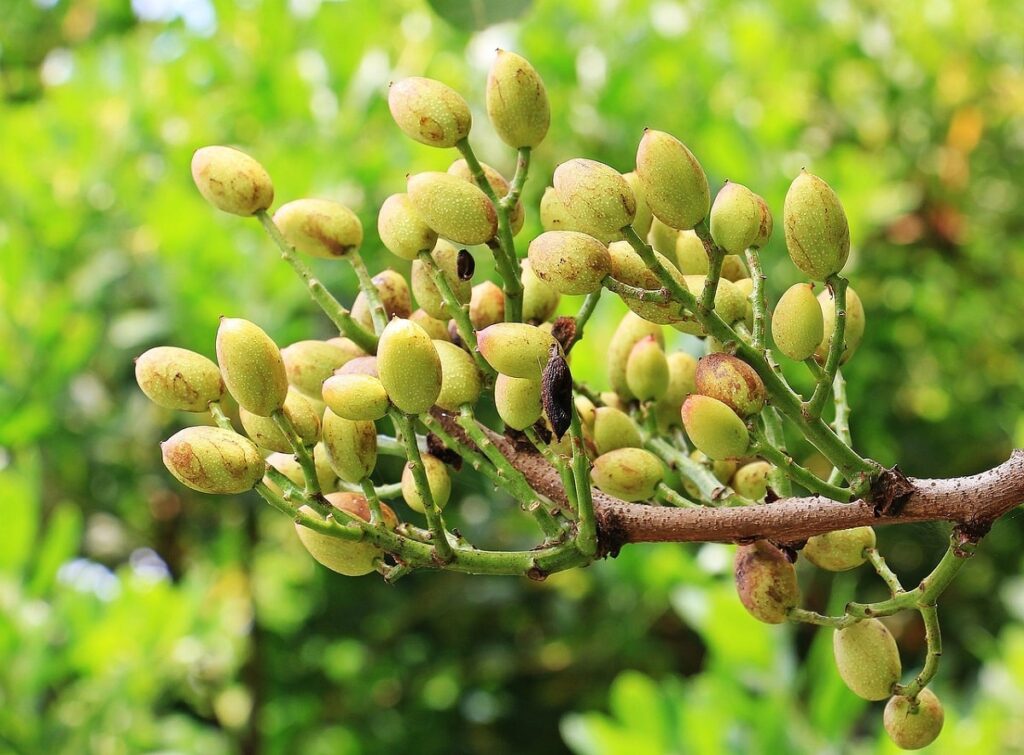

One of the most important reasons for pruning pistachios is to encourage fruit production. But that’s not the only thing, since other purposes of pruning are to facilitate harvesting, to direct the growth and formation of trees, to improve ventilation and to facilitate the penetration of sunlight. . Many people do not know what the main guidelines are for learning about the size of pistachios.
For this reason, we are going to dedicate this article to telling you everything you need to know about pistachio pruning and what is needed for it.
When is the size of the pistachios?

Young pistachios are cut the first and second year to define their shape. Taking care of the shape of the tree is important as it affects the quantity and quality of the harvest, the ease of harvesting and other agricultural activities. Cut ripe pistachios to keep their shape and clean the inside of the tree, which improves ventilation and allows sunlight to penetrate inside. All of these tasks benefit the production of future harvested fruit.
If there’s anything we need to consider when pruning pistachios, it’s whether there will be frost after cutting. Pistachios, like other fruit trees, can suffer tissue damage when temperatures drop dramatically after pruning. In this way, as long as there is a risk of frost (temperatures close to 0º), pruning should be delayed until the risk is reduced. Therefore, we need to align pruning schedules with periods of minimum tree activity and growth.
Usually, the best time to prune pistachios is early spring, before the tree resumes its activity and when there is no risk of low temperatures. This will reduce sap loss and the wound will begin to heal as the growth phase approaches. In climates with mild winters, fall pruning may be a good option.
While major pruning, such as training, production, or renewal, should be done in the cool season, green pruning should not be. The best time to green pistachios is early to mid-summer, when it’s hottest.
Necessary tools

We need several tools to cut pistachios. The choice largely depends on the type of pruning and the size of the tree. Basically, you need pruners and a handsaw. If our pistachios are large, we will need stairs, in addition to the necessary security elements. Here are the main materials needed:
- Mowers: Cut branches up to 5 cm long.
- Mountain chain: Saw branches from 5 to 20 cm
- Mower height: Prune tall branches.
- Chain saw: Cuts rough wood longer than 20 cm.
- Stairs
- Safety glasses, gloves and boots.
It is recommended to disinfect pruning tools before pruning. This will help prevent fruit tree diseases.
How is a young pistachio tree pruned?
To prune pistachios, we must first decide what type of pruning to do, and for this we must know the age of the tree. Unlike pruning a ripe pistachio that grows and needs practice to prune, we need to think more about production and make harvesting easier. Well, if it is less than 5 years old, the tree should be pruned to guide its growth and establish the main branch.. From there, the pistachios will move on to the production phase, where pruning is necessary to improve the quality of the fruit and facilitate its harvest.
Pruning is done during this development period to guide the growth of the tree and define its structure. We will see the type of pruning we need to perform at this stage of development:
training size
This includes the direction of pistachio growth and formation in the early years. As this is a fairly vigorous pruning, do it when the tree is calmer, i.e. in early spring, or in autumn in regions where the winters are not too cold.
We will do this by:
- Year 1: We are going to cut all the branches so that the branches below can sprout.
- Year 2: Slightly cut the main branch to 2/3 of its length. We will remove the branches that grow from the lower half of the trunk and leave the rest.
- Year 3: Slightly cut the main shoot to 2/3 of its length and remove the shoots that grow inwards from the pistachios.
fruiting size
Its main objective is to establish secondary productive branches. To do this, we must choose the 3 main branches on which the rest of the tree will grow. The branches should not be too stiff to prevent them from breaking under future weight. Next, we will prune the main branches a little, about 2/3 of their length, and prune the suckers that emerge from these branches to determine the structure of the tree.
How is the adult pistachio tree pruned?

Adult pistachios, those that are already in the production stage, are pruned to maintain their shape and clean the inside of the tree. In this way we facilitate the entry of light and improve its ventilation. These are called production models, so we’ll see what they’re made of.
production size
This type of pruning is designed to take advantage of the amount of sunlight captured by the canopy to improve the quantity and quality of the harvest.
Perform a production pruning to clear branches and clear the inside of the canopy to improve light entry and ventilation. In this way, we will try to get a leafy cut with an entrance and an exit to increase sun exposure. In addition, we will prune unproductive branches to allow new branches to grow and we will remove branches that grow inwards from the tree. The objective of this pruning is to increase the yield of the tree and to obtain better quality fruit.
Let’s see what production pruning includes:
- First, we will eliminate the biggest suckers because they are not very productive and slow branch growth.
- We shouldn’t remove all rejects. The weakest shoots located inside the glass will be left to shade the wood that forms the structure of the pistachio tree.
- The lower branches should be pruned because they receive less light and therefore bear less fruit.
- We need to wear glasses with light inside and out to increase our exposure and better take advantage of sunlight. We will also prune branches that are tangled in the canopy, as well as those that are damaged, broken or diseased.
- Not all twigs can be cut in order to maintain the leaf to wood ratio. In this way excessive wood will be avoided, which reduces the regeneration capacity of productive branches.
rejuvenation waist
This type of pruning is carried out on pistachios showing signs of aging which they have been in production for many years, between 20 and 40 years. These symptoms can be:
- small yellow leaves
- Low level of performance
- Loss of leaves inside the tree
This is done to rejuvenate the pistachios and can be done in large or gradual steps.
- Substantial rejuvenation size: In the first case, we remove all the leaves from the tree, effectively leaving the base and the main branches of the trunk to grow back.
- Gradual rejuvenation size: It consists of pruning from the top of the crown to the base of the branches. This is done in stages, every 3 years we will cut one of the four main branches of the tree.
Green pistachio pruning
The pruning of green branches can be done in summer. Although it can be done at any time of the year, it is usually done at the end of August, when there is little activity in the pistachio trees due to the heat. This is done to control the growth of suckers or suckers, removing those that don’t work with pistachios.
I hope with this information you can learn more about pistachio pruning and its characteristics.