
Maybe this name is not the one you recognize. But If instead of saying sedum nussbaumerianum, we say sedum adolphii, things will surely change.
Not yet? Not sure what succulent it is? So let us show you what this plant looks like and what the main care is. You will surely fall in love with her.
How is sedum nussbaumerianum

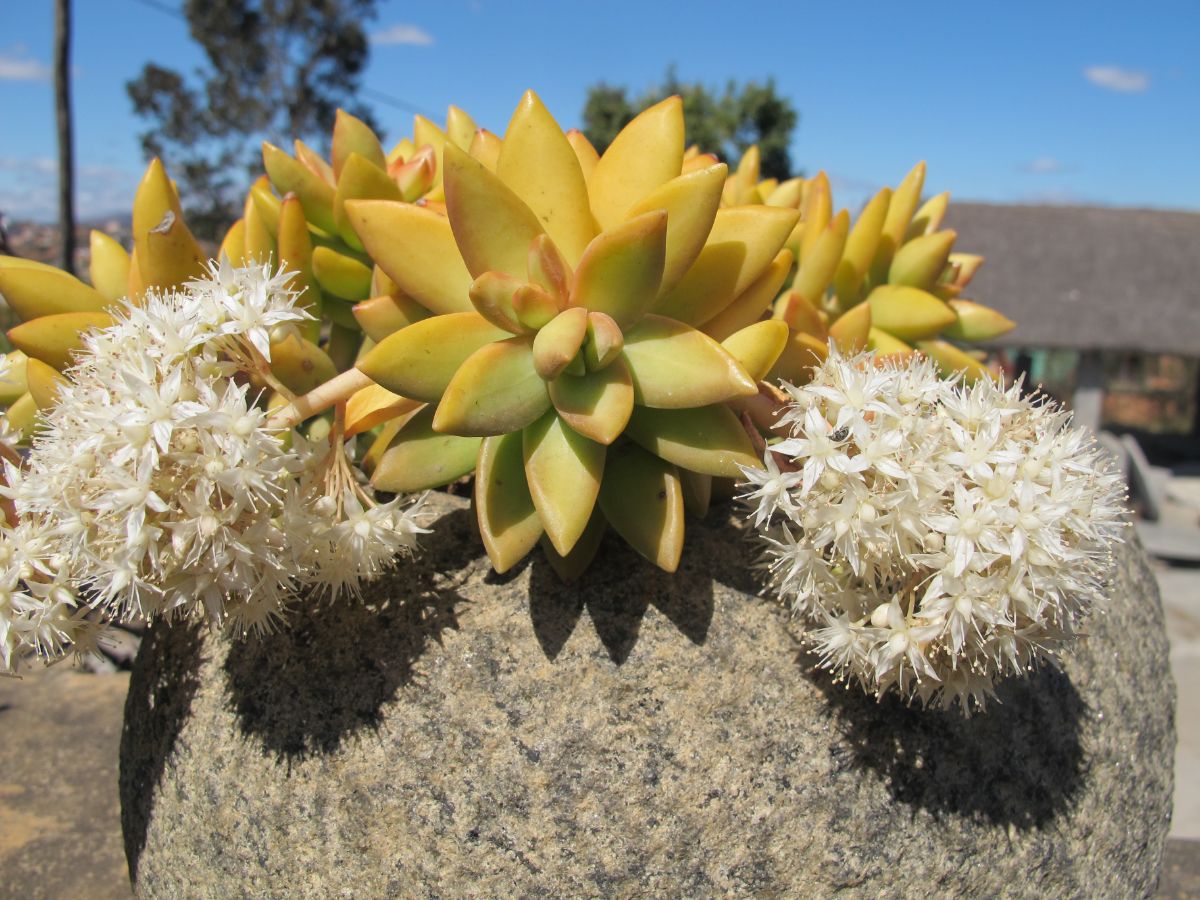
Sedum nussbaumerianum, as we have already told you, It is also marketed as Sedum adolphii, golden sedum or copper sedum due to the color of its leaves. It is a succulent originating, like many of them, from Mexico, more precisely from the volcanic region of Veracruz.
The plant grows in the form of a bush and when it is in a pot it completely covers its width, even becoming drooping because it develops very quickly. It is not a plant that grows much in height (barely 30 centimeters), but it is very prolific in width. In addition, it is no problem to plant it in the garden, it will easily cover the ground and grow very little in height.
As for the leaves, they are lanceolate, thick (because they store water there) and quite robust. They end in a point and their color is a yellowish-green, although when the sun gives them enough, the tips turn golden (hence the curious name). Although some like to keep a greenish color, there are many others who enjoy the orange tint more. which they acquire when there is a lot of sun.
In addition, this plant blooms. It usually occurs in spring and summer and its flowers are white and star-shaped. Unlike other succulents, the truth is that this one blooms more abundantly, with which it will not cause you many problems to see it.
A sedum nussbaumerianum which is no longer called that
It’s like that. One of the facts you need to know about sedum nussbaumerianum is that it will be increasingly difficult for you to find it with this name. According to the official succulent registry, International Crassulaceae Network, the name sedum nussbaumerianum has already fallen into disuse and henceforth this species will only be recognized as sedum adolphii.
Sedum nussbaumerianum treatment

You already know a little more about this succulent. And if you see it in stores (whatever its name), you might like it enough to buy it.
However, In order for it to get ahead and really fill your pot or for you to enjoy this shrub, you need to know what the most important care it needs is. And in this sense, we have compiled them for you so that you do not have a problem with it. Take note.
location and temperature
In good succulent that it is, the sedum nussbaumerianum needs to be outdoors and if possible in good direct sunlight between 4 and 6 hours a day. Now well, Do you want the leaves to be greener? So put it in partial shade? Would you rather it look orange? Then in full sun for longer.
What we do not recommend in any way is to put it in the shade or with very little light because in the end the little humidity that there is will affect it and prevent it from pulling forward. .
This, yes, at first it will have to be adapted to the sun Since where you buy it, they may not have it in the sun, but it can be filtered.
As for the temperature, the ideal for this plant would be between 15 and 25ºC. The normal thing is that it can tolerate more heat, and also more cold. Actually, It can withstand down to -2ºC as long as they are sporadic (and not constants). If it’s more, you’ll have to protect it.
Substrate

The soil for Sedum nussbaumerianum should be light, which means it needs additional drainage to reach it (tree bark or orchid soil, volcanic soil, etc.). It is best to apply a universal substrate, earthworm humus and this drainage to get the most out of the plant.
Irrigation
Irrigation of succulents is minimal, you know. But in the case of sedum nussbaumerianum, it should be borne in mind that, having such thick leaves, it does not need as much water as other plants. For this reason, we recommend watering it once every 15 to 20 days in spring and summer, while in winter it can be once a month or more.
In this case, pay close attention to humidity. It’s almost deadly to this plant so try not to affect it. You will notice this if you see that the leaves look like they have been wet and have a “wet top” that will eventually rot the plant beyond repair.
Subscriber
In general, succulents are not plants that need fertilizer. But If they have been with you for a long time, you can give them nutrients from time to time in the irrigation water.
Plagues and diseases
Pests and diseases don’t usually affect sedum nussbaumerianum, but you should be aware of them.
In the first case, scale insects, snails and spiders can make their own on this plant. In a second, humidity, irrigation and lack of sunlight are the main problems you will face. But, if you catch it in time, you can get it back.
Multiplication
Finally, if you want to propagate your plant to have more of these succulents, know that there are several ways to do it:
- through the seeds, drawn from the flowers I took out in the spring and summer. It is not a widely used method because it takes a long time to advance and grow enough.
- through the leaves, because from them you can get new plants. You just have to give them time to create a rosette and from there a plant will grow.
- Through the branches of the plant. It’s true, if at some point a branch breaks, a new plant will grow from the cut of the plant, but also from what was cut. You can seal this cup and plant it in the ground so that within a few days it will develop roots and you will have a new plant.
As you can see, the sedum nussbaumerianum is a real “jewel” for the garden. Do you dare to have it?